
America Is in a Self-Imposed Stalemate; Why Did the Advanced USS Gerald Ford Leave the Battlefield with Iran?
TEHRAN (Defapress) - Mohammad Zarchini - Less than two months after US President Donald Trump's direct order to dispatch the naval fleet to the Persian Gulf, the most advanced aircraft carrier of the United States Navy left the battlefield not due to Iranian ballistic missiles, but due to an internal incident and excessive wear and tear; of course, this is a claim made by the US military and its government officials, and the reality on the ground needs to be examined.
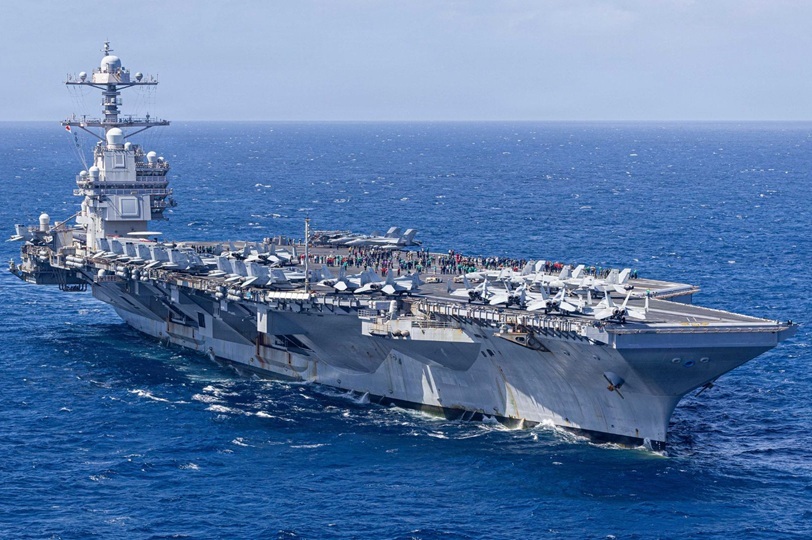
The USS Gerald R. Ford (CVN-78), the most expensive and advanced nuclear-powered aircraft carrier in American history and a symbol of Washington’s military power in Western Asia, arrived at the Souda Bay Naval Base on the Greek island of Crete on Monday (March 22) for emergency repairs. The tactical withdrawal comes as the military operation known as “Operation Epic Fury” against Iran is still ongoing, and White House officials claim that they are seeking to reduce the “Iranian threat in the Strait of Hormuz.”
But the reality on the ground tells a different story. What has happened to this $13 billion supership in recent weeks is not only a technical failure, but also indicates a deep crisis in the defense-industrial structure and the exhaustion of the US armed forces, which are unable to withstand a long-term mission against the will of the Iranian people.
The beginning of the failure: From toilet repair to laundry fire
The USS Gerald R. Ford, which set sail from Norfolk, Virginia, in June 2025, was originally scheduled to serve a routine six-month mission, but successive White House orders turned the mission into a grueling 10-month voyage.
The first signs of the ship’s disintegration date back to February 2025. American media reports indicated widespread blockages in the ship’s toilets. More than 650 of the ship’s vacuum toilets were out of order, and sailors had to wait in line for hours to use the limited toilets. The problem, caused by the constant use of equipment and a lack of standard maintenance, was only a small part of a larger crisis that was coming.
The climax of this crisis, however, came on March 12, 2026. A massive fire broke out in the main laundry room of the USS Gerald R. Ford, which took nearly 30 hours to contain. According to published information, the fire not only injured several sailors and required one to be airlifted to a medical facility, but also destroyed more than 600 beds and caused more than 200 crew members to suffer from respiratory problems due to smoke.
Expert analysis: From deliberate sabotage to systematic burnout
While Pentagon officials stressed that the incident was “not related to combat operations,” unanswered questions remain about its cause. American media have reported that one of the possible scenarios in the investigation is that the crew themselves deliberately set the fire to end the grueling mission.
The truth is that the USS Gerald R. Ford and its 5,000 sailors are on the verge of physical and mental collapse. “After nearly a year at sea, the USS Gerald R. Ford and its crew are paying the price for Donald Trump’s hasty military decisions,” Senator Mark Warner, the vice chairman of the Senate Intelligence Committee, said in a statement.
The Associated Press, speaking to sailors on the ship, painted a picture of despair. “We are very angry. Some of my colleagues are openly saying they will leave the Navy as soon as they return home,” said one sailor. Another sailor stressed that repeated deployments have compounded the hardships of the operation, with many missing weddings, children’s birthdays, and even the final moments of their loved ones’ lives.
Collapse from inside: A Warning for the future of American power
Chinese military experts have also delved deeper into the incident in their analysis for Beijing’s state media. Retired People’s Liberation Army colonel Yue Gang told CCTV that regardless of the cause of the fire, the incident reflects a systemic crisis in the US Navy.
Yang added: “If it were an accident, it shows poor discipline and poor management. If the fire was intentional, it shows a sharp decline in morale and personnel’s resistance to being sent to the front lines. The US Navy is worn out by long-term missions around the world, which greatly increases the risk of mistakes or hidden rebellions.”
Another expert, Zhang Shufeng, believes that the problem goes back to the US shipbuilding industry. He said: “Despite its advanced nature, the Ford is still facing operational problems in key systems such as the electromagnetic catapult and ammunition hoist. These issues are closely related to the depletion of the US defense industrial base.”
Iran is powerful; America is in a trap of miscalculation
The dispatch of the USS Gerald Ford to the region was part of Trump’s so-called “maximum pressure” strategy to force Iran to back down from its positions. But Steve Witkoff, Trump’s representative in negotiations with Iran, recently admitted in an interview that the US president was surprised by Iran’s resilience to pressure.
He said that Trump did not believe that Iran would accept Washington’s conditions despite applying maximum pressure and threatening to use a huge naval fleet.
With the departure of USS Gerald Ford from the region, only the Abraham Lincoln is left in West Asian waters, which is also facing logistical challenges and wear and tear. Meanwhile, Iran, relying on indigenous capabilities and utilizing anti-ship ballistic missiles and advanced drones, has shown that no naval fleet, no matter how advanced, is capable of changing the regional equations.
