
Iraq's New President Copies "America First" Slogan
TEHRAN (Defapress) - The Iraqi parliament made Nizar Amidi a politician and elected the candidate of the Patriotic Union of Kurdistan as the country's new president, an election that ended five months of political deadlock and delays in forming a government. Amidi won 227 votes in the second round of voting, defeating his independent opponent by a wide margin. He is the sixth Iraqi president since the fall of Saddam Hussein in 2003.
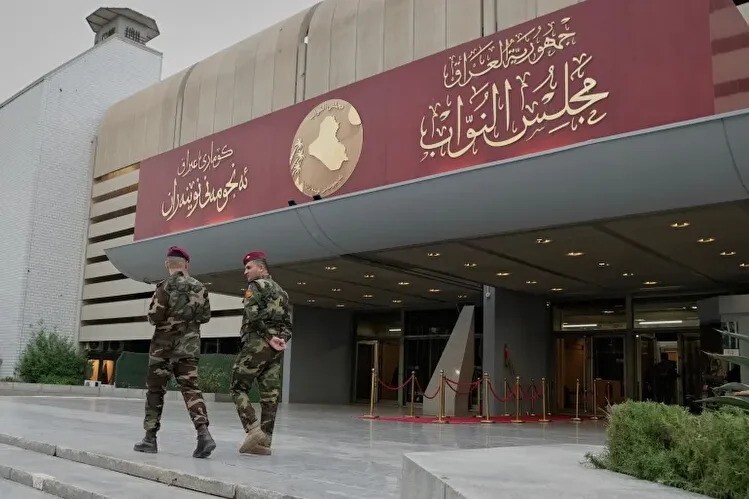
After the vote in parliament, Amidi emphasized that he was aware of the complexity of the challenges ahead and promised to put the principle of "Iraq first" at the forefront of his work while cooperating with the three branches of government. He also condemned the attacks that had targeted Iraqi soil during Iran's regional war.
The elections were held in a situation where Iraq is still affected by the consequences of the regional war with Iran that lasted for several weeks; a war that has recently been stopped with the declaration of a ceasefire. During this time, Resistance military groups in Iraq attacked American bases and diplomatic centers, and in return, American and Zionist attacks on these groups resulted in the martyrdom of several Iraqi soldiers.
Now, after the election of the Iraqi president, all eyes are focused on the election of the prime minister, an issue that is more sensitive and decisive than the election of the president. According to the sectarian quota system after 2003, the prime minister must be Shiite, the speaker of parliament Sunni, and the president Kurdish.
By law, the president should have been elected within 30 days after the first session of parliament in December, but competition among political parties, especially Kurdish parties, has delayed this process several times. Meanwhile, a group of Shiite parties allied with Iran, known as the Coordination Framework, which holds a majority in parliament, had proposed former Iraqi Prime Minister Nouri al-Maliki as prime minister, a move that was met with threats from Donald Trump to cut off US support for Iraq if Maliki was elected.
According to the constitution, Amidi has 15 days to appoint the candidate of the largest parliamentary faction to form a cabinet, which must be formed within 30 days. Amidi, 58, has been active in Iraq’s political structure for decades and has a history of working with two former presidents and the Ministry of Environment. This comes as Iraq has been without a new government for nearly 150 days since the November elections.
