
Repeated Ceasefire Violations and the Prospect of Tension in Lebanon
TEHRAN (Defapress) - Recent developments in Lebanon and numerous reports of ceasefire violations by the Israeli regime have once again drawn the attention of public opinion and international institutions to this regime's long history of disregarding agreements and international commitments. Since the establishment of the Israeli regime in 1948, there have been countless instances of violations of UN resolutions, political agreements, and military ceasefires recorded in its record.
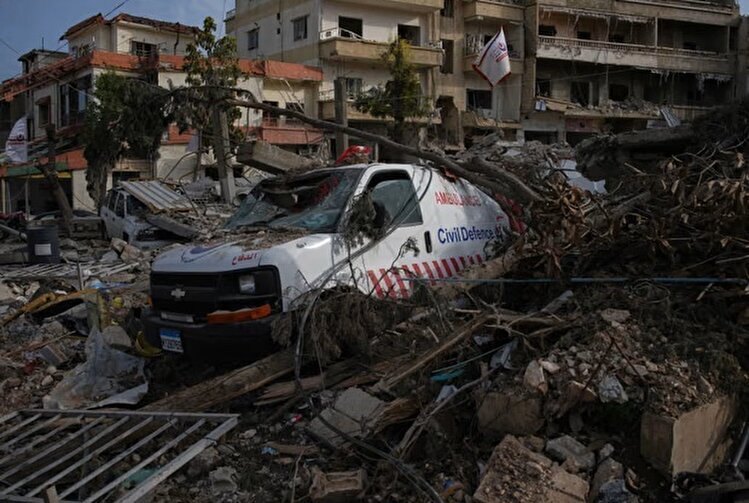
In the latest developments, despite the announcement of a 10-day ceasefire in Lebanon and the insistence of mediators on halting hostilities on all fronts, field reports indicate that Israeli military attacks and operations continue in various areas of southern Lebanon. This situation occurs simultaneously with discussions regarding the creation of a buffer zone and restrictions on the return of residents to some border villages.
These events have once again raised questions about the Israeli regime's level of adherence to international agreements and the future of the ceasefire in Lebanon, a subject that will be examined further by reviewing the background and recent developments.
A Long History of Violating International Obligations
Without exaggeration, the Israeli regime is considered one of the most untrustworthy regimes in contemporary history. Since its establishment in 1948, numerous instances of violating international commitments, UN resolutions, and peace agreements have been recorded in its record. Even some Western analysts have spoken of the existence of a "systematic pattern of breaking promises" in the behavior of this regime.
Examples include ignoring Security Council Resolution 242 after the 1967 war and continuing the occupation of Palestinian territories. Other instances include violating commitments under the 1993 Oslo Accords and expanding illegal settlements in occupied territories, attacking Iraqi nuclear facilities in 1981 and Syrian facilities in 2007, assassinating Iranian nuclear scientists, and attacking embassies and consulates, all of which are evaluated as being in contradiction with international law.
Many observers believe that this regime's reliance on political and military support from the United States has led it to consider itself above international law and to ignore any agreement that does not align with its expansionist goals.
From Violating the Gaza Ceasefire to the Goldstone Report
One significant example of agreement violations dates back to November 2008, when Israel violated a six-month ceasefire with Hamas. During an operation in which six Hamas members were killed, the groundwork was laid for a massive attack on the Gaza Strip.
Subsequently, the famous UN "Goldstone Report" confirmed that during this three-week offensive, the Israeli army committed "war crimes and crimes against humanity" by targeting civilian infrastructure and residential areas.
The Fate of the Oslo Accords
One of the most prominent examples of commitment violations is the fate of the Oslo Accords. Signed in 1993 as a framework for establishing an independent Palestinian state, the implementation process faced serious challenges due to the actions of the Israeli regime.
Between 1993 and 1999, the construction of Israeli settlements in the West Bank increased significantly. The settler population, estimated at around 110,000 at the beginning of this period, has today reached over half a million. This action is considered a violation of the Fourth Geneva Convention under international law, as it prohibits an occupying power from transferring its civilian population into occupied territory.
The Lebanon Ceasefire and Thousands of Violations
In the past two years, numerous reports have been published regarding ceasefire violations by the Israeli regime in Lebanon. In September 2025, the Lebanese Army Command announced that over 4,500 ceasefire violations had been recorded since the ceasefire was established in November 2024.
Furthermore, a report by the UN Interim Force in Lebanon (UNIFIL) indicated that by mid-November 2025, over 5,000 ceasefire violations by Israel had occurred. These included unauthorized flights by fighter jets, ground infiltrations, and maritime violations.
The Lebanese Foreign Ministry also announced in January 2026 that over 2,036 violations were recorded in the last three months of 2025 alone, including 542 in October, 691 in November, and 803 in December. In another report, the UN reported 6,256 violations of Lebanese sovereignty over three months, including 1,542 ground violations, 3,911 aerial violations, and 803 maritime violations.
UNIFIL also announced that since November 2024, over 10,000 violations of Resolution 1701 have been recorded, including over 8,100 aerial violations, more than 2,600 Israeli military activities north of the Blue Line, and over 1,000 firing trajectories.
Hezbollah's Restraint in the Face of Violations
Despite this high volume of repeated violations, reports indicate that Hezbollah has refrained from military response over the past two years. According to the TASS news agency, a source in the Lebanese Parliament stated that Hezbollah has avoided any military reaction to prevent disrupting coordination between the Lebanese army and resistance forces.
According to informed sources, this decision was made to provide an opportunity for the Lebanese government to fulfill its responsibilities. Meanwhile, Hezbollah's focus has been primarily on providing material assistance to citizens harmed by Israeli attacks.
This comes at a time when Israeli attacks have resulted in the martyrdom of civilians and the displacement of tens of thousands of people in Lebanon.
Comprehensive Ceasefire Violated Within Hours
One of the most striking cases of agreement violations occurred within the first hours after the announcement of a comprehensive ceasefire. According to the initial announcement by Shehbaz Sharif, Pakistan's Prime Minister, the US commitment included halting hostilities on "all fronts," and America's allies were expected to adhere to it.
However, less than 24 hours after the ceasefire announcement, Israeli fighter jets began extensive attacks on southern Lebanon. Meanwhile, Benjamin Netanyahu declared that the ceasefire did not include Lebanon.
This action was taken despite the Lebanese Prime Minister asking Shehbaz Sharif to confirm that the ceasefire did indeed include Lebanon. Reports indicate that these attacks have so far resulted in at least 254 deaths and over 700 injuries.
Continued Attacks and the Establishment of a "Yellow Line"
Concurrently with these developments, media outlets have reported the continuation of Israeli artillery attacks on areas in southern Lebanon, including Kounine near Bint Jbeil. A reporter for Al-Mayadeen network reported that Israeli soldiers fired around the town of Bint Jbeil following an explosion there.
Despite difficult security conditions, reports indicate that some Lebanese citizens are returning to their villages in the Bint Jbeil area.
Meanwhile, Al Jazeera reported that the Israeli army's artillery targeted areas such as Beit Lif, Al-Qantara, and Touline in southern Lebanon. The Israeli army claimed to have targeted armed individuals who approached its forces south of the so-called "Yellow Line."
Israeli authorities also announced that residents would not be allowed to return to 55 villages in southern Lebanon. According to them, an area called the "Yellow Line" is designated as a buffer zone, and any approach will be met with military response.
Israeli army radio also announced that the operational pattern in southern Lebanon would be similar to the operational mechanism in the Gaza Strip. According to this claim, any armed individual approaching Israeli forces or crossing this line will be targeted. The regime's army has also been authorized to demolish buildings and infrastructure it perceives as threats within this zone.
UN Concern Over Continuing Attacks
UN experts expressed concern in October 2025 over Israel's continued attacks in Lebanon, calling them a clear violation of the ceasefire. According to them, these attacks have caused civilian casualties and widespread destruction of infrastructure, complicating the Lebanese government's efforts to manage the security situation in the south of the country.
Reports indicate that over 80,000 Lebanese residents remain displaced and unable to return to their homes.
Future Scenarios for the Lebanon Ceasefire
The Tehran-based Abrar Moaser Research Institute, in a report titled "Ceasefire in Lebanon: Current Trends and Future Possibilities," stated that Iran's insistence on establishing a ceasefire in Lebanon as one of the preconditions for the Islamabad negotiations ultimately led to the 10-day ceasefire agreement.
Although the Axis of Resistance managed to force Israel to accept this ceasefire, statements by Israeli officials regarding Hezbollah's disarmament and peace with the Lebanese government have raised doubts about its sustainability.
According to this report, Hebrew sources also acknowledge that Israel will likely continue airstrikes and targeted assassinations in Lebanese territory even during the ceasefire period. Furthermore, a plan to create a reinforced security belt from the Mediterranean Sea to the Shebaa Farms and the slopes of Mount Hermon has been proposed.
Outlook for Tension in Southern Lebanon
Concurrently, the United States has announced that, despite the ceasefire, Israel has the right to defend itself against potential attacks. Some observers see this stance as a factor that could escalate tensions in the near future.
On the Lebanese domestic front, the issue of Hezbollah's disarmament has become one of the main focal points of developments. Reports indicate that the government of Nawaf Salam, alongside efforts to normalize relations with Israel, has initiated new measures toward disarming Hezbollah north of the Litani River.
According to this report, domestic, regional, and international developments indicate that despite the 10-day ceasefire, two main challenges lie ahead for Hezbollah: first, the potential for tension with the Lebanese government over disarmament, and second, the possibility of renewed conflict with the Israeli army in southern Lebanon.
A review of decades of behavior by the Israeli regime regarding international agreements and resolutions shows that violating ceasefires and commitments has been part of this regime's behavioral pattern. Recent developments in Lebanon and numerous reports of ceasefire violations have once again brought this issue into sharp focus.
