
Zulfiqar of Iran's Armed Forces Are on Trump's Neck and the Vile MAGA Movement
TEHRAN (Defapress) - Pavel Koshkin, senior fellow at the American-Canadian Institute; The Iran issue has become a major part of the US domestic policy agenda. Pacifist sentiments have increased in American society, and the level of protests against the war has reached a record high. The regional war with Iran has become a game of political maneuvering by both parties. Democrats in Congress have used this adventure to discredit Donald Trump and his party colleagues, and are trying to impeach the president himself and Secretary of War Pete Hegsett on charges of “professional incompetence.” At the same time, Republicans are actively appealing to religion to justify a regional war with Iran.
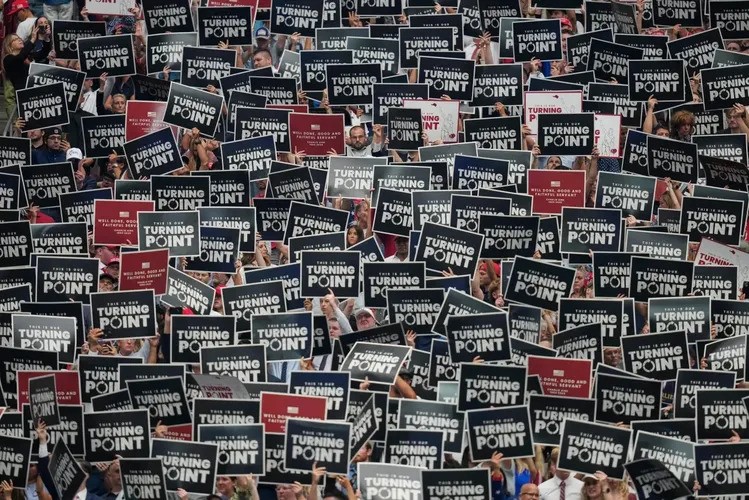
According to new polls by Politico and the Public First Center, support for a regional war with Iran is only 38 percent. The majority believe that adventurism in West Asia is not in American interests, and the president himself, despite his triumphant rhetoric, has no clear plan for exiting the conflict without major reputational losses.
Interestingly, the discontent also includes “Trumpism followers,” voters who supported Trump in 2024; their share is about 30 percent. They believe that the president has become involved in foreign policy at the cost of ignoring the domestic problems he promised to focus on during the election campaign. Only 15 percent of respondents have no doubts about their leader and think he has achieved his goals in West Asia.
These results are consistent with a study by the University of Massachusetts, which found that 63 percent (mostly Democrats and moderate Republicans) are confident that Trump has failed to resolve the Iran issue. 52 percent consider him “completely incapable,” and only 8 percent approve of a ground attack.
Meanwhile, 33 percent approve of Trump’s performance as president, down from 44 percent and 38 percent in April and July 2025, respectively. Disapproval ratings in the NBC News poll have reached 37 percent.
Even the loyal Trump followers known as the “MAGA” movement have apparently become disillusioned with Trump’s Iran policy. While they still number in the low 20s, prominent figures such as Trumpism founder Steve Bannon, Tucker Carlson, Marjorie Taylor Greene, and Joe Kent, the retired director of the National Counterterrorism Center, have openly condemned Iran’s regional war.
Another compelling indicator of anti-Trump sentiment is the record level of political activism in his second term. By the end of March, more than 3,000 anti-war events had been held across the United States and several other parts of the world, with a total of about 8 million people attending, compared to 5 to 7 million in 2025. Overall, the growth in protest activity during Trump’s second term is estimated to be more than 130 percent compared to his first term (2017-2021).
Resistance in Congress also continues. Since the beginning of the adventure until mid-April, US senators, mostly Democrats, have introduced a resolution banning regional war with Iran six times, but the Republican majority has always rejected it.
Domestic disputes over the regional war with Iran have also spilled over into the realm of religion. Trump clashed with Pope Leo XIV over the use of religion to justify war. After the Pope’s criticism, the president wrote on his social media: “I don’t need a Pope to criticize the President of the United States.” He also posted an AI-generated image of himself as Jesus, which he was eventually forced to remove. The behavior sparked outrage, especially among the 20 percent of American Catholic adults, many of whom voted for Trump in the 2024 election.
Meanwhile, Democrats have launched an impeachment effort against Pete Hegsett and introduced a resolution to remove him. His charges include “inciting a regional war with Iran, killing civilians, particularly in the attack on the Minab girls’ school, obstructing congressional oversight, abusing power, and instilling religious ideas in the military.”
Meanwhile, efforts to invoke the 25th Amendment (the president’s mental incapacity) have begun, citing Trump’s blasphemous remarks and wild rhetoric.
Time is running out for the president. The November 2026 midterm elections are fast approaching. A regional war with Iran is a heavy burden for Republicans. In the worst-case scenario, the ruling party risks losing both houses of Congress, a disaster that would trigger a Democratic impeachment effort likely to be partially successful.
Even in the Senate, at least one seat from Texas could go to the Democrats. The opposition candidate, James Talarico, is using progressive religious rhetoric to discredit Trump among moderate evangelicals. The potential loss of Texas, which Republicans have held for more than 20 years, could destabilize them.
The domino effect could weaken the chances of Marco Rubio or JD Vance as possible Republican candidates in 2028. Trump’s clash with the Pope over Iran has only exacerbated their electoral woes.
The two-week truce gave Trump breathing space to keep gas prices in the $4-$5 range. But the threat of military escalation hangs over him like a sword of Damocles. His position is precarious, and the possibility of political-economic instability and rising social tensions is high.
The enormous price America is paying is not just military. Domestic attrition, a war over truth and meaning, and the disintegration of electoral consensus have challenged the stability of the declining superpower more profoundly than any battle on the ground.
