

Political Consequences of a Massive Attack on Moscow
TEHRAN (Defapress) - After one of the heaviest drone attacks on Moscow since the start of the Russia-Ukraine war, most Russian military analysts have made their assessment in the form of two key points. First, given the public positions and actions of Russian officials, the Kremlin does not seem to view Ukraine’s long- and medium-range attacks as a strategic threat. From Moscow’s perspective, the situation is still under control, and the fate of the war will be decided at the front, where the Russian army has the upper hand.
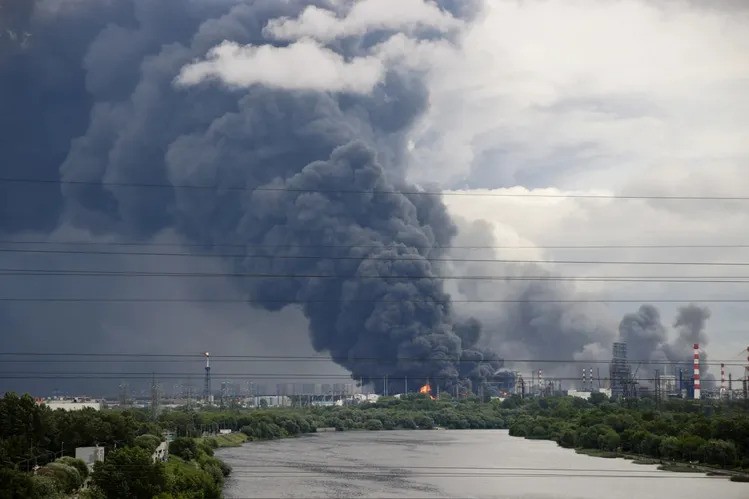
The second point is that Ukraine and Europe are trying to create an image of victory. In his opinion, the tangible result of these attacks could be that more Russian citizens feel that the war is no longer a distant phenomenon, but that it is directly affecting their daily lives.
The developments of Wednesday’s tense night showed that this assessment not only remains valid but is even more in line with reality than ever before.
It is clear that the attack by Ukrainian armed forces on the Russian capital on Wednesday night, June 18, will not be the last attack on Russia, but what remains in question is the grand strategy behind Ukraine’s tactics in increasing the intensity and scope of attacks on Moscow.
Part of this strategy is quite obvious. Relying on its new capabilities in drone production, the Ukrainian government is trying to destabilize the domestic political atmosphere in Russia on the eve of a major test for the Kremlin.
On June 16, Vladimir Putin signed a decree calling for State Duma elections on September 19. Less than 48 hours later, a large wave of drones was sent to Moscow.
Behind Zelensky is Europe, which, without concealment, plays the role of a safe foreign base and a support for equipment for Ukraine’s defense industry. Since it is practically impossible to completely block the arms routes from Europe to Ukraine, Moscow’s opponents apparently aim to drive Russia into a state of exhaustion and demoralization.
But the main question remains: what is the endgame for Putin’s geopolitical rivals?
It remains unclear how increasing military pressure on Moscow can be reconciled with Europe’s simultaneous efforts to engage Russia diplomatically. This contradiction in the “good cop, bad cop” model makes sense; in practice, there is always a gap between theory and reality.
The idea that Putin can be forced to back down by publicly confronting him is not just a misconception; it is a potentially dangerous one.
If Russia reaches a point where it has nothing to lose, it may turn out that the other side, especially the countries that support Ukraine militarily, has much more to lose.
Of course, these words can be considered an emotional reaction. Putin is a calm and calculating politician and is unlikely to push the region towards an uncontrollable escalation.
But here a fundamental question arises: from Moscow’s perspective, what level of escalation is still controllable and at what point will this control be lost?
Zelensky has claimed that what is now being seen in the form of attacks on the Russian capital is only the beginning and that the main blows will be struck on the eve of autumn.
If this is not simply psychological warfare, an important question arises: will this increasing pressure, a large part of which has been made possible by European support, not eventually reach a critical point, a point where the Russian leadership feels that the foundations of the country’s national security are directly threatened?
For now, there are more questions than answers. But these are serious questions; questions that may even be too late to ask.
The pressure on one of the world's major nuclear powers cannot be increased indefinitely. Sooner or later, this compressed spring will be released.
This fact is well understood in Europe, the United States, and Ukraine, and this once again draws attention to the hidden side of the ongoing diplomatic game.
Last week, the ambassadors of Germany, France, and the UK handed over a message to the Russian Foreign Ministry. However, no clear explanation of its true content has been provided so far.
We do not know the full picture of events. We see only part of the reality and are forced to guess the whole scene from scattered signs. This is the nature of life in the "current critical moment."
The only thing that can be said with certainty is that the times ahead will by no means be calm and predictable.
