
Zionist Regime Is the Biggest Threat to Regional Stability and Security
TEHRAN (Defapress) - Esmaeil Baghaei, Spokesperson for the Ministry of Foreign Affairs, in his press conference this morning with media representatives and journalists, while congratulating Journalist Day and commemorating the Iranian diplomats and journalists martyred at the Iranian Embassy in Mazar-i-Sharif, stated in his remarks: "In the past year or two, a large number of your colleagues were martyred in Palestine and Lebanon while fulfilling their duties. We honor the memory and legacy of every single one of them."
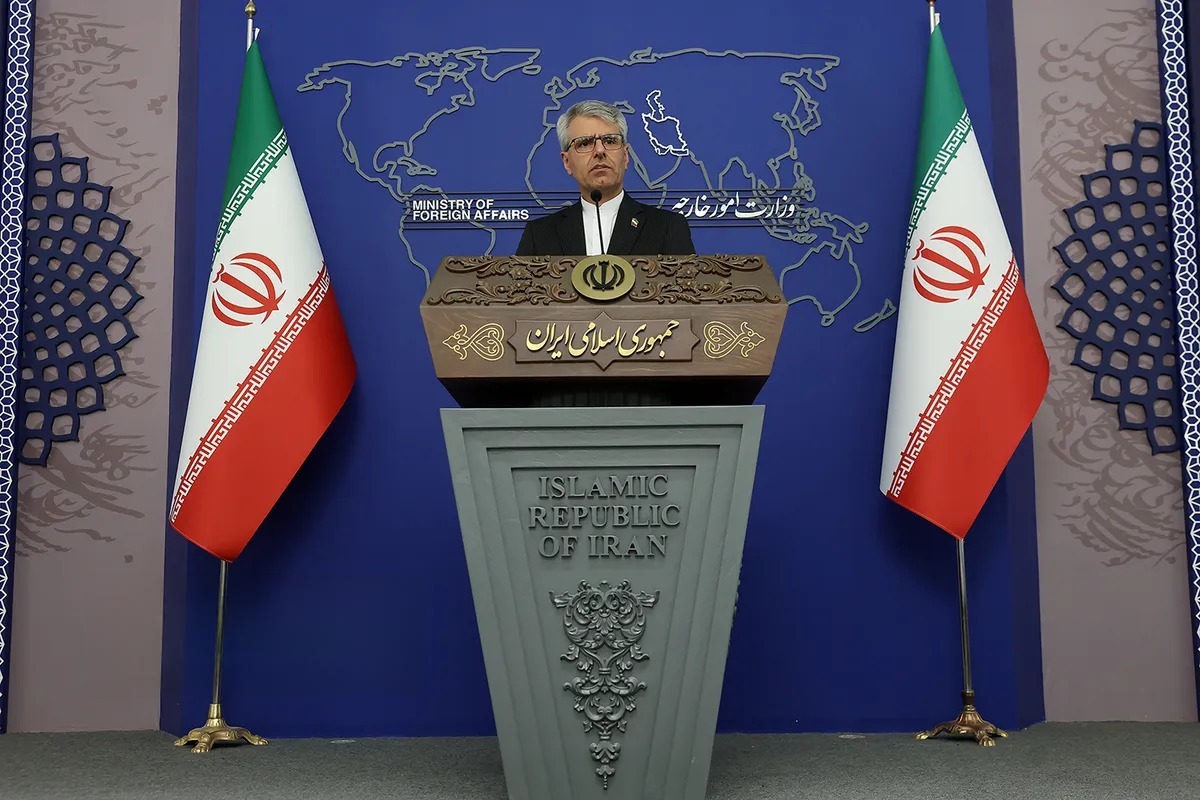
Baghaei added: "The action taken by certain regional countries to sign defense memorandums with one another is a decision that indicates a shift in perception among the nations of the region. They have realized full well that security is not a purchasable commodity. Furthermore, Iran's policy has consistently been to invite regional countries toward cooperation and strengthening endogenous security without relying on foreign actors. This development must be noted."
The Foreign Ministry Spokesperson continued: "Following October three years ago and the onset of the genocide in Gaza and the regime’s attacks, the countries of the region came to a collective conclusion as to who poses the greatest threat to stability and security for the entire global community."
He noted: "The ambitions of the Zionist regime are hardly unrevealed. The regime's attacks against Lebanon, Palestine, and Syria, alongside its threats against regional countries, all demonstrate the reinforcement of this perception: that countries in the region can no longer rely on the United States' claims of providing security as they did in the past."
Baghaei added: "The United States itself has been a component of regional insecurity. The Zionist regime could certainly not have committed its crimes without US support. Our conviction is that security in the region is indivisible. Any plan that correctly identifies the enemy and the threat stands a chance of contributing to the reinforcement of security."
The Foreign Ministry Spokesperson stated: "Security in the region is indivisible, and any plan grounded in the historical and geopolitical realities of the region that recognizes the enemy and threat stands a chance to help strengthen security in our region."
Regarding Kuwait's approach regarding the closure of the Iranian school, he added: "Concerning the four Iranian citizens, our follow-ups have been continuous and are ongoing with full seriousness."
Baghaei continued: "Unfortunately, the Kuwaiti government, disregarding its legal and international obligations as stipulated in international documents, refused to grant consular access to our nationals. This is a completely legitimate and lawful request by Iran, and we hope the authorities of the Kuwaiti government will reconsider this decision, which contradicts international obligations, as swiftly as possible and provide the conditions and groundwork for the release of the Iranian citizens."
Completing his remarks, the Foreign Ministry Spokesperson noted: "The closure of the Iranian school in Kuwait is another strange action by the Kuwaiti government. Retaliation against the most innocent segments of society who utilize this school for education is utterly unjustifiable."
He added: "The Iranian school in Kuwait has a long history, and this appears to be a political decision. Our embassy in Kuwait is pursuing the matter, and we hope this issue will be resolved."
Baghaei also emphasized: "Our expectation from regional countries, including Kuwait, is to refrain from projection and to avoid making their territory and facilities available for illegal and aggressive actions by the United States against Iran."
The Foreign Ministry Spokesperson stated: "This is not an unreasonable expectation; it is an expectation rooted in the principle of good neighborliness. Additionally, regional countries must refrain from actions that in no way help restore relations."
Referring to the requests by Venezuela and Chad to withdraw from the International Criminal Court (ICC), he said: "Venezuela and Chad are not the only countries to have submitted withdrawal requests; this in itself is a signal. A signal of the international community's disillusionment with a court established to prevent impunity."
Baghaei added: "The trial of the past few years was one from which the Court failed to emerge with pride due to US pressure. Furthermore, as a result of the genocide in Palestine and the threats made by the US against the Court's judges, countries have concluded that we are dealing with selective justice."
Regarding the statements by the Foreign Ministers of Turkey and Pakistan concerning Iran's awareness of the Mecca Agreement, the Foreign Ministry Spokesperson said: "Yes, Iran was more or less informed of this agreement. Moreover, there is no reason for us to be concerned regarding three neighboring countries, namely Turkey, Pakistan, and Saudi Arabia, with whom we share deep religious and civilizational ties, or to view this pact as directed against Iran."
He further added: "The history of friendship between Iran, Pakistan, and Turkey is long-standing. This development is an important sign that regional countries have concluded they cannot rely on US claims of providing security and are attempting to test another approach."
Regarding the Caspian Sea Convention and allegations against it, Baghaei said: "This document was signed in 2018 and its various dimensions have been discussed and examined by other competent institutions to this day. Furthermore, Iran makes independent decisions regarding its national interests and expediency."
The Foreign Ministry Spokesperson added: "This document has four [signatory] members who have signed it, and until all five countries sign it, it cannot be implemented. Those who decide to address shared concerns would like this document to enter into force. We take our own interests into consideration."
Pointing to the potential joining of other countries to the Mecca Agreement and the possibility of Iran joining, he noted: "Iran has been a pioneer in emphasizing the pursuit of security mechanisms based on cooperation among regional countries. Iran's proposals remain intact and can be updated. We are in contact with regional countries and hope all nations adopt the best path toward securing collective regional security."
Regarding Iran's attendance at the UN General Assembly session, Baghaei said: "A final decision has not yet been made in this regard, but we utilize every opportunity and intend to participate in this session again this year."
Referring to Iran's conditions for reopening the Strait of Hormuz, the Foreign Ministry Spokesperson clarified: "The reason for the closure of the Strait of Hormuz was the military aggression of the United States and the Zionist regime against Iran. Naturally, negotiations between Iran and Oman regarding the shipping lane concern the two countries; inherently, it is a bilateral negotiation between two coastal states."
He stated: "The opening of the Strait of Hormuz depends on the fulfillment of conditions imposed on Iran and the Strait by the US and the Zionist regime. As long as the US naval blockade continues, the necessary conditions for opening the Strait of Hormuz do not exist."
Regarding the proposed idea of Iran potentially collecting transit tolls in the Strait of Hormuz, Baghaei said: "We are not discussing such details at this stage, and discussions are ongoing. Regarding the traffic map, an understanding has been reached; regarding the joint statement, certain points remain. We have no discussion on these details right now."
The Foreign Ministry Spokesperson added: "Topics such as a mechanism to monitor traffic safety, environmental issues, and the provision of maritime services have been discussed. Naturally, when you provide maritime services, you also collect service fees."
Regarding the Supreme National Security Council's decision on the agreement with Oman, he stated: "The decision-making process is clear. Any negotiation that takes place is under the supervision of the Supreme National Security Council, and the process is pursued according to instructions; in this case as well, it is handled in the exact same manner."
Baghaei continued: "Regarding whether we are negotiating with the US: no, we are not, and the exchange of messages is taking place through intermediaries. What the next step will be depends on the circumstances."
Regarding mine-clearing operations along the median line in the Strait of Hormuz, the Foreign Ministry Spokesperson said: "In Paragraph 5 of the Memorandum of Understanding violated by the US, Iran's role was very clearly specified. The responsibility for the future management of the Strait of Hormuz rested with Iran. Security provision, including rendering the area safe and clearing mines, fell upon Iran. This issue must be pursued between the two coastal states."
He added: "The northern and southern lanes will be converted into a median lane following the agreement. It was the US that brought about this situation by creating a route contrary to the MoU."
Pointing to changes in the Supreme National Security Council and their potential impact on negotiations, Baghaei said: "The entire world saw clearly over the past year and a half that our country is a nation of institutions, not individuals. Policy formulation and decision-making take place within the framework of institutional bodies. I would like to congratulate Mr. Rezaei on his appointment and wish him success."
Regarding the formation of a joint legal team between the Ministry of Foreign Affairs and the Judiciary to pursue the file on US and Israeli crimes, the Foreign Ministry Spokesperson added: "The most important work to be done is opening a case and issuing an indictment for the perpetrators and commanders of the crimes committed during the two imposed wars. Raising the issue in international courts requires that proceedings have commenced locally."
He continued: "The documentation process is being carried out continuously. The very document compiled by the Ministry of Health regarding the Lamerd crime is significant. We have reflected this and will continue on this path."
Baghaei referenced Parliament's plan for the Strait of Hormuz, noting: "Iran's governance institutions are fully coordinated with the Islamic Consultative Assembly [Parliament]. The traffic management plan in the Strait of Hormuz is under review, and the Foreign Ministry is involved in the process, sharing its views. Just today, Mr. Araghchi held a meeting with members of the National Security Commission."
The Foreign Ministry Spokesperson added: "Regarding the New York Times report on Iran presenting a list of demands to the US, it must be said that this media hype aims to whitewash the core issue. In any analysis concerning the Strait of Hormuz, one must immediately consider the primary cause of the outbreak."
He stated: "The Strait of Hormuz was open from the creation of Prophet Adam until February 28 of last year, and despite threats, nothing happened to transit ships. The problems stemmed from the aggression of the US and the Zionist regime. The US government still prides itself on maintaining a naval blockade and targeting Iranian ports. As long as these violations continue, under such conditions, would international shipping dare to pass through this route?"
In response to a journalist's question regarding the potential visit of Ghalibaf and Araghchi to Pakistan, Baghaei said: "Exchanges between two countries with close relations are naturally expected to occur. Officials from both our side visit Pakistan and theirs visit Iran. In recent days, we had visits to Pakistan by the Minister of Industry, the Minister of Science, and the Minister of Interior."
The Foreign Ministry Spokesperson added: "Invitations for the visits of Messrs. Araghchi and Ghalibaf have been received, and whenever the appropriate context arises, these visits will take place. They primarily target bilateral relations. Iran-Pakistan relations have become far more significant, forming a natural part of good relations between two neighbors."
Regarding security consultations between Iran and Iraq, he said: "We must certainly strive to keep the outlook of Iran-Iraq relations clear. The process moves in this manner, and consultations between the two countries are continuous. We are mindful of the threats and dangers facing our borders. The trajectory of cooperation is positive, and we hope this process expands day by day based on the security understanding reached a few years ago."
Referring to the Ukrainian President's acknowledgment regarding an attack on an Iranian ship, Baghaei added: "We stated our positions very explicitly and were not convinced by the Ukrainian side's claim that it was unintentional. However, despite the confession of Ukrainian officials, they must certainly make reparations; if they do not, we will compensate for it ourselves."
In reaction to US media reports regarding American attrition, the Foreign Ministry Spokesperson said: "We give no credence to any report, whether positive or negative, regarding the extent of US capabilities. What matters is our own high state of readiness. There is no doubt that the US has suffered attrition."
He continued: "The crimes committed by the US destroyed its standing across all arenas in an unprecedented manner. We insist on remaining alert at all times and enhancing our capabilities."
Regarding consultations with regional countries on security, Baghaei said: "In every dialogue we hold with Oman and regional countries, we converse on the necessity of increasing cooperation to achieve endogenous security. We hope recent developments pave the way for countries to move down that path."
Regarding consultations with Afghanistan on water rights, the Foreign Ministry Spokesperson added: "The issue of water is among our most vital topics with the Afghan side. We have made progress, but it is not merely a technical matter."
Regarding reports on the US crime in Lamerd, he noted: "Over the course of these recent months, three names, Minab, Lamerd, and Qeshm, became prominent. However, these three names must not divert our attention from thousands of other war crimes committed by the US and the Zionist regime. New dimensions regarding the Lamerd crime are published daily, and the use of phosphorus is part of it. We have reflected these matters to the relevant international bodies. We are still searching for the remains of our children's bodies in the ruins of the Minab school."
Referring to Trump's remarks on economic pressure against Iran, Baghaei stated: "Did the US welcome diplomacy from the outset when it decided to commit military aggression? One cannot counter an entity through diplomacy alone when it insists on using force and emphasizes a naval blockade. You must counter its actions through power combined with diplomacy."
Regarding Araghchi's remarks on non-negotiation with the US, the Foreign Ministry Spokesperson clarified: "Mr. Araghchi's point was that our focus is currently on negotiations with Oman. The Strait of Hormuz has become insecure due to other reasons, and we continue to face a naval blockade."
In response to allegations by the Zionist regime against the Islamic Republic of Iran, he said: "This is a very clear example of falsehood fabrication. Media outlets covered it as well: a lie is manufactured in a fake Indian media outlet, disseminated in the Zionist regime, and then commented upon; this is merely the tip of the iceberg. All allegations by the Zionist regime against Iran are lies fed to people for 30 years."
At the conclusion of the press conference, regarding the Zionist regime's failure to implement the Sharm El-Sheikh agreement, Baghaei said: "This must be answered by the President of the United States. In Sharm El-Sheikh, they claimed this plan could bring about peace and stability, and we said it lacked executive viability. Now we see that they do not abide by any promise or agreement."
