
Enemy’s Offensive Posture with the Deployment of Seven Warships: American Terrorists Will Be Crushed Before Reaching Iran’s Coasts
TEHRAN (Defapress) - In an offensive move, the United States has initiated the expansion of its combat posture in West Asia by dispatching seven new warships carrying at least 9,000 fresh military personnel; a heavy movement carried out under the U.S. President Donald Trump's evaluations regarding the resumption and sharp increase of military strikes against Iran following the November midterm elections.
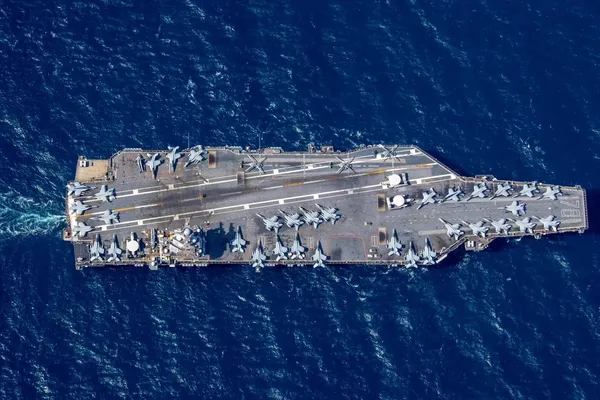
According to reports confirmed by official Pentagon authorities, this massive naval group includes the aircraft carrier USS Theodore Roosevelt accompanied by three guided-missile destroyers, as well as the amphibious assault ship group USS Makin Island alongside the 13th Marine Expeditionary Unit. They left the San Diego Naval Base early this week for West Asian waters and are expected to enter the operational area by late November.
This deployment, accompanied by the transfer of dozens of F-35B Lightning II short takeoff/vertical landing fighters, over 2,200 Marines, the amphibious transport docks USS Anchorage and USS John P. Murtha, and a massive volume of infantry fighting vehicles and heavy armored personnel carriers, pushes the total number of U.S. military personnel in West Asia beyond 50,000 and brings the number of active Washington combat vessels enforcing the blockade of Iranian ports to more than 20. This military composition includes 5,000 personnel in the aircraft carrier strike group and approximately 4,200 Marines and sailors aboard the amphibious ships.
These military maneuvers occur at a time when diplomatic channels have reached a dead end under Washington's contradictory rhetoric and behavior, and pressure on the vital arteries of the region has reached its peak. In a recent interview with Time magazine, Trump explicitly stated that if a favorable agreement acceptable to Washington is not reached with Tehran, an increase and resumption of military strikes after the midterm elections would be probable and on the table.
This comes as indirect and intensive negotiations between Iranian and U.S. representatives on the sidelines of the UN General Assembly in New York concluded without tangible results just hours after Trump's criminal speech regarding the destruction of Iran. In subsequent days, the U.S. President completely rejected Iran’s seven-day goodwill proposal to reopen and secure transit through the Strait of Hormuz, which was conditional on the implementation of prior U.S. commitments and the lifting of the blockade on Iranian ports pursuant to the June Memorandum of Understanding.
International mediators attempted to present a revised draft of a temporary agreement under which Iran would allow free passage through the Strait of Hormuz in exchange for the U.S. lifting the blockade on Iranian ports. However, since war holds no popularity among the American public and the Republican Party is making strenuous efforts to retain Congressional seats ahead of the election, the White House has resorted to high-risk behaviors and the creation of artificial crises beyond its borders.
In this context, the arrival of the aircraft carrier Theodore Roosevelt could signify reinforcing and joining the two aircraft carriers USS George W. Bush and USS George Washington currently deployed in the region, or substituting one of them to intensify the pressure of the U.S. Navy's blockade on Iranian oil tankers and communication lines.
However, a closer examination reveals that the primary objective of this heavy military posture is not limited merely to a display of power in the Strait of Hormuz or placing pressure on the oil fleet; rather, it harbors the potential to draw the battle toward Iran's eastern coasts. By evaluating the simultaneous recent movements of terrorist and separatist groups in Sistan and Baluchistan Province and their intense clashes with Iranian military and security forces, a dangerous scenario comes to light: the U.S. intends to use the strategic Chabahar Port as the golden key to strike at Iran's borders.
Due to its unique geographical position, situated outside the bottleneck of the Strait of Hormuz and on the coast of the Indian Ocean, Chabahar Port, in the enemy's foolish imagination, lies outside the dense air-defense zone of the Strait of Hormuz. This makes it an interesting subject for Pentagon scenario writers. The combined amphibious force of the Makin Island group, the 13th Marine Expeditionary Unit, heavy transport vessels, and F-35B Lightning II fighters is designed for such a scenario: conducting a beach landing operation, rapidly occupying Chabahar Port, and establishing a forward operating military bridgehead and base. This aims to block Iran's international trade artery independent of the Strait of Hormuz on one hand, and create an insecure zone on the eastern borders in direct or indirect coordination with separatist terrorists on the other.
Confronted with this scenario and a serious threat to territorial integrity, adopting necessary defensive and preemptive offensive strategies becomes imperative. The first and fundamental step in Iran's defense doctrine to counter such folly is the decisive destruction of enemy vessels and amphibious warships before they reach the troop landing perimeter on the Makran and Chabahar coasts.
Using newly operationalized and highly advanced anti-ship ballistic missiles that were recently tested with complete success in the field, Iran's Armed Forces must immediately target U.S. transport vessels, amphibious ships, and support craft before they approach Iranian territorial waters, neutralizing and sinking them in deep seas so that no ground force can reach the shore.
Simultaneously with this missile response at sea, the swift and comprehensive fortification of air defense positions, armored equipment, and defensive bunkers across Sistan and Baluchistan Province, along with preparing forces for a heavy, all-out, and attritional conflict, will shatter the enemy's calculations of a swift victory.
Meanwhile, the calculations of the aggressor front and Washington think tanks suffer from a severe strategic, historical, and mathematical miscalculation. The historical developments of the last decade, particularly the heroic and enduring experience of the eight years of Sacred Defense, have clearly proven to all aggressors and imperialist powers that soil, homeland, independence, and territorial integrity represent a national red line and the highest value defining the identity of the Iranian people.
The Iranian nation and its Armed Forces have demonstrated time and again in decisive operations that in defense of every single inch of this sacred land, from the lily-carpeted expanse of the Persian Gulf to the rugged rocks of Makran and Baluchistan, they will fight until the last drop of blood. Under no circumstances will they allow the slightest step to be taken by any foreign invading force on the pure soil of the homeland, nor will they allow dreams of occupation and partition to materialize.
However, the unique and distinct element defined in the new defense equations and deterrence doctrine of the Islamic Republic of Iran is that the dimensions of the country's crushing and devastating response will by no means remain limited to direct U.S. invading forces at sea or along the coastline. Should this military aggression or amphibious operation be launched through the territory, coasts, ports, bases, or regional facilities of neighboring countries, the Arab states providing financial, political, and logistical support for these attacks must perform a fundamental and immediate reassessment of their security calculations.
In Iran's new and crushing doctrine of retaliation, the era of merely targeting economic facilities, refineries, energy infrastructure, or commercial arteries of these countries has come to an end. This time, the glass palaces of regional rulers, primary decision-making centers, military headquarters, and sensitive governmental offices of these states have been designated as the direct, primary, and immediate targets of Iran's precision-guided ballistic missiles, ensuring they feel with their entire being the heavy and direct price of facilitating aggression, betraying regional security, and providing weaponry and operational platforms to American aggressors.
Ultimately, assessing the totality of U.S. military movements in the Persian Gulf and the Sea of Oman indicates that Washington, through a combination of direct threats, dispatching naval combat groups, and instrumentalizing terrorist groups on the eastern front, seeks to impose a new miscalculation on the region. Nevertheless, the convergence of Iran's smart missile deterrence with the experience of all-out defense and national resolve to safeguard territorial integrity will transform the equation of aggression into an attritional nightmare for any invading force.
