
We Will Push the Americans Back to the South Pole
TEHRAN (Defapress) - Major General Ali Abdollahi, Chief of the General Staff of the Armed Forces and Commander of the Central Headquarters of Khatam al-Anbiya (PBUH), visited an exhibition showcasing key programs and activities of the Foundation for the Preservation and Publication of Sacred Defense and Resistance Works and Values.
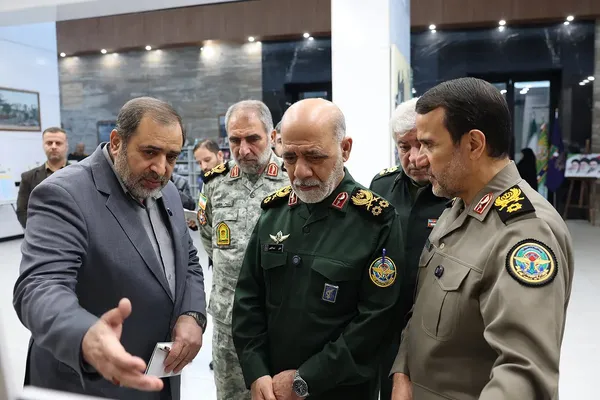
On the sidelines of this visit, Major General Abdollahi commended the efforts of the Foundation regarding the Second and Third Sacred Defenses, noting: "This exhibition demonstrates that the Foundation has been actively engaged since the onset of these two recent wars, successfully gathering authentic evidence and documentation of the events, including films, images, and written records."
He added: "Recording and compiling these documents prevents the distortion of reality and ensures that the public and future generations are informed about what actually transpired on the battlefield. This is a valuable endeavor; it is essential to complete the remaining sections to allow for the further expansion and dynamism of these activities."
Referring to the 12-Day and 40-Day Imposed Wars, the Chief of the General Staff of the Armed Forces remarked: "From the very beginning, the United States and the Zionist regime sought to overthrow the Islamic Republic of Iran, deploying their full military capacity and mechanisms toward this objective."
The Enemy’s Miscalculation Regarding Iran
Major General Abdollahi continued: "The enemy assumed they would achieve their goal within a short period; however, that did not happen. The 12-Day Imposed War concluded with a ceasefire proposed by the enemy; in the subsequent conflict, despite the enemy’s expectation that they would finish the job within 24 to 48 hours, the fighting persisted for 40 Days.
Noting that the enemy lacked an accurate understanding and assessment of the realities within the Islamic Republic of Iran, he added: "The United States and the Zionist regime assumed they could achieve victory by relying solely on military equipment and hardware. However, these two wars showed that military hardware is only one factor in a conflict. Ultimately, it is national will, faith, and belief in divine promises that determine the outcome on the battlefield."
Emphasizing the role of the populace and the Armed Forces in confronting the enemy, the Commander of the Central Headquarters of Khatam al-Anbiya (PBUH) remarked: "The resolve of the people, the Armed Forces, and the commanders, coupled with faith and belief in divine promises, served as the primary pillars of the nation’s steadfastness. By the grace of God, the Islamic Republic of Iran emerged victorious from these two conflicts through its resilience and resistance, while the enemy suffered defeat."
Referring to the enemy’s explicitly stated objective of overthrowing the Islamic Republic of Iran, Major General Abdollahi stated: "The enemy repeatedly articulated this goal but failed to attain it; they neither succeeded in seizing the nation’s territory nor in shaking the resolve of the Iranian people."
Acknowledging the losses and hardships endured during the war, including the martyrdom of the Supreme Leader and commanders, he observed: "The war brought with it immense suffering and adversity, and grave atrocities were committed; yet, alongside these losses, it also yielded significant lessons and experiences for the country."
The Chief of the General Staff of the Armed Forces identified the resilience and endurance of the people as one of the most significant achievements of this period, adding: "In the field and in terms of the public will, a high level of resilience was demonstrated, a quality that stands as one of the country’s greatest assets."
Referring to the nation's defense advancements, Major General Abdollahi stated: "This conflict provided an opportunity to identify and rectify weaknesses within the military sphere, while ensuring the continued production of domestic equipment with enhanced capabilities and efficiency."
He noted: "A defining feature of this conflict was the reliance on domestically produced equipment. This experience proved that self-sufficiency, anchored in the expertise of the nation’s scientists and researchers, paves the way for strengthening our defense capabilities."
Enhancing Defense Capabilities in the Naval and Air Defense Sectors
The Commander of the Central Headquarters of Khatam al-Anbiya (PBUH), reflecting on the performance of the Armed Forces across various defense domains, remarked: "In the naval sector, significant achievements and successes were realized; the Armed Forces were able to take effective action against the naval power of the United States."
He declared: "At sea, we have managed to push the Americans back. By the grace of God, we will drive them all the way to the South Pole; the Americans should expect this from us."
Major General Abdollahi also highlighted the country's progress in countering enemy fighter jets and aircraft, noting: "In this area, too, the operational capacity and precision of the Armed Forces have improved compared to the past."
Expressing his appreciation for the efforts of the nation's scientists and researchers, he emphasized: "The country's scientific and research capacity has played a pivotal role in bolstering our defense capabilities and securing new achievements."
Emphasis on Continued Resistance and Response to the Enemy’s Atrocities
Highlighting the role of the people’s steadfastness in navigating the war, the Chief of the General Staff of the Armed Forces stated that the Iranian nation and the combatants of the Islamic Republic successfully passed the arduous test of war through their resilience and resistance, a steadfastness that paved the way for victory.
Major General Abdollahi emphasized that this path must be pursued until the enemy regrets its actions. Furthermore, he noted that seeking retribution for the blood of the martyred Leader, the martyrs of the war, and the martyred children is a demand that will be pursued, relying on Divine grace.
