
Iran's Fair Sanctions Set Europe on Fire
TEHRAN (Defapress) - These days, the economic situation in the United States and Europe has unveiled, more than ever before, the bitter reality of the West's structural dependence on energy from the West Asia region. Following the onset of the regional war involving Iran on February 28, which led to the decisive choice by Iran’s Armed Forces to block the Strait of Hormuz, an unbelievable reality was imposed upon the Western world. By closing this strait, Iran effectively imposed sanctions on the United States and Europe, deadly sanctions whose effects can be clearly observed in official statistics and on the streets of Europe. What the martyred Leader of the Islamic Revolution explicitly stated years ago, that "the Iranian nation can also impose sanctions, and it will do so", is no longer a prediction today; it is an ongoing reality whose price is being paid by the architects of the snapback mechanism.
The accumulated malice of the US and Europe through sanction mechanisms and the snapback process served as a prelude to the bitter events of January 8 and 9, ultimately leading to Iran's regional war. The West assumed that the pressure tool of sanctions would always remain one-sided, but the blockage of the Strait of Hormuz after February 28 altered this equation. Following this action by Iran’s armed forces, the vital lifeline of global energy was severed, and Western markets faced successive shocks. The result of the sanctions imposed by Iran is reflected in official figures: in the US, the Consumer Price Index reached 3.7% in September, gasoline prices surged by 9.1% in just one month, and its annual growth reached 34.2%. The national average gasoline price crossed the $4.30 mark. Energy inflation became the primary driver of rising prices, while pressure on rent and housing remained severe.
Europe is experiencing an even more acute situation. Eurozone inflation has reached 3.8%, and energy prices have increased by 18.8% compared to the previous year. This pressure spilled directly into the streets. In Spain, a widespread wave of housing protests began in late September. The eviction of an 87-year-old woman from her home after a skyrocketing increase in rental rates ignited nationwide protests in the country. Tens of thousands of people took to the streets in Madrid and more than 50 other cities; some estimates put the number of demonstrators in Madrid at up to half a million. Housing prices in Spain saw an annual growth of 12.2%, and a shortage of nearly 700,000 residential units was reported. Labor unions have called for a general strike, and the government has been forced to call early elections.
In Portugal, the housing situation has turned into one of Europe's worst crises. Housing prices grew by 16.5% year-over-year in the second quarter and have more than doubled since 2017. New rent prices have nearly doubled. Tens of thousands marched in Lisbon against the cost of living and the housing crisis. Many young people and families are unable to secure housing in major cities, and protests have been accompanied by the setup of temporary encampments.
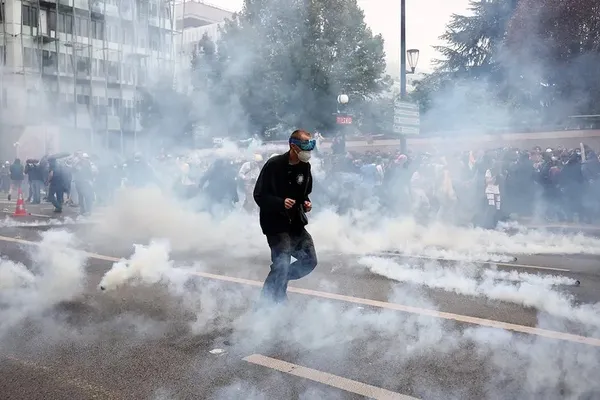
France is also witnessing one of the most violent waves of protests in recent years. Hundreds of thousands of people (official estimates around 550,000, and union estimates up to 800,000) took to the streets on October 17 to protest against rising living costs, fuel prices, and the weakening of public services. The protests, which began in schools over a shortage of teachers, spread rapidly and led to violence in some cities, including setting fire to public buildings, looting, and clashes with police. Between 1,200 and 2,400 people were arrested, and several municipalities suffered severe damage. These protests coincided with similar waves in Italy, Belgium, and other European nations, demonstrating that economic strain is no longer confined to a single country.
These developments are not accidental. The disruption in the energy flow through the Strait of Hormuz has kept global oil prices at elevated levels and sharply increased fuel and energy costs in the West. What the West designed with sanctions and snapback has today become a weapon against its own economy and social stability. By accurately understanding its geostrategic position, Iran delivered a fitting response to more than four decades of continuous oppression by the US and Europe. By applying fair sanctions against the West, it demonstrated that sanctions are not an exclusive pressure tool of the West.
Official inflation statistics, soaring gasoline prices, double-digit housing growth in Portugal and Spain, and streets filled with protesters in France and other European countries are the clearest proof that the era of unilateral sanctions has come to an end. The cost of years of economic malice has now returned to its own designers.
