

BTS of the Operations of Mohammed bin Zayed and Mohammed Dahlan in Haaretz
TEHRAN (Defapress) - On the very same day that the UK, along with 12 other Western countries, announced they would impose sanctions on illegal settlements located in the occupied West Bank, the newspaper Haaretz claimed in a report that UAE President Sheikh Mohammed bin Zayed Al Nahyan had warned Israeli Prime Minister Benjamin Netanyahu about the attack during an encrypted phone call approximately 10 days before Hamas carried out Operation Al-Aqsa Storm.
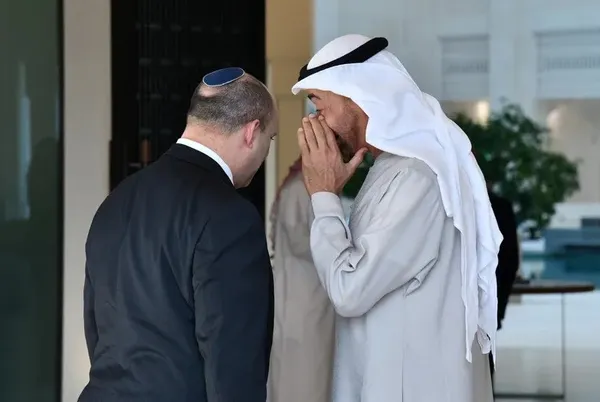
According to the Haaretz report, an official from the UAE embassy personally went to Netanyahu’s office with a special phone to ensure confidentiality. During this conversation, Bin Zayed informed Netanyahu that Hamas leader Yahya Sinwar was preparing a major operation, describing it as an "earthquake." However, Netanyahu did not take the matter seriously, associated the potential Hamas operation with the West Bank region, and stated that Israel was prepared for any scenario. Furthermore, Netanyahu did not share this critical intelligence with the then-heads of the Shin Bet, Mossad, and the IDF General Staff. According to Haaretz, Bin Zayed also shared this same information with the then-CIA Director, William J. Burns.
Netanyahu dismissed these allegations as an "absolute lie" and a "conspiracy," announcing that he would sue Haaretz, while the Likud party claimed that Mohammed Dahlan, a Palestinian politician residing in the UAE, was behind the news. Here, a crucial question arises: Did Dahlan leak this information arbitrarily, or was he instructed to do so by another individual or faction? This figure, who has a history of conducting security operations against Hamas in the Gaza Strip, was purged from Fatah by Palestinian Authority President Mahmoud Abbas, forced to reside in the UAE, and has served among Bin Zayed’s senior advisors for years, being recognized as one of the key links in diplomatic channels between the UAE and Israel. The likelihood of such a figure conveying such sensitive information to the public without at least implicit approval from one of the Persian Gulf Arab states is extremely slim.
In fact, the UAE's stance following this news reinforces its likelihood of being true. In the UAE's statement, the matter was not denied; instead, it sought to keep the issue quiet. The statement noted: "Government entities of the UAE and Israel have maintained open and direct channels of communication since the establishment of relations over five years ago. When necessary, all relevant information has been and continues to be shared between the relevant authorities." This selective silence, which neither confirms nor denies the news in a diplomatic tone, will help validate the report in the eyes of public opinion. This revelation, made by an actor close to the UAE just weeks before the October 27 election, should be interpreted as an attempt by the UAE to align with the new reality emerging in the region's security architecture.
To understand why this message was delivered now, one must look at Persian Gulf dynamics in recent months. On September 4, the UAE released Egyptian writer Abdul Rahman Youssef al-Qaradawi from prison. Abdul Rahman al-Qaradawi, the son of the Islamic scholar Youssef al-Qaradawi, had been in detention for over a year. Following his release, he specifically thanked Turkey and Turkish President Recep Tayyip Erdoğan in a video message. In his message, Qaradawi described Erdoğan as a leader who has always stood on the right side of history. The statement also declared that the Turkish Ministry of Foreign Affairs and intelligence agencies played a decisive role in this process.
These actions reflect not merely a humanitarian gesture, but also the signs of a strategic pivot. Under circumstances where Iran's regional war has upended regional security equations, the Strait of Hormuz has been closed by Iranian armed forces, and Persian Gulf oil facilities have been targeted by Iranian strikes, the UAE can no longer remain committed to a single axis.
Releasing someone from the Muslim Brotherhood school of thought and exchanging signals with Turkey can be read as a step toward drawing closer to the "Mecca Pact", a new security umbrella formed by Turkey, Pakistan, and Saudi Arabia, or at least keeping that possibility open. The Abraham Accords signed by the UAE with Israel provided an anchor of security for Abu Dhabi both economically and strategically. However, Iran's regional war shook this anchor. The fact that Netanyahu himself publicly disclosed his secret trip to the UAE in May, which the UAE immediately denied, was a development that exposed the fragility of this alliance.
Looking at the broader regional puzzle, it becomes clear that nothing that has transpired in the region in recent days and weeks is accidental. The fact that UK-led sanctions on the West Bank, joined by Spain, France, the Netherlands, and eight other Western nations, coincided precisely with the publication of the Haaretz report must be read as part of a coordinated diplomatic pressure strategy. Additionally, the statements by US Vice President JD Vance are highly significant. In his remarks, he emphasized that just as the US does not subordinate its European policy to NATO, it will not subordinate its Middle East policy to Israel. On one hand, coordinated sanctions from Western allies and mounting diplomatic pressure from the US, and on the other, the cold message sent by the UAE through Dahlan (which it did not deny), demonstrate that Netanyahu is under pressure from both the East and the West.
Can taking all these actions just weeks before the October 27 election be seen as an attempt to lay the groundwork for the post-Netanyahu era? These developments project an image of an Israeli leader who received intelligence warnings about a long-standing enemy but took no action to counter them, sidelined the security apparatus, placed his own political survival ahead of Israel's existence, and effectively brought Israel to the brink of destruction through his actions. This narrative could serve as a comprehensive political weapon designed for the opposition in the upcoming elections, with international actors contributing to it indirectly. In fact, Netanyahu had precisely this impression, which is why he described the news of his prior knowledge of Operation Al-Aqsa Flood as a rumor intended to aid a left-wing victory. In contrast, four key figures from the opposition front, Gadi Eisenkot, Naftali Bennett, Avigdor Lieberman, and Yair Golan, issued a joint statement calling for an investigation into the matter. Heads of the Zionist regime's security apparatus also explicitly stated that security institutions were not informed of this intelligence.
Netanyahu’s isolation has now become a striking reality. Coordinated sanctions from the West, growing diplomatic pressure from the US, revelations from the UAE, and demands for an investigation from the domestic opposition front all appear to be the product of a unified alignment. The common denominator in this alignment is that Netanyahu is no longer seen by international and regional actors as a manageable partner, but rather as an obstacle that must be removed. Whatever the outcome of the October 27 election, the sending of this message indicates that the next chapter of engagement with Israel is being written in foreign capitals. Both Western capitals and regional partners, anticipating that Netanyahu will be removed from power, are preparing for a new Zionist government. The signals of the UAE drawing closer to the Mecca axis are part of this same grand puzzle. The Persian Gulf Arab states are preparing for a world without Netanyahu and, quite possibly, without the Abraham Accords.
