
Collapse of Air Defense and Early Warning Systems During Yemeni Army Attacks on Riyadh Airport
TEHRAN (Defapress) - As a key hub for air traffic in West Asia, Riyadh's King Khalid International Airport has repeatedly been the target of complex, combined attacks by the Yemeni Army in recent weeks.
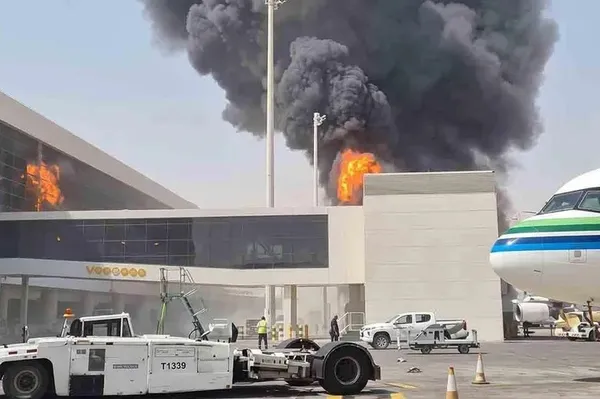
The significance of these attacks lies not only in the resulting casualties and material damage but also in the exposure of structural weaknesses within Saudi Arabia's defense architecture. Numerous reports indicate that the Saudi public warning system was completely inactive from September 29 until the time of the deadly strikes, with no alerts issued to citizens or travelers. This occurred despite confirmation from Western and Arab sources that Riyadh had been targeted by various attacks approximately 12 times during this period, a pattern suggesting that the continuous strikes by the Ansar Allah movement are progressively degrading the operational viability of King Khalid Airport.
The Cycle of Attrition and the Failure of Defensive Layers
Saudi Arabia's public warning system, which had been operational since May 2025 via mobile alerts and social media, remained silent during the Ansar Allah movement's attacks on King Khalid Airport. Western and Arab officials have confirmed that the last public warning before the strikes was issued on September 29, after which no further notifications were provided to the public. This information blackout occurred even though Ansar Allah forces had publicly and repeatedly declared their intention to shut down the Riyadh airport. Analysts believe the government’s decision stemmed from an attempt to maintain an appearance of "stability and calm" and prevent public panic; in practice, however, it led to increased casualties and an erosion of public trust.
In its attacks on King Khalid Airport, the Yemeni Army employed a multi-layered saturation tactic. According to initial reports, Yemeni Forces first launched several suicide drones to disrupt radar and air defense systems, followed shortly thereafter by the firing of cruise and ballistic missiles at specific targets. This combination, particularly the use of "Quds" cruise missiles carrying 150-kilogram warheads, overwhelmed air defense systems, rendering them unable to simultaneously detect and intercept targets moving at varying speeds and altitudes. Field sources emphasize that despite advanced radars and AWACS aircraft, these weapons launched undetected, and no warning sirens sounded.
Intelligence Gap
Saudi Arabia's failure to defend King Khalid Airport can be analyzed across several key dimensions, as follows:
A – Depletion and shortage of interceptor munitions: Numerous reports indicate that the Yemeni army's successive attacks have severely depleted Saudi Arabia's stockpiles of Patriot interceptor missiles. Global supply constraints compound this situation, with even the US military grappling with shortages of these munitions. A defense analyst comments on this matter: Saudi Arabia must protect Riyadh, its airports, oil facilities, military bases, and holy cities. Even a multi-layered system cannot create an impenetrable shield over a country as vast as Saudi Arabia.
B- Intelligence gaps and lack of sensor integration: Analysts believe that beyond equipment shortages, serious intelligence gaps and insufficient integration among various sensors and radars have been the primary reasons for the failure to detect attacks. The launching of drones and cruise missiles is inherently easy to conceal, and detecting them requires precise human intelligence (HUMINT), an area where Saudi Arabia appears to face significant weaknesses.
C- Strategic implications for other allies: This air defense failure carries significant consequences for regional security and Saudi Arabia's Western allies. Riyadh's inability to protect an international airport has raised serious questions regarding the effectiveness of the US security umbrella in the region. Some analysts believe that Saudi Arabia's decision to forge a joint defense alliance with Pakistan and Turkey (known as the Mecca Defense Pact), thereby sidelining the US, may have contributed to diminishing Washington's incentive to assist Riyadh in countering the Ansar Allah movement.
The incident at King Khalid Airport serves as a tangible symbol of the collapse of a defense strategy predicated on technological superiority when faced with a war of attrition and asymmetric warfare. The silence of the warning systems and the failure of Saudi Arabia’s air defense shield highlight a point where exorbitant military spending loses its effectiveness against innovative, low-cost tactics. Reopening King Khalid International Airport without fundamentally addressing these vulnerabilities and restoring lost confidence not only endangers passenger safety but could also be viewed as yet another strategic failure for Riyadh in managing future crises.
The dramatic decline in Riyadh’s defensive capabilities regarding its critical infrastructure points to a single conclusion: the complete erosion of defense systems in a nation that is incapable of even producing basic equipment and relies entirely on Western countries to meet its needs.
