
Iran's Surprise Strikes on the Enemy
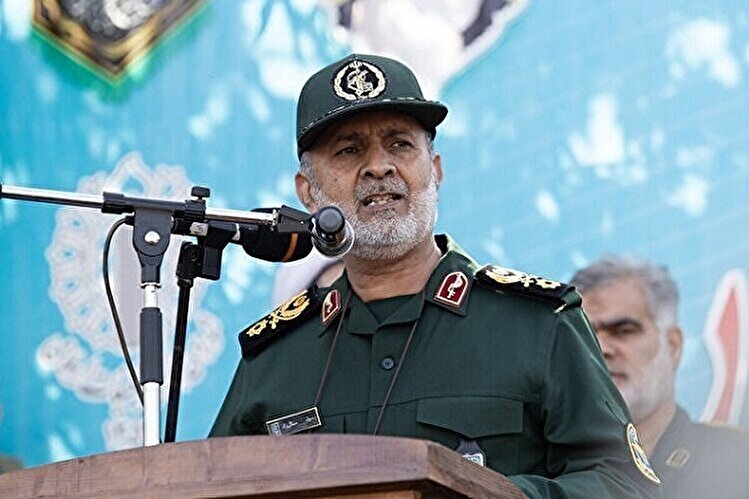
TEHRAN (Defapress) - In an interview with Defapress correspondent, Brigadier General Rasoul Sanaei-Rad, the Political Deputy of the Ideological-Political Office of the Supreme Commander-in-Chief, explained the developments in the region and the repeated violations of the ceasefire by the Americans: What we are witnessing today is the continuation of a process that was planned. In the initial plan to attack Iran, the Americans had not foreseen the seizure of the Strait of Hormuz; but with the closure of this vital waterway, they faced widespread pressure.
Stating that the increase in fuel prices not only put pressure on American citizens but also on European allies and industrial and non-industrial countries of the world, Brigadier General Sanaei-Rad added: The importance of the Strait of Hormuz is not limited to oil exports, but also petrochemicals and chemical fertilizers, which directly affect world agriculture, pass through this route. To compensate for this situation, they imposed a naval blockade on Iran, which also added to the dimensions of the crisis and pressure on global trade.
The Political Deputy of the Ideological-Political Office of the Supreme Commander-in-Chief continued: The Americans have been seeking to take control of the Strait of Hormuz from us since then using various methods; but they did not succeed. They used the ceasefire and negotiations as a cover for this goal, and during the same period, they violated the ceasefire several times under various pretexts and attacked the Strait of Hormuz; but they did not get anywhere. The Americans even used the policy of deception, which also failed.
He said: What is bothering Trump today and has become a symbol of America’s discredit in the world is the closure of the Strait of Hormuz despite America’s repeated promises to open it. Even after the memorandum of understanding, which stipulated that Iran would reopen the safe route and then conduct mine clearance, they were pressuring Oman to open a parallel route on the southern coast, but this plan also failed.
Brigadier General Sanaei-Rad emphasized: “Now all the enemy’s efforts are focused on forcing Iran to surrender. For this reason, attacking our observation, defense, and offensive centers that can be effective in the Strait of Hormuz and the coasts of the Persian Gulf and the Sea of Oman has been put on their agenda; also, creating public fear and panic by targeting infrastructure and sending the message that even logistical support centers deep in the country and communication lines will be cut off are all part of this strategy; Partly to carry out the operation and partly to make their seriousness believable and create fear in Iran.
The Political Deputy of the Ideological-Political Office of the Supreme Commander-in-Chief noted: Despite all these cases, our warriors are standing firm and this resistance will continue. Knowing the enemy's malicious plan, we have targeted complexes by carrying out intelligent offensive operations that could be effective in expanding their operations in the future or be considered an obstacle to our operations.
Regarding the enemy's casualties and damages, he stated: The Americans usually try to hide the news of their casualties, but the announcement of 13 wounded and subsequently two dead and one missing indicates our effective strikes. We used surprise and targeted a point they did not expect. With our careful observation, we knew that they had moved their facilities and forces from bases that had previously been spared from the attack to centers that happened to be their gathering places, and these centers were hit.
Brigadier General Sanaei-Rad added: For this reason, everything from the destruction of helicopters and airplanes to the killing and wounding of American forces has occurred at this stage of the operation; in such a way that there is no possibility of concealment for them; in addition, it seems that the enemy was still counting on his mercenary agents and traitors in the southeast and northwest of the country in his plan; therefore, simultaneously with the numerous attacks on American bases, counter-revolutionary centers were also hit.
The Political Deputy of the Ideological-Political Office of the Supreme Commander-in-Chief added: "It can almost be said that one of the most severe and destructive attacks was carried out against them at this stage, and the flames of fire and the continuous movement of ambulances towards this base are evidence of the extent of damage inflicted on the enemy's mercenary elements."
