

Reflection on the Collapse of the Persian Gulf Security Doctrine in the Mecca Pact
TEHRAN (Defapress) - The experience of the 40-day war and facing the strong blows of Ansar Allah in the ongoing conflict in Yemen revealed Saudi Arabia’s fundamental vulnerabilities in protecting its national territory and vital infrastructure more than ever before. Riyadh’s tangible inability to provide minimum national security against peripheral threats has forced the Saudis to mobilize military actors from the Islamic world to compensate for this deterrence gap.
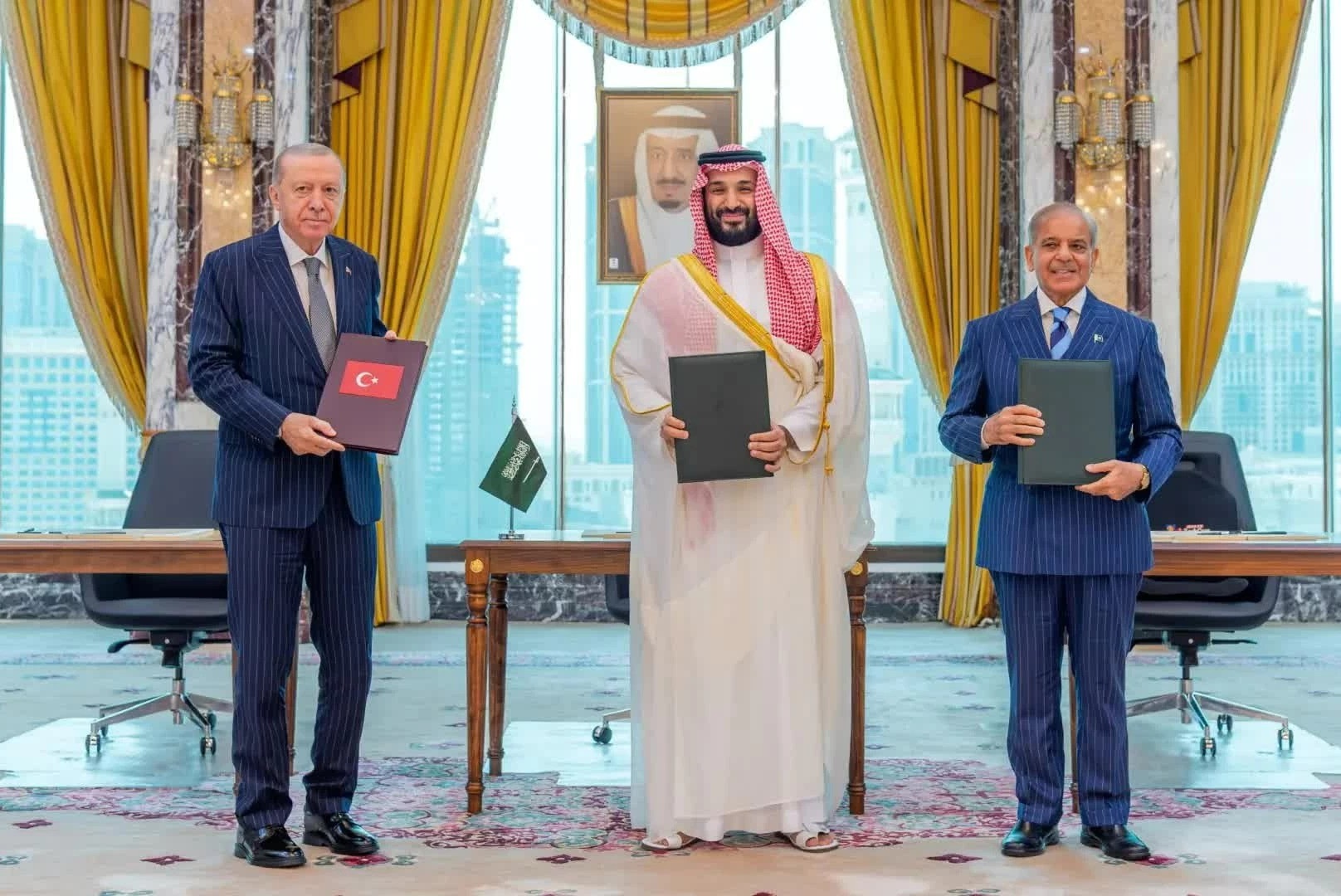
Meanwhile, the conclusion of the trilateral joint defense treaty between Saudi Arabia, Turkey, and Pakistan in Mecca is considered a turning point in the transition from the old order. This strategic agreement, which is based on an explicit commitment to “mutual defense,” demonstrates Riyadh’s practical departure from Washington’s umbrella of support and an effort to urgently rebuild regional deterrence.
The formation of the Mecca Security Triangle should be seen as a direct reflection of the rupture in the traditional defense doctrine of the Persian Gulf. The core of this pact has a similar interpretation to Article 5 of the NATO Charter; in that any military attack on the territory or territorial integrity of any of the signatories is considered a direct aggression against all members and will result in a unified armed, diplomatic, and operational response.
This passive approach is the result of understanding a bitter reality in Riyadh: expensive Western weapons without structural support and tangible field deterrence have not been able to guarantee the security of the kingdom against the erosion caused by regional battles.
Therefore, the Mecca Pact attempts to create a new structure for regional stability by synergizing the complementary capacities of the three Muslim countries. Saudi Arabia puts its huge financial capital and diplomatic credibility on the balance sheet; Turkey covers it with its military-industrial infrastructure, tactically and combatively; And Pakistan, relying on its nuclear deterrent capacity, holds the upper hand in the strategic balance. The nexus between Arab wealth, Turkish military industry, and South Asian nuclear power is, in fact, Riyadh’s attempt to escape security isolation and build a defensive armor at a critical juncture in West Asia’s developments.

The deeper roots of this change in behavior must be sought in the gradual decline of trust in America’s security commitments. In recent years, and especially with the acceleration of the absurd and brutal aggressions of the American terrorist army and the Zionist regime against Iran, the House of Saud has realized in practice that Washington is no longer willing to pay the direct costs of protecting the absolute security of its regional allies.
With the White House’s strategic priorities shifting toward containing China in the Indo-Pacific, the classic doctrine of “oil for security” has officially lost its historical function. International analysts, including Nawaf Obaid, believe that the Mecca coalition marked the end of America’s security engineering in West Asia and is evidence that Riyadh has been forced to redesign its survival engineering, regardless of Washington’s will.
The confusion resulting from this major step by Riyadh was reflected in diplomatic uncertainty and the White House's initial silence. Among Western observers, two conflicting narratives have emerged in analyzing this event: a group, such as Harlan Ullman, sees this step as a clear sign of the decline of America’s military and political credibility in the region and as a salvo in unipolarity. On the other hand, analysts such as Asli Aydintasbaş believe that Washington may view this convergence as a form of “burden sharing”; a process that, if not at odds with the West’s overall interests, could reduce the burden of US military concentration and facilitate the gradual withdrawal of American forces from regional quagmires.
In conclusion, the Mecca Pact is more than a temporary maneuver; it is the beginning of a transformation in Saudi Arabia’s security self-awareness. Recognizing its inability to rely solely on the West and facing field failures in maintaining sustainable security, Riyadh has based its decisive strategy on building deterrence locally through regional alliances.
Although the continuation of this alliance depends on the stability of relations between the three countries, its formation was the end of America’s dream of regional hegemony. Accordingly, this step marks the beginning of a new chapter in the West Asian equations; a chapter in which Saudi Arabia tries to compensate for its inability to be self-sufficient in security by depending on a new front of powers.
