

US Infrastructure in Erbil Has Been Almost Completely Destroyed
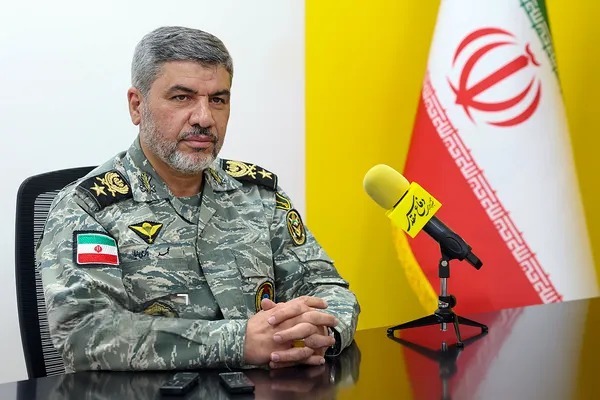
TEHRAN (Defapress) - Brigadier General Mohammad Akraminiya, spokesman for the Iranian Army of the Islamic Republic of Iran, outlined last night (Saturday) on the IRIB program the dimensions of the Army's recent operations against the United States. He stated: "The Zionist regime, in collusion with the United States of America, imposed a war on the Islamic Republic of Iran on February 28 of last year and violated our country's land and territorial waters, but none of the objectives defined for this war were achieved."
Enemies' Declared and Hidden Goals Were Not Met
He stated that the Americans had put forward the destruction of Iran's nuclear capability, the missile capabilities of the Islamic Republic, and the Resistance Front as their declared objectives, adding: "In the very first days of the war, the U.S. President also demanded Iran's unconditional surrender."
Brigadier General Akraminiya noted: "Today, reviewing the results of this war, it can be declared with certainty that, by divine grace, none of these goals have been realized; a success achieved through the determination of the people, the measures of the Supreme Leader, and the devotion of the nation's sons in the Armed Forces."
Emphasizing that the enemy has been defeated in this war, he stated: "In today's wars, the main criterion for evaluating victory and defeat is the degree to which objectives are achieved. In the past, occupying territory or capturing enemy fortresses might have been the criteria for victory, but today, the methods of war, the tools of war, and the evaluation criteria have changed, and achieving political and field objectives is considered the main indicator."
The Army spokesman added: "Neither the enemy's political objectives nor its field objectives were achieved. The Americans tried to draw people into the streets and create dissatisfaction to lay the groundwork for overthrowing the system, but the people stood by the system and country, supported the Islamic Republic, and disrupted the enemy's equations."
Referring to the continued public support for the Islamic Republic system, Brigadier General Akraminiya said: "Tonight marks the 147th night of the people's presence and support for Iran, and this resistance shows that the enemy has failed to achieve its goals."
Pointing to recent operations by the Army of the Islamic Republic of Iran against U.S. positions in the region, he stated: "In the field, we have inflicted very serious damage on U.S. infrastructure and bases in the region, losses that are undeniable, even though the Americans impose strict censorship on news releases regarding them."
The Army spokesman recalled: "Just as was observed in the 12-day war, news related to the damages inflicted on the U.S. was released with a delay and trickle out, and in the future, further dimensions of these losses will be revealed."
Regarding the operations of the past 15 days, Brigadier General Akraminiya said: "After the Americans breached their commitments and attempted to create a fake and illegal route in the Strait of Hormuz, the Islamic Republic of Iran took action to restore its rights within the framework of existing understandings and responded to the aggressions committed."
He added: "In these operations, the Army of the Islamic Republic of Iran targeted U.S. bases in three countries, Jordan, Kuwait, and Bahrain, which are among its most important bases in the region."
U.S. Strategic Investments in the Region Targeted
Referring to the expansion of U.S. military infrastructure in the region following the 2003 Iraq War, the Iranian Army spokesman stated: "After that war, the Americans made extensive investments, particularly in Kuwait and other regional countries, to maintain strategic control over the region."
He continued: "The U.S. Fifth Fleet base in Bahrain was one of its most important maritime control centers, especially for managing developments in the Strait of Hormuz; today, however, virtually no trace of this base remains, and it has been rendered operationally useless."
Referring to the outcomes of recent Armed Forces operations against the U.S. in the region, Brigadier General Akraminiya said: "In addition to inflicting damage on U.S. infrastructure and bases, the Islamic Republic of Iran also succeeded on the battlefield in thwarting the execution of U.S. operations."
He stated: "Timely operations by the Armed Forces at U.S. bases in the region, including several sorties by the Army Air Force in Kuwait, Qatar, and Erbil, Iraq, as well as operations by the Army's kamikaze drones and missile and drone strikes by the Islamic Revolutionary Guard Corps (IRGC), led to the halting and alteration of the U.S. strategy in the region."
U.S. Admission to Arming Anti-Revolutionary Groups in the Kurdistan Region of Northern Iraq
Referring to statements by the U.S. President, the Army spokesman added: "The U.S. President also admitted that they had provided a significant volume of weapons to anti-revolutionary groups stationed in Erbil to conduct ground operations against the Islamic Republic of Iran."
Brigadier General Akraminiya continued: "Today, these groups are practically paralyzed and lack the capacity to conduct operations. The current situation is not only contrary to U.S. predictions, but has resulted in a highly unfavorable condition for the country."
Stating that heavy damage has been inflicted on U.S. bases in the region, he asserted: "The majority of these bases no longer have the operational capacity to carry out past missions, and this issue is particularly evident in Erbil, Iraq."
The Army spokesman said: "In Erbil, almost all American infrastructure has been destroyed, and anti-revolutionary groups have lost their ability to operate."
Brigadier General Akraminiya further emphasized that the U.S. still possesses extensive military capacity, stating: "The Americans have abundant equipment and numerous bases in the region, Southern Europe, and the Mediterranean, and they are trying to compensate for and replace the damages incurred using these capacities."
He added: "The Armed Forces of the Islamic Republic of Iran are also fully prepared to continue their operations as before if the war persists, until the U.S. reaches the conclusion that it cannot impose its will on the Iranian nation through aggression and the use of military force."
Regarding developments in the Strait of Hormuz, the Army spokesman said: "The Islamic Republic of Iran has repeatedly declared that the Strait of Hormuz will not be opened through war, malice, and aggression, nor will conditions return to the pre-war state."
He stressed: "The Strait of Hormuz can only return to normal conditions within the framework of Iranian order and with U.S. respect for this order, and this is a reality that the U.S. must accept."
Satellite Imagery and Field Intelligence Confirm Widespread U.S. Losses
Brigadier General Akraminiya, referring to existing documentation on the outcomes of recent Armed Forces operations, said: "Satellite imagery continuously received and analyzed, alongside field intelligence gathered from regional countries, shows that the damage inflicted on U.S. bases and infrastructure has been extensive, and its defense capabilities in the region have been severely damaged."
The Army spokesman announced the deployment of a new generation of kamikaze drones in recent operations, stating: "Arash-2 drones were used in these operations, but at the end of the 40-day war, new drones were also unveiled, the specifications of which will be announced at an appropriate time."
He added: "Currently, the Armed Forces are utilizing drones even more advanced than the Arash-2, possessing greater destructive power, higher precision, and longer operational ranges."
The Army spokesman clarified: "So far, the technical specifications of these new drones have not been officially released, and details will be shared when appropriate."
Describing the coordination between the Army and the IRGC in executing recent operations, Brigadier General Akraminiya said: "There is both a division of labor and complete coordination between the Iranian Army and the IRGC; both military organizations design and execute their operations in a coordinated manner under the command of the Central Headquarters of Khatam al-Anbiya (PBUH)."
He added: "Before executing any operation, required intelligence is fully gathered, and bases and centers that play an effective role in supporting or carrying out enemy operations are meticulously monitored and identified."
The Army spokesman continued: "After completing the identification process, operational targets are determined by the Khatam-al Anbiya Central Headquarters and divided between the Army and the IRGC according to their missions, and each force executes its operation based on its assigned task."
The U.S. Lacks a Clear Strategy to Continue or Exit the War
Evaluating recent regional developments, Brigadier General Akraminiya stated: "The war initiated by the U.S. has reached a stage where Washington appears to lack a clear strategy both for continuing it and even for exiting it."
He added: "From the perspective of the Islamic Republic of Iran, the Americans neither had a proper strategy to initiate and manage the war, nor have they designed a strategy to end it, and they are now in a state of desperation."
Contradictory Positions of the U.S. President Signal Confusion
Brigadier General Akraminiya pointed to statements by the U.S. President, saying: "There is ample evidence of this situation, including the fact that the U.S. President adopts contradictory positions at various points, reflecting confusion and the lack of a coherent strategy in managing this war."
Stating that the war has had widespread consequences for the region, the U.S., Iran, and other regional countries, the Army spokesman said: "In the short term, this war has caused insecurity, economic stagnation, and economic problems in the region, the effects of which are clearly visible in the oil market, stock markets, and other economic indicators."
He emphasized: "Of course, the effects of this war are not limited to the economic sphere; it has also brought broad geopolitical and security consequences, affecting the standing of the U.S., Iran, and other regional nations, as well as the balance of power in West Asia."
Brigadier General Akraminiya highlighted the weakening of regional security frameworks as one of the most critical outcomes of the war, saying: "Both bilateral U.S. defense and security pacts with regional countries and mechanisms like the Persian Gulf Cooperation Council (GCC) have been severely weakened by this war."
Referring to developments in the international system, the Army spokesman stated: "Following the collapse of the Soviet Union in 1991, the U.S. claimed the formation of a unipolar order led by itself; however, events such as the September 11 attacks, the 2003 Iraq War, and subsequent developments showed that this claim lacked practical backing."
He added: "In recent years, various scholars and think tanks have increasingly spoken of the emergence of a multipolar order and multilateralism, and the recent war appears to have accelerated this process."
Brigadier General Akraminiya affirmed: "The current situation facing the U.S. shows that the balance of power in the region, and even in the international system, is shifting, and the standing of the U.S. vis-à-vis major powers like China and Russia has weakened."
Even European Allies of the U.S. Did Not Support This War
Pointing to the reaction of Washington's Western partners, he stated: "Even the European allies of the U.S. did not support this war, and the North Atlantic Treaty Organization (NATO) practically provided no assistance to Washington, as they did not view this war as logical or rational."
The Army spokesman continued: "This war was shaped on incorrect calculations and false assumptions, and by starting it, the U.S. essentially laid the groundwork for the erosion of its own international position."
The U.S. Will Suffer from Strategic Consequences of the War
Brigadier General Akraminiya stressed: "The transition to a new international order will continue with greater momentum in the future, and both the region and the international system will move further toward a multipolar order, a trend that, in his view, will ultimately be most detrimental to the United States."
Operational Targets Determined Based on Intelligence and Impact on Enemy Actions
Detailing the target selection process in Armed Forces operations, the Army spokesman said: "Targets are selected based on operational requirements and the impact of each location on enemy actions."
He added: "The point from which the enemy launches missiles, deploys drones, or conducts air operations against the Islamic Republic of Iran is evaluated as an operational priority at that moment, and decisions are made based on available intelligence."
Brigadier General Akraminiya emphasized: "Operations begin with intelligence; information is first gathered and processed, after which targets are set. These targets are placed in a database and targeted at the appropriate time according to priority."
Referring to certain operations announced during the war, Brigadier General Akraminiya stated: "We reported on a portion of the operations during the war, including an attack by the Iranian Army Air Force F-5 fighters against Camp Buehring in Kuwait."
Describing the operation as an astonishing and courageous act, he said: "This operation was carried out by the heroic pilots of the Iranian Army Air Force, and its report was published and witnessed by our dear people."
Strike on the U.S. Helicopter Base in Kuwait
Pointing to the significance of the Camp Buehring, the Army spokesman stated: "This base was a massive helicopter hub housing approximately 250 American helicopters."
He added: "Following this operation, initial reports from our pilots on the scene, as well as subsequent satellite data, showed that significant damage was inflicted on these helicopters."
Brigadier General Akraminiya continued: "This operation caused widespread confusion among the Americans, to the extent that the Kuwaitis mistakenly targeted three of their own fighters."
Complex Iranian Army Air Force Operation Piercing Enemy Defense Layers
Regarding the features of this operation, he said: "It was highly complex, as our pilots had to design the entry route, the approach to the target, the execution of the strike, and the exit from the area in such a way that the enemy could not engage them despite its extensive equipment."
The Army spokesman noted: "This operation remains a landmark in terms of design and execution, and I believe military academies around the world will study and teach it as a case study in the future."
Destruction of Terrorist Groups' Infrastructure in Erbil
Referring to Army Air Force operations in Erbil, Iraq, Brigadier General Akraminiya said: "Several sorties were conducted by Army Air Force fighters in that region, targeting the bases of terrorist groups."
He added: "In these operations, the combat structure of hostile groups suffered severe damage, and their infrastructure was destroyed."
