
Terrorist U.S. Navy’s Retreat to Alfred Mahan's Theories
TEHRAN (Defapress) - The U.S. Navy is bringing back one of the oldest and most controversial concepts of naval warfare, the “battleship,” or the heavy warship that was once considered a symbol of American naval power.
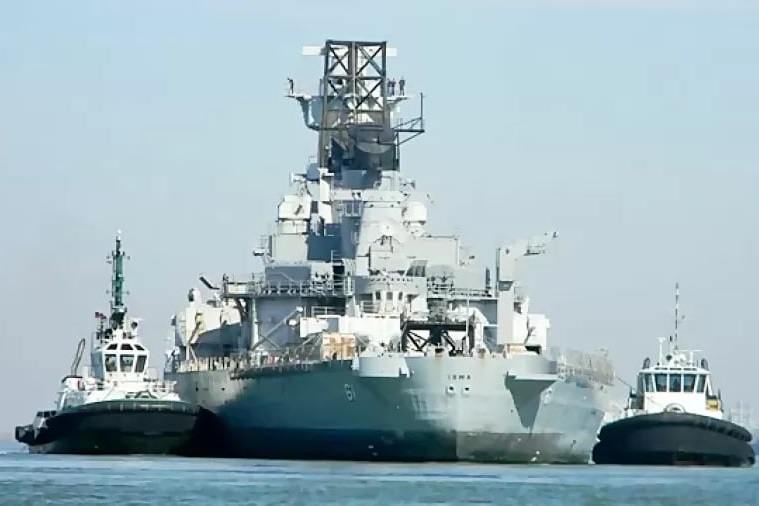
According to this report, Washington has decided to bring into service a new generation of massive warships with modern technologies and nuclear propulsion, a project known as the “Trump” class.
The story of putting these massive warships into service began last December, when Donald Trump announced that the U.S. Navy intends to build a new class of combat vessels weighing 30,000 to 40,000 tons. This decision was in effect a revival of the battleship concept, a concept that had been almost abandoned after the Iowa-class battleships were decommissioned.
The announcement of this project brought mixed reactions in US military and media circles. Many analysts described the plan as very expensive and even unnecessary. Critics believed that the era of heavy battleships was over and that today long-range missiles, submarines, and drones play a more decisive role in naval warfare. However, supporters of this project say that the United States is returning to the ideas of the famous sea power theorist Alfred Mahan, who believed that victory at sea would be possible only through a large, powerful, and numerous fleet.
The report continues that the idea of building such vessels is actually not a new one, and the US Navy has been studying it for years. Ben Reynolds, the Deputy Assistant Secretary of the US Navy for Budget, recently said that Washington has long sought to design a much larger and more powerful surface combatant than the current destroyers.
According to the US Navy, the new warships are supposed to perform a range of key missions, from air and missile defense of an aircraft carrier group to commanding fleet operations, anti-submarine warfare, surface combat, and even conducting strategic strikes with long-range hypersonic missiles.
One of the most important uncertainties about the project was its type of propulsion. In January, Admiral Daryl Caudle, the US Navy’s chief of staff, said that a nuclear reactor would probably not be used to accelerate the construction of the first vessel. But now it has become clear that the final decision has changed.
The US Navy has announced in its latest 30-year fleet development plan that the Trump-class battleships will be equipped with nuclear propulsion, and 15 of them will be built by 2056. This number is, of course, less than Trump’s initial promise of building 25.
The US military has cited the need for long operational range, long endurance at sea, and the energy supply required for advanced weapons systems as the reason for choosing nuclear propulsion. According to Navy commanders, these vessels are not intended to replace destroyers, but rather to create a powerful command center and a platform for carrying heavy firepower on the battlefield.
Admiral Caudle provided more details at the congressional hearing, saying that a significant part of the technologies of this battleship are taken from the Ford-class aircraft carriers. The most important part of it is the A1B nuclear reactor; the same system that is installed on the latest US aircraft carriers.
According to him, the use of this reactor will allow the ship to operate in the Pacific Ocean, which is three times larger than the Atlantic Ocean, for a longer period of time without the need for refueling. This is especially important in the context of the growing competition between the United States and China in the Indo-Pacific region.
In terms of armament, it will also be one of the heaviest combat ships in the world. According to published information, the warship will be equipped with an advanced SPY-6 radar and will have 128 Mk41 vertical launch cells; a system that will allow the launch of various types of defensive missiles, Tomahawk cruise missiles, and even future US naval nuclear missiles.
In addition, hypersonic missiles, electromagnetic cannons, and laser weapons will also be part of the equipment of the ship. In such a combination, even the traditional 127 mm cannons of the ship are almost marginalized.
Finally, the cost of bringing a new generation of super-large warships into service is also very high. The US Navy expects the first ship of this class to begin construction in 2028 and cost about $17 billion. The second ship will cost $13 billion, and the third unit will cost about $11.5 billion.
