
Octagon: A Symbol of Egypt's Military Ambition in the New Era
TEHRAN (Defapress) - The inauguration of Egypt’s new strategic command building, known as the Octagon, in the new administrative capital east of Cairo is not just the exploitation of a military complex; it also represents a new stage in Cairo’s strategy to enhance command capabilities, increase combat readiness, and consolidate its position as one of the influential military powers in West Asia.
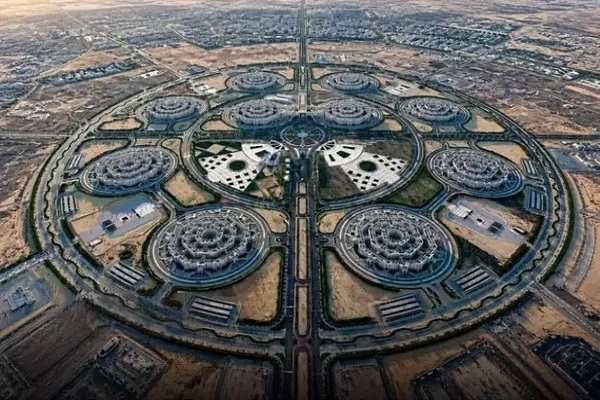
The building complex, which was inaugurated in the presence of President and Commander-in-Chief of the Egyptian Armed Forces, Abdel Fattah al-Sisi, will serve as the country’s new strategic command headquarters. Egyptian officials describe the Octagon as the largest military command and control complex in the region, a center that will coordinate between the various branches of the armed forces and government institutions by utilizing advanced command, control, communications, crisis management, and new technologies.
On the other hand, the Octagon was built in the heart of Egypt’s new administrative capital and consists of eight interconnected main buildings; A design that also inspired the name of the complex. According to published information, in addition to housing the General Command of the Armed Forces, the center will also serve as a national operations room for crisis management, coordination between security agencies, and decision-making in emergencies.
However, the inauguration of the new building of the Egyptian Strategic Command Octagon can be considered part of the Egyptian army's modernization project over the past decade. In recent years, Cairo has made significant investments in the development of military infrastructure, purchasing advanced equipment, strengthening the navy, air force, and defense, and upgrading command and information systems. These measures show that Egypt is trying to adapt its military structure to modern command models and network-based battles.
However, if we examine and investigate the project of opening the new building of Egypt's Strategic Command Octagon more deeply and meticulously, we find that Egypt's action in constructing and opening this building complex is, in fact, an intelligent and timely response to the complex security environment surrounding the country. Because the rapid developments in the region, from the war in Gaza and instability in Libya and Sudan to security threats in the Red Sea and the Eastern Mediterranean, have caused Cairo to focus more than ever on increasing its strategic preparedness.
Accordingly, it should be said that the opening of the new building of Egypt's strategic command, known as the Octagon in the new administrative capital in eastern Cairo, is part of Egypt's efforts to increase the speed of decision-making and response to security developments around it. In fact, we should point out that by opening this building complex, Cairo is seeking to create a center so that, if necessary, it can carry out information, command, and crisis management in an integrated manner in this center.
But the inauguration of the new Egyptian Strategic Command building, known as the Octagon in Cairo, in addition to its military function, also carries a political message. In fact, this project indicates Egypt's desire to demonstrate its defense capabilities and consolidate its position as one of the main players in regional security. In addition, the establishment of the strategic command headquarters in the new administrative capital is also part of the plan to transfer the centers of governance to this city and create modern infrastructure for the country's administration.
In summary, we must say that the Octagon can be seen as a symbol of a new stage in Egypt's defense policy. A policy that is based on the development of command infrastructure, increased coordination between the armed forces, the use of new technologies, and strengthening deterrence against regional threats.
Of course, we must also pay attention to the very important issue that although the practical impact of this project on the balance of power in the Middle East will be determined in the long term and in light of the security developments in the region, there is no doubt that the inauguration of this complex is one of the most important steps for Egypt on the path to modernizing its military structure.
Now, the question arises whether the Octagon is invulnerable to possible attacks? The answer is no. Because even though Egyptian officials introduce the Octagon as one of the most advanced military command and control centers in the region, military experts believe that no fixed command center can be considered completely immune from new threats.
The reason for this invulnerability is also certain because the concentration of strategic command, communications, and operations management in a large complex, while increasing coordination, can make this center one of the valuable targets to target in the event of a military conflict.
Finally, although the Octagon can be considered a symbol of the Egyptian military's power and modernization, like any other strategic infrastructure, its effectiveness in critical situations will depend not only on the technology and fortifications of the complex but also on the overall command architecture, organizational flexibility, and the ability to maintain continuity of operations against a range of potential threats.
