

Yemen's Ansar Allah's Undisputed Sovereignty Over the Bab al-Mandab Strait with the Conquest of the Strategic Island of Prim
TEHRAN (Defapress) - The Yemeni Ansar Allah movement has fundamentally changed the geographical and military landscape of the region with a sudden attack. The world press reported with astonishment that the Ansar Allah units had launched a rapid offensive and had completely captured a large area of Yemeni territory and, most importantly, the Bab al-Mandab Strait.
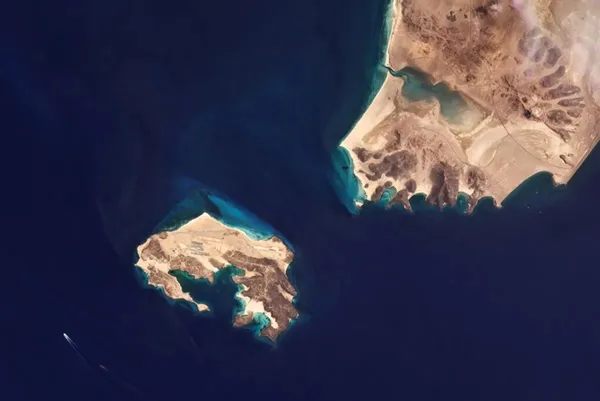
World media sources confirmed the Ansar Allah movement's control over the entire western coast of Yemen, including the island of Prim. According to reports, the areas captured by the movement in the past few days exceed 4,200 square kilometers.
From a military perspective, Ansar Allah took crushing revenge on Saudi Arabia and its mercenaries inside Yemen; Few people today remember that Saudi mercenaries inside Yemen, relying on Saudi air support in 2017-2018 and during Operation Golden Arrow, systematically took control of almost half of the Red Sea coast, including cities such as Khis, Al-Hawkha, and the mountainous region of Jabal al-Habashi. Now what the Emirati and Saudi coalition had achieved with great difficulty over nearly two years was captured by Ansar Allah in just a few days.
Currently, Ansar Allah units control the entire western coast of Yemen, but without the slightest doubt, the key point captured by Ansar Allah is Prim Island. This small piece of land with an area of only 13 square kilometers separates the Red Sea from the Gulf of Aden in the Arabian Sea on the one hand, and divides the waterway of the Bab al-Mandab Strait into two unequal parts on the other. The large strait, or Dact-el-Mayun, is 20 kilometers wide and is limited to the coast of Djibouti in the west. The small strait is also called Bab Iskander and is a relatively narrow passage three kilometers wide between the island itself and the Yemeni coast.
Whoever controls the island has control over all shipping in the Bab al-Mandab Strait. To do this, it is enough to deploy a few fixed or mobile firing points equipped with drones or other weapons in the bay. Western military publications have previously written that even one or two barrel artillery shells can ensure the complete blockage of the Bab al-Mandab Strait, let alone missile systems capable of targeting any vessel minutes after firing. The possibility of laying naval mines and using USVs should not be ruled out. If the Emirati and Saudi mercenaries, who currently control only about a third of Yemeni territory, do not change the situation, the main key to opening and closing the strait will remain in the hands of Ansar Allah.
Even if Ansar Allah of Yemen does not continue its advance and merely consolidates its presence in the occupied areas, it will deal a heavy blow to the transportation of Saudi oil and oil products, and it will also question the efficiency of the northern transit route to the Suez Canal and then to Europe.
Also, during its advances in southern Yemen, the Ansar Allah movement of Yemen did not forget its attacks on Saudi Arabia. It targeted the key Saudi East-West oil pipeline that provided the transportation of crude oil and products to the port of Yanbu.
After targeting this pipeline, if the Ansar Allah movement also blocks the Bab al-Mandab Strait, the situation of one of the main US allies in the region will be severely complicated. On the other hand, a series of reports have been published in the American press claiming that Mohammed bin Salman has apparently asked Donald Trump to send the US Navy to enter the war between Yemen and Saudi Arabia and participate in attacks against Ansar Allah. Neither side has commented, but American journalists claim the White House has responded negatively to the Saudis.
The victories of Iran and Yemen clearly signal a changing reality in the world; a world in which control of traffic routes is more important than possession of resources. The Bab al-Mandab Strait is not only used for oil exports, but it is also the most important transit route that allows 80 percent of the liquefied natural gas produced in West Asia to be transported to Europe via the Suez Canal. Since Ansar Allah entered the regional war in Iran, maritime traffic in the Red Sea has decreased so much that in a few months, Egypt’s income as operator of the Suez Canal has fallen by 60 percent, and the Egyptian budget has experienced a deficit of more than seven billion dollars.
The simultaneous control of the Straits of Hormuz and Bab al-Mandab by Iran and Yemen could complete Trump's oil nightmare and present the US President with unprecedented trouble on the eve of the midterm elections.
