
Turkey and India: Factors of Distance and Possibility of Closeness
TEHRAN (Defapress) - Alexander Grigoriev, researcher and analyst of international issues: Last year, one of the think tanks in Ankara held a conference on Turkish-Indian relations for the first time, which was attended by experts and officials from both countries. The atmosphere at the conference was quite optimistic; officials from both countries emphasized the historical and cultural commonalities, referring to India's support for Turkey in the "War of Independence" and the existence of common words in both languages, such as "hava" meaning weather and "kısmet" meaning fate.
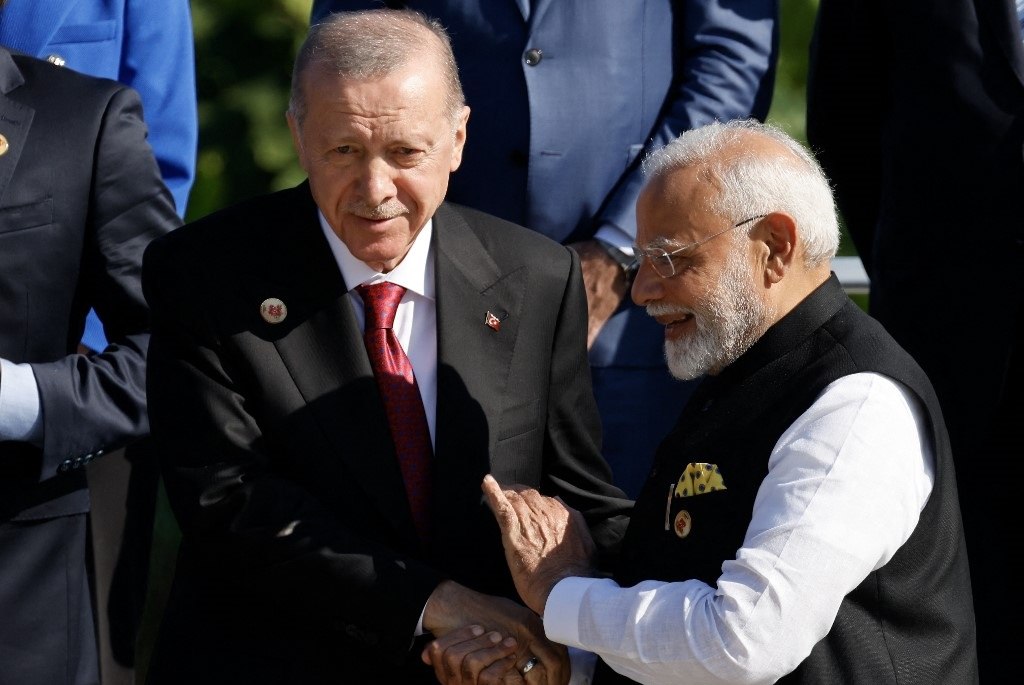
The conference aimed to strengthen bilateral relations, which have had a very unbalanced trend. As growing economies and emerging powers, both countries are expanding their bilateral trade despite the neutral political relations resulting from their leaders’ positions. However, Erdogan’s close ties with the Muslim world and Pakistan are in no way compatible with the deep partnership between India and the Zionist regime pursued by the prime ministers of both sides.
The conference was reportedly so successful that it caused concern in Islamabad, according to several sources. But soon after, everything changed.
Last year’s terrorist attack in Kashmir, which cost the lives of 26 people and the subsequent India-Pakistan clashes, forced Ankara to make an entirely predictable choice.
Tensions in India-Turkey relations increased after Ankara verbally supported Pakistan against India’s Operation Sandur, which targeted facilities linked to radical groups in the Pakistani part of Kashmir. Indian media portrayed Turkey as an enemy and accused it of sending military equipment and reinforcements to Islamabad. Ankara claimed that there was no additional aid and that the long-standing defense ties between the two countries were clear. Turkey and Pakistan have had a decades-long military partnership and consider each other strategic allies.
Ankara called for a joint investigation to uncover the truth about the Kashmir attack and expressed solidarity with its “Pakistani brothers.”
As criticism of Turkey mounted in the Indian media, a wave of tourism sanctions and campaigns against Turkish companies emerged. In New Delhi, the operating license of the Turkish company Celebi Airport Services India, which served nine airports, including Delhi, Mumbai, and Bangalore, was revoked on the pretext of national security concerns. Air India also announced plans to reduce its dependence on the Turkish company Teknik for the maintenance and repair of its wide-body aircraft.
According to the Turkish Ministry of Culture, the number of Indian tourists in 2025 decreased by 25% from 330,000 to 250,000.
This “freeze” in relations between the two countries lasted about a year, after which a “relative warming” occurred. Last April, the Indians unexpectedly invited Turkey to the 12th round of foreign policy consultations. Ankara sent Deputy Foreign Minister Berenice Ekinci as the head of the accompanying delegation to the meeting. According to Turkish officials, the visit went very well, and the parties expressed interest in maintaining a constructive dialogue.
One of the factors that contributed to the resumption of negotiations was Turkey’s decision last year not to react to some emotional statements by Indian parliamentarians and the restrictions imposed.
According to sources in Ankara, after the start of the regional war with Iran, India began to think more seriously about the reliability of transit routes. In 2023, the Modi government floated the concept of the India-West Asia-Europe Economic Corridor (IMEC), which would connect to the UAE by sea and then pass through Saudi Arabia, Jordan, and Israel by land. Ankara saw the project as an attempt to bypass Turkey and supported a rival Iraqi proposal called the “Development Road.” Since 2023, as tensions between the UAE and Saudi Arabia have increased, the IMEC project has been shrouded in uncertainty.
Meanwhile, Turkey is positioning itself as a key player in the “Middle East Corridor” (connecting East Asia to Europe via the Caspian and Caucasus). Indian officials have said they are interested in new connectivity projects, including this ambitious one, to diversify trade routes.
However, the main challenge in the relationship between the two countries is that Turkey has insisted on its position on the “Kashmir issue,” believing that India has illegally controlled the Muslim-majority region and that Kashmiris should be given the right to self-determination through a referendum. Recep Tayyip Erdogan refused to mention the issue in his speech to the UN General Assembly in 2024, in a symbolic move to appease India. But last year’s crisis led to a change in the Turkish leader’s official stance. "We call for a solution to the Kashmir issue through dialogue, based on UN Security Council resolutions and the aspirations of our Kashmiri brothers and sisters," Erdogan said at the 80th UN General Assembly.
Indian officials believe that if Ankara moderates its public stance on the issue and adopts a more balanced and diplomatic approach, it could help to make the dialogue more active. Currently, the possibility of exchanging visits at higher levels is being considered, but there is a long and winding road ahead before full normalization of relations.
