
Trump’s Cat-and-Mouse Game with Havana
TEHRAN (Defapress) - Donald Trump’s contradictory statements about Cuba have raised serious questions among political analysts. On Tuesday, the US President announced at the White House that Cuba “will contact us” and that Washington is ready to “help” the country. He even said that there is no need for regime change in Havana and that “I can help them whether the regime changes or not.” These statements come just a day after the US Treasury Department imposed new sanctions on 11 high-ranking Cuban political and military officials, as well as institutions such as the National Police, the Ministry of the Interior, and the Cuban Intelligence Service.
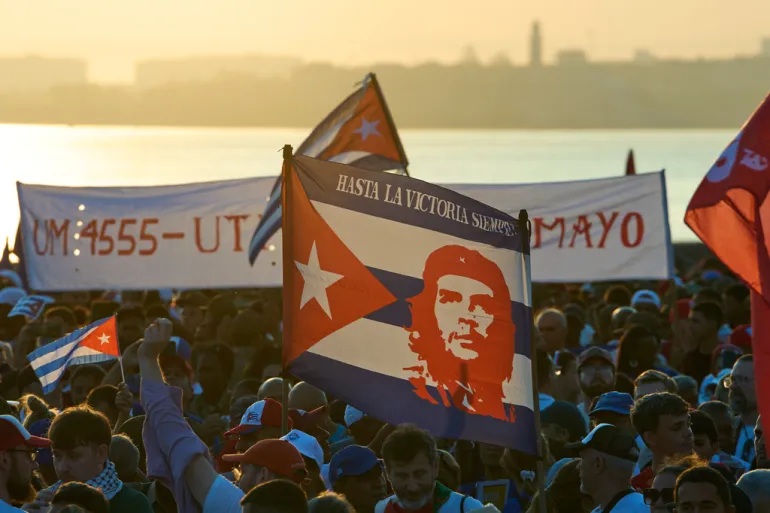
In practice, Washington is pursuing two seemingly contradictory strategies at the same time: on the one hand, maximum pressure through an energy blockade and targeted sanctions, and on the other, a willingness to talk. Trump directly referred to Cuba’s severe energy crisis, saying: “They can’t even turn on the lights, they have no food. This country really needs help.” According to the Cuban electricity company, up to 59 percent of the country was without electricity during peak hours on Tuesday, and last week, a record 70 percent blackout was recorded. Experts believe that fuel shortages caused by the US oil embargo, the failure of eight power plants, and a reduction in Venezuelan oil shipments are the main factors in the collapse.
Cuban President Miguel Diaz-Canel has called the new sanctions “collective punishment” and “genocide” and stressed that none of the Cuban officials have assets under US jurisdiction. He accused Washington of waging “all-out economic warfare” aimed at creating social discontent and political change in Havana. However, Trump, relying on the strong vote of the Cuban-American community in Florida, has continued his policy while seeking to reduce Chinese influence on the island. Beijing has invested in solar energy projects and telecommunications infrastructure in Cuba in recent years, while Trump wants Havana to move out of China’s orbit and back towards Washington.
Behind the scenes, the US Department of Justice is considering filing a lawsuit against Raúl Castro for the shooting down of the Brothers to the Rescue planes in 1996, which is likely to be announced on May 30, the symbolic day of Cuban independence among the opposition. The bottom line is that Trump’s strategy towards Cuba is neither pure reconciliation nor pure confrontation, but “maximum pressure with an offer of liberation,” the same model that was previously implemented in Venezuela. Instead of backing down, Cuba has pursued the purchase of 300 drones from Russia and Iran, and Diaz-Canel has warned that any military attack would lead to a “bloodbath.” What is clear is that the high cost of this conflict is being paid by ordinary Cubans, who are caught in the dark and fuel-poor, in the crossfire of the great powers.
