
Oil Prices Based on Anticipation of Protracted Conflict Despite Fragile Ceasefire
TEHRAN (Defapress) - The ceasefire established between the United States, the Zionist regime, and Iran has initiated a new process. However, the ambiguity in the Strait of Hormuz and the fragility on the ground indicate that the crisis has not ended completely. According to experts, the current situation opens a window towards a more cautious and more costly period in energy markets.
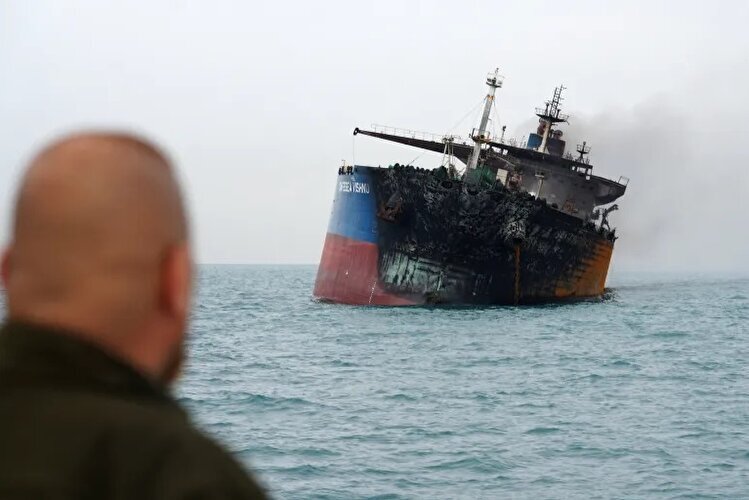
Will the crisis end immediately, even if the Strait of Hormuz is fully reopened?
The ceasefire reached between the United States and the Zionist regime with Iran early Wednesday morning seems to have opened a window to a new process rather than ending tensions in the region. It is expected that, after the ceasefire Pakistan mediated, the parties will return to the negotiating table on Friday, but developments in the field show that this process is still moving on fragile ground.
According to Yediot Aharonot's report, the Zionist regime plans to announce a ceasefire with Lebanon tomorrow. Meanwhile, an Iranian delegation has also left to Islam Abad, Pakistan. There are also reports from Washington that indicate the progress of diplomacy, along with threats. The US government, emphasizing that Iran must open the strait, signals that otherwise, harsher consequences may be on the agenda.
This situation shows that an intermediate period is being experienced in which the parties impose new conditions and redesign their positions. On the other hand, while discussions of the ceasefire continue, the status of the Strait of Hormuz is also at the center of talks, because even if Hormuz is opened, answering the question of how much the global system can return to its previous state is still very difficult.
The bottleneck of the global energy system: Hormuz
The Strait of Hormuz remains one of the world's most vital chokepoints for energy trade. According to international energy data, approximately 20 million barrels of oil are transported through this narrow passage daily. This amount is equivalent to roughly one-fifth of the world's oil supply. Similarly, with 250-275 thousand tons of LNG carried daily, a significant part of the global gas trade also depends on this passage.
This density has turned Hormuz into not just a regional transit point but also a fault line of the global economic system. Given the energy dependence of Asian economies, any disruption in the strait directly affects the global trade chain.
Professor Murat Aslan, a faculty member at Ankara Yıldırım Beyazıt University, draws attention to the fact that this situation must be examined not only in terms of volume but also capacity. He states that in a strait that operates with limited capacity even under normal conditions, the number of ships that can be allocated to energy transport is limited to approximately 80-90 per day.
Considering the backlog of approximately 800 ships that accumulated in the region during the war, with the existing capacity, it is technically impossible to eliminate this accumulation quickly. Likewise, calculations made solely based on physical transit capacity show that this process will extend not over weeks but over a longer period.
According to Aslan, Hormuz is vital because of the volume it carries, but it is linearly limited in terms of capacity. For this reason, even a small disruption can turn into a bottleneck that affects the entire system.
How did markets read the ceasefire?
In the early days of the crisis, oil markets reacted sharply. Brent oil prices rose to $120, while some transactions in physical markets approached $150. After the ceasefire news, prices quickly fell to $93.
But this decline was not sustained. The market soon trended back to the $95-100 range. This volatility shows that prices are shaped not only by the current supply situation but also by the perception of future risk.
Professor Dr. Murat Aslan emphasizes that price movements cannot be explained solely by physical supply reductions. He states that the market is simultaneously pricing in the possibility of a deeper crisis that could arise if the war were prolonged.
When will the Strait of Hormuz return to normal?
The opening of the Strait of Hormuz may not mean the return of energy flows to their previous level in a short time. Because the crisis has not only a political aspect but also technical and logistical ones.
During the war, a backlog of approximately 800 ships has accumulated in the region. Given the strait's existing capacity, it is technically impossible to clear this accumulation quickly. Additionally, there is a need to rebuild the insurance system, re-insure tankers, re-establish commercial contracts, and reactivate damaged port infrastructure.
Professor Dr. Murat Aslan draws attention to the time lag between technical reopening and practical normalization for this reason:
"Although it is not possible to give a definitive timeframe, considering existing capacity constraints and market dynamics, the normalization process is expected to take between 1 and 3 months in most scenarios."
Why are alternative routes insufficient?
The routes proposed as alternatives to Hormuz are far from having the capacity to fully replace global energy flows. The Saudi Arabia East-West pipeline offers a capacity of around 7 million barrels per day, and the UAE pipeline offers around 1.5 to 2 million barrels per day. Even considering these two together, a gap of about 10 million barrels is created in the global market. This magnitude means taking about 10% of global supply out of circulation.
On the natural gas side, the situation is more fragile. The limited alternative routes for natural gas transport increase dependence on Hormuz.
According to Professor Dr. Murat Aslan, this situation is not only a short-term supply problem but also a permanent risk factor. The high dependence of regional LNG exports, primarily from Qatar, on this narrow passage eliminates alternatives in the natural gas market almost entirely.
Is a new energy balance emerging?
The crisis in Hormuz, although a temporary disruption, indicates a shock that could have more permanent effects on the global energy market. The risk premium created in markets directly affects commercial behaviors and supply strategies. The acceleration of major importing countries' search for alternative sources and routes to secure energy suggests that the system may be reshaped.
Professor Dr. Murat Aslan emphasizes that the balance established at the end of this process will be different from the previous system. According to Aslan, the market may reach equilibrium, but this equilibrium will not resemble the previous system. A higher risk premium and a more cautious commercial structure will stand out.
The current situation shows that the ceasefire alone may not be sufficient to end the crisis. Although technically possible to open the Strait of Hormuz, the security risks on the ground, economic fragility, and the strategic objectives of the parties make full normalization of the process difficult in the short term.
For this reason, what is happening stands out as part of a broader process in which the global energy system is evolving towards a more cautious, more costly, and more fragile structure.
