
Hezbollah Unveils New Generation of Asymmetric Warfare: 10,000 FPVs Ready to Fire
TEHRAN (Defapress) - More than a month has passed since the ceasefire agreement between Lebanon and the Israeli regime, an agreement reached through the direct mediation of the Trump administration, and after weeks of heavy fighting on the northern front of occupied Palestine. Although this agreement has led to a reduction in large-scale reciprocal attacks and a halt to direct strikes on major cities on both sides, including Beirut and Tel Aviv, the field reality shows that the battle in southern Lebanon has neither stopped nor entered a phase of lasting stability.
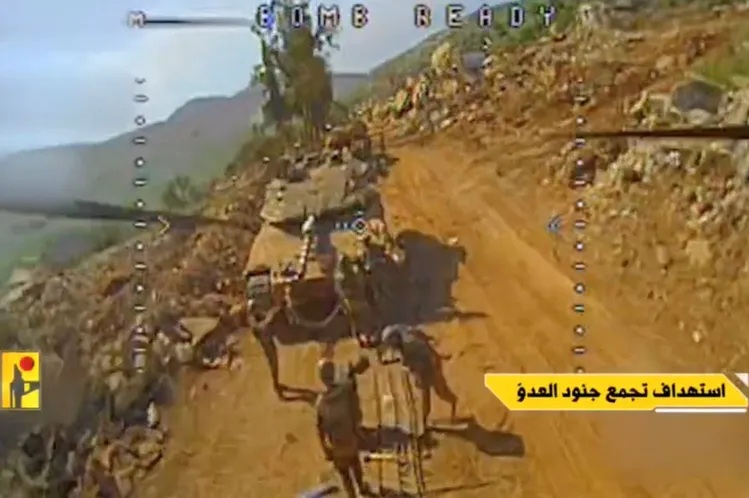
In practice, the nature of the war has changed. What is currently unfolding in the north of the occupied territories is less a classic battle and more a war of attrition, low-cost and based on modern technologies; a war whose main axes are formed by FPV drones, guerrilla operations, and limited but continuous attacks.
Hezbollah's Return to the Guerrilla Warfare Doctrine
Developments in recent months indicate that Hezbollah, after the costly experience of "hybrid warfare," has returned to its traditional model: guerrilla warfare. In past years, Hezbollah had attempted, in addition to maintaining its asymmetric capability, to transform into a classic paramilitary power with an extensive command structure, complex communication systems, and specialized units.
However, the recent war demonstrated that these same centralized structures are highly vulnerable to the Israeli regime's intelligence, drone, and air superiority. The assassination of field commanders, precision strikes on command centers, and complex intelligence operations imposed high costs on Hezbollah and drove this movement towards redefining its military strategy.
Now, field indicators suggest that Hezbollah is pursuing three main axes in its new strategy:
Extensive use of FPV drones equipped with fiber optics.
Return to ambush operations and small, independent units.
Focus on a war of attrition rather than large-scale classic battles.
In effect, Hezbollah is now trying to exert continuous security and psychological pressure on the northern front of occupied Palestine, instead of entering a costly, all-out war.
FPV Drones: The New Challenge for the Israeli Army
Hezbollah's most important tool in this phase of the battle is FPV drones; small, low-cost, and highly precise drones which, especially in versions equipped with fiber optics, have become one of the most complex possible threats for the army of the Israeli regime.
The FPV drones are manufactured in workshops and knowledge-based factories affiliated with the Ministry of Defense of the Islamic Republic, and the fiber-optic model has been delivered to Lebanon's Hezbollah in quantities of tens of thousands. In addition to the FPV drones, the control system and fiber optics for these drones are also Iranian, manufactured in the workshops and factories of the Ministry of Defense.
Unlike conventional drones that are guided via radio waves, fiber-optic drones are controlled through a very thin cable that maintains the connection between the operator and the drone until the moment of impact. This factor has rendered electronic warfare, jamming, and spoofing systems of limited effectiveness against them.
Hebrew media has repeatedly highlighted the difficulty of countering these drones in recent weeks. Some reports even speak of disruptions in some operational and construction activities of the Israeli army in the northern areas, or attempts by Zionist soldiers to collect fishing nets from Israeli port cities to counter these drones; an issue indicating that the FPV threat is not just a limited tactical threat but is gradually turning into a strategic challenge.
Asymmetric Cost-to-Damage Ratio
One of the most important features of FPVs is the low production cost relative to the amount of damage inflicted. Drones, whose manufacturing cost is very low compared to classic military equipment, can target systems and equipment worth millions of dollars.
In recent months, numerous reports have been published about the targeting of Merkava tanks, engineering equipment, communication systems, and some sensitive infrastructure of the Israeli army. Some sources have also reported the destruction of very expensive communication systems in border areas, equipment whose replacement is time-consuming and costly.
The threat of FPV drones has also affected the activities of construction companies affiliated with the Israeli regime, which were tasked with demolishing Lebanese border villages. Concerns over precise drone attacks have led to a reduction in some engineering activities and the movement of heavy equipment, including the D9 military bulldozer, in certain areas.
Israel's Limited Geography and Growing Vulnerability
Unlike vast fronts such as the Russia-Ukraine war, the limited geography of occupied Palestine means drone attacks have a greater operational and psychological impact. The concentration of infrastructure, the limited geographical depth, and the proximity of sensitive centers to conflict lines increase Israel's vulnerability to large-scale FPV attacks.
For this reason, even a limited number of these drones can cause significant disruptions in operational, logistical, and security domains. If such attacks expand, the psychological pressure resulting from continuous insecurity on the northern front could become a major challenge for Tel Aviv.
Change in Israel's Strategy: From Containment to Geographic Change
In response, the Israeli regime has also changed its strategy in recent months. Whereas in the past the main goal was containing border threats, there are now signs of efforts to create permanent changes in the geography of southern Lebanon.
Establishing a buffer zone, widespread destruction of infrastructure, and restricting the return of residents to certain border areas are part of this new strategy; a strategy whose stated goal is to permanently push resistance forces away from the northern borders of occupied Palestine.
However, the experience of asymmetric wars in the region has shown that technological superiority does not necessarily mean the end of guerrilla threats. Asymmetric forces typically try to erode the conventional military superiority of the opposing side through dispersal, flexibility, and the use of low-cost tools.
Southern Lebanon: A Laboratory for the New Generation of Asymmetric Warfare
What is taking shape today in southern Lebanon resembles less a classic battle and more a long-term war of attrition; a war in which limited but continuous attacks, harassment operations, and low-cost drones have replaced large-scale classic battles.
In such conditions, FPV drones are not merely a tactical tool but represent a change in warfare in the region; a change that could influence the pattern of future conflicts in West Asia.
It appears that southern Lebanon has now become one of the most important testing grounds for new-generation warfare; a place where technology, guerrilla warfare, and attrition warfare are simultaneously redefining the balance of power.
