
Asymmetric Epic of the Iranian Armed Forces in the First Week of the Forty-Day Imposed War
TEHRAN (Defapress) - At first glance, the initial results of the operation known as "Epic Fury" were impressive. Early strikes hit IRGC command centers, air defense systems, missile and drone positions, and Iranian airbases. However, as events unfolded, Iran demonstrated that it was not seeking a symmetrical response to the United States. Tehran focused on a vast array of ballistic missiles, cruise missiles, and one-way attack drones, targeting not only Israel and U.S. military installations, but the entire infrastructure of the U.S. presence in the region.
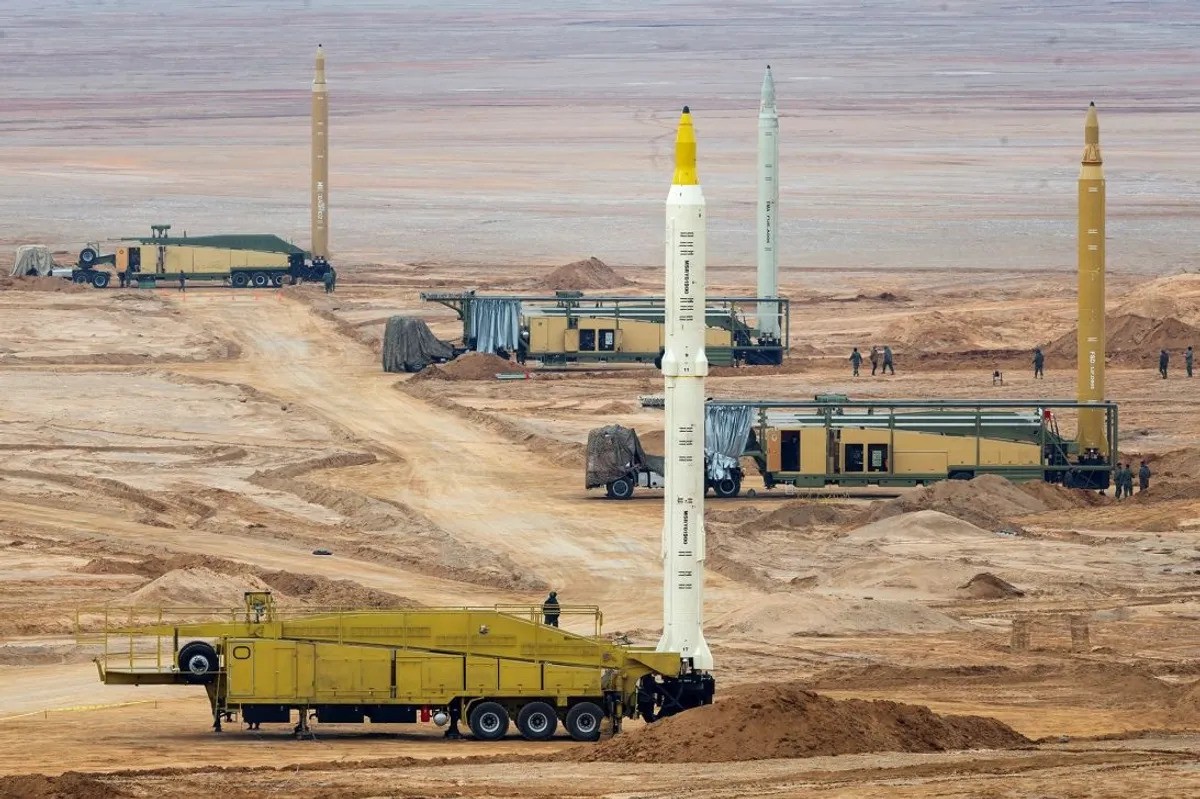
According to estimates by Airwars, in the first 40 days of the war alone, Iran fired approximately 650 ballistic missiles and thousands of attack drones toward Israel. Simultaneously, around 6,400 missiles and drones were launched toward Persian Gulf states associated with the United States. These are not official figures from the Pentagon or Tehran, but rather the result of independent monitoring; nevertheless, they illustrate the sheer scale of Iran's response.
Furthermore, Iran's response escalated almost immediately beyond a bilateral conflict with the U.S. and Israel. On March 1, the United States, alongside the governments of Saudi Arabia, the UAE, Qatar, Bahrain, Kuwait, and Jordan, officially announced Iranian missile and drone strikes on the territories of Bahrain, Iraq (including Iraqi Kurdistan), Jordan, Kuwait, Oman, Qatar, Saudi Arabia, and the UAE.
Thus, within a matter of days, the geography of Iran's response encompassed a major portion of West Asia.
Israel: Around 650 Ballistic Missiles and Thousands of Drones
Israel was the primary target of direct missile attacks. In the first 40 days, Airwars estimated that around 650 ballistic missiles were launched and that one-way attack drones numbered in the thousands. Airwars documented more than 100 cases of civilian harm across Israel and the West Bank.
Strikes and warhead impacts were recorded in various parts of the occupied territories. The AP reported strikes on residential buildings in Tel Aviv, facilities in Beit Shemesh, a road in Jerusalem, and an Iranian warhead landing near the Old City. Information regarding strikes on most Israeli military facilities is traditionally withheld by the military. However, Israel was only one of the targets of Iran's response.
UAE: More than 1,000 Drones and Hundreds of Missiles
The pressure on the UAE was exceptionally extensive. According to Emirati officials, in the first week of the war alone, 205 ballistic missiles and 1,184 drones were detected in the country's airspace.
Attacks were not limited solely to U.S. facilities. On February 28, two Iranian drones struck the Mina Zayed naval base in Abu Dhabi, which was utilized by French forces. The strikes were confirmed by video footage and satellite imagery; subsequent analysis of satellite images revealed damage to U.S. anti-missile infrastructure, including components of the THAAD system in the UAE.
Bahrain: Attack on the U.S. Fifth Fleet Headquarters
Due to hosting the headquarters of the U.S. Navy's Fifth Fleet, Bahrain held special significance for Washington and was consequently placed on Tehran's target list. The AP reported that by the end of the first week, Bahraini officials had recorded the firing of 75 ballistic missiles; simultaneously, the launch of 124 drones toward Bahrain was observed. Among the most critical targets was the state-owned Ma'ameer refinery, which was targeted by an Iranian missile.
Based on satellite imagery, The Washington Post confirmed damage to U.S. Navy facilities in Bahrain (the Fifth Fleet headquarters). A satellite dish and other infrastructure elements were among the damaged targets. According to this investigation, a significant portion of the confirmed damage to U.S. facilities was concentrated in Bahrain and several bases in Kuwait.
Qatar: Destruction at Al Udeid Air Base
Al Udeid Air Base in Qatar, one of the most important U.S. military centers in West Asia, was also targeted. Satellite analysis by The Washington Post confirms damage to at least two satellite communications facilities at the base. This points to an important detail: Iranian strikes targeted not just runways or warehouses, but communication, radar, missile defense, and command infrastructure.
Kuwait: One of the Most Vulnerable U.S. Allies
The situation in Kuwait was particularly dire. Several major U.S. installations, including Ali Al Salem Air Base and Camp Arifjan, are stationed in the country.
The Washington Post's analysis reported damage to barracks, hangars, warehouses, radar facilities, and energy infrastructure. At Al Salem Air Base, Patriot systems and radar facilities were damaged; radar domes were also hit at Camp Arifjan. The U.S. Embassy in Kuwait was targeted as well. The Associated Press reported the destruction of the embassy's main building and evidence of extensive fire damage.
Additionally, U.S. service members suffered painful casualties in Kuwait. According to subsequent investigations by The Washington Post, six U.S. military personnel were killed during the days of the regional war with Iran as a result of a drone attack on a tactical operations center.
Saudi Arabia: From the U.S. Embassy to the Airbase
Saudi Arabia also became a direct target of Iran's response. According to Saudi officials, two drones struck the U.S. Embassy compound in Riyadh, causing fires and widespread damage. Iranian drones also attacked the Ras Tanura refinery complex.
Furthermore, satellite imagery revealed damage to Prince Sultan Air Base. The Washington Post reported damage to an E-3 Sentry airborne early warning aircraft and a refueling tanker. Thus, Iran targeted not only the bases themselves, but also the rarest elements of U.S. aerial infrastructure—namely, command and control and aerial refueling assets.
Jordan: Strike on Missile Defenses
Jordan also formed part of the U.S. war puzzle and, consequently, became part of Iran's targets. Satellite imagery of Muwaffaq Al-Salti Air Base showed damage to radars and equipment belonging to the U.S. THAAD system.
Iranian missiles and drones repeatedly traversed Jordanian airspace. In the first week alone, several people were injured by falling debris resulting from air defense interceptions. Subsequent attacks on U.S. infrastructure in Jordan demonstrated that even after weeks of bombardment, Iran maintained the capability to strike targets at a significant distance from its own territory.
Iraq: Erbil and U.S. Infrastructure
In Iraq, resistance groups took action to target U.S. bases and facilities in Iraq and Iraqi Kurdistan. In the Erbil region, extensive launches of missiles and drones were recorded. Multiple airborne assets were fired toward the U.S. Consulate area; resistance groups simultaneously announced attacks on areas where U.S. military personnel were deployed.
Attacks Beyond the Persian Gulf
The geography of the response extended even beyond the Persian Gulf. On February 28, a Shahed drone struck a UK airbase in Cyprus, inflicting damage on the facility. In this manner, Iran's response encompassed not only Israel and U.S. bases in the Persian Gulf, but Western military installations across a far broader territory.
15 U.S. Bases and at Least 228 Damaged Facilities
A fuller picture of the effectiveness of Iran's strikes emerged later through the comparison of satellite imagery. The Washington Post investigation examined more than 100 high-resolution images using Europe's Copernicus system and commercial Planet images. This evaluation identified 217 damaged or destroyed structures and 11 pieces of equipment, a total of at least 228 targets across 15 U.S. military bases.
Damaged targets included barracks and residential buildings, hangars and warehouses, fuel tanks, radar stations, Patriot and THAAD systems, satellite communications equipment, command centers, aircraft, aviation equipment, and energy infrastructure.
As acknowledged by U.S. media, by the end of April, Iranian strikes on U.S. facilities and bases had left seven U.S. service members dead and more than 400 wounded; The Washington Post emphasized that the 228 targets hit by Iran were not a final figure, but merely the damage that could be confirmed through available imagery. Following the initial weeks, access to high-resolution commercial satellite images was severely restricted, meaning the true scope of the attacks exceeds current statistics.
Asymmetric Response
Ultimately, a picture emerged that was entirely different from what was imaginable following the initial U.S. strikes. Although the U.S. and Israel achieved relative dominance over Iran's skies for a limited number of days and struck part of Iran's fleet, air defenses, missile facilities, launchpads, and command infrastructure, Iran was capable of fighting in an entirely different manner. Iran's combat style was not based on classical aircraft-versus-aircraft or fleet-versus-fleet engagements, but proceeded asymmetrically, matching inexpensive missiles and drones against the vast network of stationary U.S. bases, airfields, headquarters, radars, warehouses, and the infrastructure of U.S. allies.
Here, a vulnerability was exposed that the U.S. appeared to have overlooked: Iran did not need to completely defeat the U.S. military machine to win; it was sufficient to absorb the initial blow and maintain its capacity to sustain pressure on the U.S. to impose the costs of war. Yet missiles and drones were merely the first phase of Iran's response.
Massive Disruption in West Asia
The blow that proved far more painful for the U.S. and its allies was the subsequent one; this attack was not directed at U.S. military bases, but encompassed the everyday life of the entire region. In this wave, aviation, airports, tourism, commerce, and maritime transport suffered severe damage. In recent decades, Dubai, Abu Dhabi, and Doha had evolved not merely into tourism hubs, but into the world's largest transportation crossroads. Dubai International Airport set a record in 2025 with 95.2 million passengers and nearly 455,000 flights, averaging roughly 260,000 passengers and over 1,200 flights daily. By the summer of 2026, Abu Dhabi handled around 93,000 passengers and nearly 500 flights per day. Through the hubs of Emirates, Qatar Airways, and Etihad, at least 90,000 passengers passed daily on transit routes alone.
This well-oiled machine for attracting tourists and goods literally collapsed within hours. Following the outbreak of war, the airspace over Iran, Iraq, Israel, and parts of the Gulf states was closed or severely restricted; on a single Sunday alone, more than 2,800 flights were canceled, and in the early days, restrictions affected nearly 13,000 of the 32,000 scheduled flights in the region. Dubai International Airport effectively ceased normal operations; Qatar Airways and Etihad suspended a significant portion of their flights, thousands of people were stranded in airports and hotels, and governments began organizing evacuation flights. Countries that had spent decades selling an image of absolute security, comfort, and predictability to the world were effectively transformed overnight into part of a vast war zone.
The strike on maritime tourism was likewise not merely symbolic. Six large cruise ships carrying approximately 15,000 passengers and over 6,000 crew members remained stranded in the ports of Dubai, Abu Dhabi, and Doha. Individuals who the day before had purchased cruise tickets in one of the world's safest tourist regions suddenly found themselves on vessels surrounded by missile alerts, with airports closed and any possibility of returning via a standard commercial flight eliminated.
In the view of many, this point marked the first true psychological shock of the war for the Gulf Arab states. The debate was no longer whether U.S. bases could intercept Iranian missiles and drones; what had been lost was these nations' credibility as a secure global hub for tourism, aviation, commerce, and transit. A reputation built over decades and taken for granted by public opinion was completely shattered within a matter of hours.
Iran's most potent instrument of leverage did not reside in missile silos or military bases; it lay on the map. The blockade of the narrow maritime corridor known as the Strait of Hormuz by Iranian Armed Forces enabled Tehran to accomplish what thousands of missiles could not: by blocking the Strait of Hormuz, Iran succeeded in transmitting the consequences of a regional war to the entire global economy. No country, regardless of its arsenal, can disable the weapon of geography, and Iran weaponized its own geography; now, Iran's enemies, frustrated and defeated, are contemplating a way to achieve an honorable exit from the predicament they created themselves.
