

Stabilizing Baghdad’s Position in the Region Without Mediation Between Tehran and Washington
TEHRAN (Defapress) - Iran-Iraq relations cannot be understood without going back to 1979, the year when the Islamic Revolution in Iran changed the entire political and security balance of the region. From that point on, relations between Baghdad and Tehran entered a tense, unstable, and hostile phase, a process that ultimately led to the eight-year war of 1980-1988. That war affected not only the two countries but the entire security structure of the region for years. Even after the war ended, deep distrust, border disputes, security concerns, and geopolitical competition prevented the formation of a normal and stable relationship.
From confrontation to convergence after 2003
Before 2003, official relations between Tehran and Baghdad remained limited, controlled, and cold, and there was basically no such thing as regular and regular visits of high-ranking Iraqi officials to Tehran, as we see today. However, the fall of Saddam’s regime in 2003 marked the beginning of a new chapter in relations between the two countries; A chapter in which Iran and Iraq gradually transformed from two neighbors with a bloody past into two actors with extensive political, security, economic, and social ties.
During this period, relations between Tehran and Baghdad not only improved but also deepened; such that the visits of Iraqi prime ministers to Tehran became part of the natural and strategic process of relations between the two countries. During his term as prime minister, Nouri al-Maliki visited Tehran and met with high-ranking officials of the Islamic Republic, including an important meeting with the Supreme Leader of the Islamic Revolution, which testified to the special level and importance of these relations. After him, Haider al-Abadi also traveled to Tehran and held talks with Iranian officials on bilateral issues and regional developments. Mohammed Shia al-Sudani also followed the same path, visiting Tehran on an official visit and meeting with Iranian officials to discuss both bilateral relations and important regional issues.
The Role of Lieutenant General Qassem Soleimani and General Abu Mahdi Al-Muhandis
In the meantime, the role of martyred Lieutenant General Qassem Soleimani and martyred Abu Mahdi Al-Muhandis in strengthening the ties between Iran and Iraq cannot be ignored. These two figures, especially in the years of the fight against terrorism and the confrontation with ISIS, played a decisive role in bringing the two countries closer, strengthening security cooperation, and forming a common understanding of regional threats. An important part of the strategic depth of today's relations between Tehran and Baghdad is the product of the same period when field, security, and political cooperation between the two sides reached an unprecedented level.
Al-Zaidi's trip to Tehran in the shadow of Washington
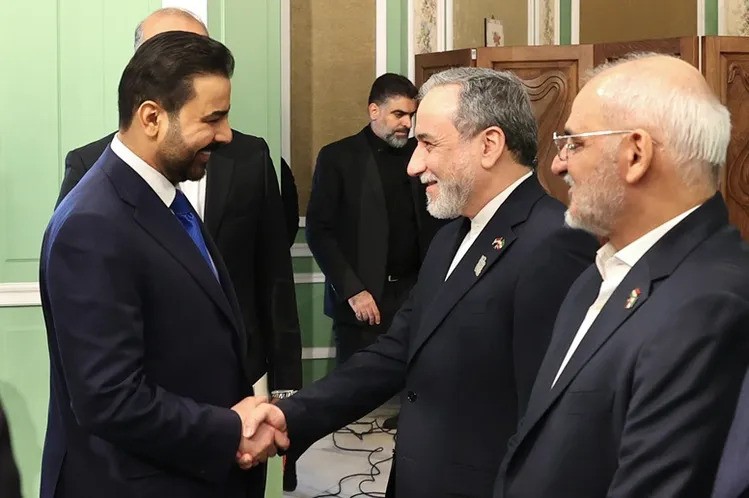
Ali Al-Zaidi's trip to Tehran was not just an ordinary diplomatic program, but equally it should not be interpreted simply as a form of mediation between Iran and the United States. Shortly before his trip to Tehran, Al-Zaidi had met with Donald Trump and several senior American officials in Washington and signed a series of agreements and MoU in the fields of energy, security, technology, and investment. This coincidence, especially in the Iranian media, has provoked reactions and strengthened the possibility that Baghdad may be seeking to play a mediating role.
In this context, the statements of Ali Akbar Velayati, the advisor to the Supreme Leader on international affairs, who described the timing of Washington’s visit as “untimely and regrettable,” fueled these speculations. However, the gap between “proposing the possibility of conveying a message” and “accepting the role of effective mediation” is serious and meaningful.
Why is Baghdad not a suitable mediator?
The reality is that the possibility of Baghdad mediating between Tehran and Washington, at least under the current circumstances, is not very high. Unlike countries such as Oman or Qatar, Iraq does not have the status of a classic and neutral mediator. On the one hand, Baghdad has strategic relations, economic ties, security overlaps, and geopolitical commonalities with Iran. On the other hand, it continues to operate within the framework of extensive cooperation with the United States and is also the host of American presence and influence. Such a situation makes Iraq more of an actor in the equation than an arbiter outside it.
To be more precise, if Baghdad plays a role at all, it is that of a “facilitator of communications,” not a decisive mediator. What is understood from Al-Zaidi’s trip to Tehran is, above all, an attempt to maintain balance, reduce pressures, and prevent Iraq from becoming a scene of confrontation with others.
Stabilizing Iraq’s position in the regional equations
In fact, the main purpose of Al-Zaidi’s trip to Tehran should be sought at a higher level: stabilizing Iraq’s position at a critical juncture in the region’s developments. West Asia is going through a phase in which the balance of power, the path of coalitions, and the shape of security relations are being redefined. In such an environment, Iraq does not want to be just a place to pass through crises; rather, it is trying to introduce itself as a balanced, responsible, and influential player in the regional security equations.
Baghdad’s policy in recent years has been based on “positive balance”; that is, maintaining relations with all influential parties, without falling completely into the camp of one axis or another. Al-Zaidi’s trip to Tehran can also be understood within this framework. He did not go to Tehran to assume the role of mediator between Iran and the United States; rather, he went to remind all parties that Iraq intends to maintain and stabilize its position in the changing regional order.
Baghdad seeks to play a role, not to convey a message
Therefore, although some analysts have tried to read this trip as a message transfer between Tehran and Washington, a more accurate interpretation is that Baghdad is seeking to consolidate its position in a larger equation; an equation in which Iraq wants to be not a marginalized person, but a holder of a place. Al-Zaidi's trip to Tehran, rather than a sign of Iraq's entry into the mediation process, is a sign of the country's efforts to consolidate its political and security weight in a region that is changing more and more every day.
