
Hamas Organizational Restructuring with Khalil al-Hayyah's Victory Over Khaled Meshaal
TEHRAN (Defapress) - The Islamic Resistance Movement Hamas has entered a new phase of leadership with the election of Khalil al-Hayya as the new head of its political bureau. This selection took place following a second round of internal elections and in the wake of the martyrdom of Yahya Sinwar, bringing an end to one of the most sensitive intra-organizational contests within Hamas.
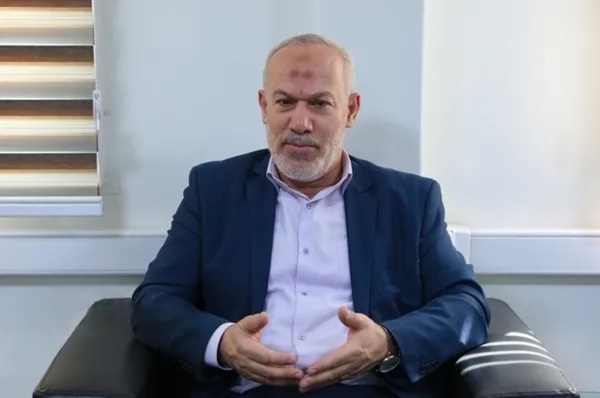
Al-Hayya, who is considered one of the veteran and influential figures of this movement, has played a significant role in political files and ceasefire negotiations in recent years. He now assumes responsibility for leading Hamas at a time when the movement faces major challenges in the arenas of war, diplomacy, and security threats. His personal life has also been marked by difficult events, including the martyrdom of his sons, which has made his standing among Palestinians all the more distinctive.
In this regard, the Defapress correspondent interviewed Nasser Abu Sharif, the representative of Palestinian Islamic Jihad in Iran, the full text of which follows:
At the outset of his remarks, he said: The election of Khalil al-Hayya is not merely a superficial change at the apex of Hamas, but neither can it be interpreted as a fundamental strategic transformation. The closest interpretation to reality is that this selection represents a redistribution within the framework of continuity. This is because al-Hayya won in the second round of voting by a narrow margin (35 votes against 34 for his rival Khaled Mashal), which indicates a serious internal debate over the priorities of the current stage.
Abu Sharif continued: Al-Hayya represents the line of the interior of Gaza, while Mashal represents the leadership outside Palestine. This choice reflects a preference for weighting Gaza and the continuation of previous practices, along with granting increasing importance to negotiating experience in crisis management. Therefore, this selection should be regarded as a recalibration of tools, not a change in objectives.
Hamas's ability to repair its decision-making structure
The representative of Palestinian Islamic Jihad in Iran, stating that the election of al-Hayya shows that Hamas still possesses the capacity for reconstruction after severe blows, remarked: Holding internal elections amid a devastating war and targeted assassinations that have pierced the first and second echelons of leadership, and then announcing the result within a matter of days, demonstrates a minimal continuity of institutional structure within Hamas that allows it to reproduce its leadership. Of course, this does not mean it will emerge stronger from the war, but it indicates that Hamas has not reached a point of collapse where it cannot make a central decision regarding leadership. The election of al-Hayya, who was previously Sinwar's deputy and then, after his martyrdom, became the head of Hamas in Gaza, indicates the organization's ability to repair its leadership structure despite heavy losses.
According to him, Haniyeh was a charismatic leader outside Palestine; Sinwar was a field commander and rigid leader who spent years in Israeli prisons and embodied military resistance. But al-Hayya is an example of a political manager rather than a charismatic leader; he is a combination of organizational roots in Gaza (a citizen of the Shujaiya neighborhood and a member of Hamas since its founding) and extensive negotiating experience as head of the negotiation team in ceasefire and prisoner exchange files.
Abu Sharif added: On one hand, he is a skilled negotiator who understands the language of mediators and is capable of managing international files, which could make him more effective in handling interactions at the negotiating table. On the other hand, he has not broken away from Hamas's ideological and organizational authority, is close to Iran, and insists on the principles of Resistance. This combination of tactical flexibility and principled firmness may make him a more complex opponent for Israel, because he is adept both at the negotiating table and on the field of resistance, in either domain.
Opportunity to reduce the rift with Fatah and the Palestinian Authority
The representative of Palestinian Islamic Jihad in Iran stated: Israeli media have assessed al-Hayya's election as a sign of preference for Gaza's weight, continuity, and ties with Iran, which may push Tel Aviv toward greater military pressure to test the new leadership's ability to withstand pressure. In contrast, al-Hayya, who was Hamas's chief negotiator, has declared that his foremost priority is to stop the war, and this may encourage Israel to explore the possibility of reaching an agreement with a figure who knows how to manage negotiations. In all likelihood, Israel will pursue both paths: continuous military pressure to improve its negotiating position, along with cautious openness to serious exchanges, especially regarding the prisoner file, which is a red line for Hamas.
According to Abu Sharif, al-Hayya's election may present an opportunity to reduce, rather than widen, the rift with Fatah and the Palestinian Authority. This is because al-Hayya, since the period of negotiations, has expressed openness toward national dialogue. He headed Hamas's delegation in joint meetings with the Fatah delegation led by Hussein al-Sheikh, and in his first speech he called for "opening a new page with all factions" and achieving national unity.
Regarding the impact of al-Hayya's election on Mahmoud Abbas's position, he said: On one hand, the emergence of a new and influential figure in Gaza may weaken the symbolic dominance of the Palestinian Authority over the Palestinian scene. On the other hand, if al-Hayya can open serious channels of dialogue with Ramallah, it may allow Mahmoud Abbas to play a national role in post-war arrangements and strengthen his position as a unifying framework, rather than weaken it. The greater challenge is whether Hamas is prepared to accept a national formula that does not, in practice, mean the stripping of its influence.
Al-Hayya's relationship with Iran
The representative of Palestinian Islamic Jihad in Iran stated: From Iran's perspective, al-Hayya's selection can be assessed with optimism but also with caution. Some analyses have described him as close to Iran at the helm of Hamas, and he has emphasized the continuity of the Resistance through his travel to Tehran. Israeli media have also interpreted this selection as a preference for weighing ties with Iran, suggesting that Tehran may view him as the continuation of the strategic line linking Hamas to the Axis of Resistance.
However, al-Hayya is not dependent on one specific axis; he resides in Doha and also appreciates the mediation of Qatar, Egypt, and Turkey. This characteristic may present him as more balanced in regional relations. Therefore, Iran's interests in Hamas's survival as an effective player in the Palestinian equation continue, but with the awareness that al-Hayya needs relative independence in decision-making to be able to maneuver among various actors.
Referring to the position of Turkey and Qatar in this selection, he added: Qatar and Turkey have a pivotal role in al-Hayya's equation. Doha is his main place of residence, and he survived an Israeli assassination attempt there in 2025. Qatar has also played a primary mediating role in ceasefire negotiations alongside Egypt, and al-Hayya has explicitly appreciated the mediating role of Qatar and Turkey.
Cairo's assessment of al-Hayya's selection
Turkey has also provided important political and diplomatic cover, and al-Hayya has appreciated their mediation efforts. The position of these two countries goes beyond mediation; they provide Hamas with a political framework and space for diplomatic movement. In a situation where field options have become limited, al-Hayya's stay in Doha is an implicit acknowledgment that Hamas needs a supportive environment outside Palestine to enable it to manage its political and negotiating files away from the front lines of war.
Abu Sharif added: Egypt, which has a complex relationship with Hamas, may see al-Hayya's election as an opportunity to open rather than a cause for concern. Al-Hayya is not a confrontational figure. He headed Hamas's delegation in several rounds of negotiations in Cairo and has appreciated Egypt's mediation, which makes him a figure acceptable to Egyptian circles. Also, Hamas's declared readiness to hand over the administration of Gaza to a national committee reduces Egypt's concerns about Hamas's full control over crossings and borders.
He added: However, Egypt remains cautious because it views Gaza through the lens of its own national security in Sinai and seeks arrangements that prevent long-term security instability. The election of al-Hayya, who has field weight in Gaza, may offer Egypt a more understandable partner in de-escalation and border files, expanding Cairo's diplomatic maneuvering space and making its role as mediator more effective, provided that Hamas adheres to its security commitments.
Redefining Hamas's role in Gaza
The representative of Palestinian Islamic Jihad in Iran, referring to the future of Hamas after al-Hayya's election, stated: The future of Hamas after al-Hayya's election is moving toward an integrated model that cannot be confined to one of two options. Al-Hayya has emphasized that Hamas will continue on the same path charted by its founding leaders, and that weapons are a red line, indicating that armed resistance will persist as a strategic principle. But at the same time, he has put forward stopping the war and reconstruction as an immediate priority, showing that today's tactical priority is on political and humanitarian work.
He added: In the post-war scenario, al-Hayya has announced that Hamas is ready to hand over the administration of Gaza to any national, professional Palestinian body that is agreed upon. This does not mean relinquishing influence, but rather redefining Hamas's role from a sovereign power bearing the full burden of civilian administration to an effective political and military force that participates in post-war arrangements without becoming mired in the deadlock of civilian administration and humanitarian crisis. Success in this delicate equation will be the real test of al-Hayya's leadership.
