

Kidnappings in Nigeria: From Schools to Churches
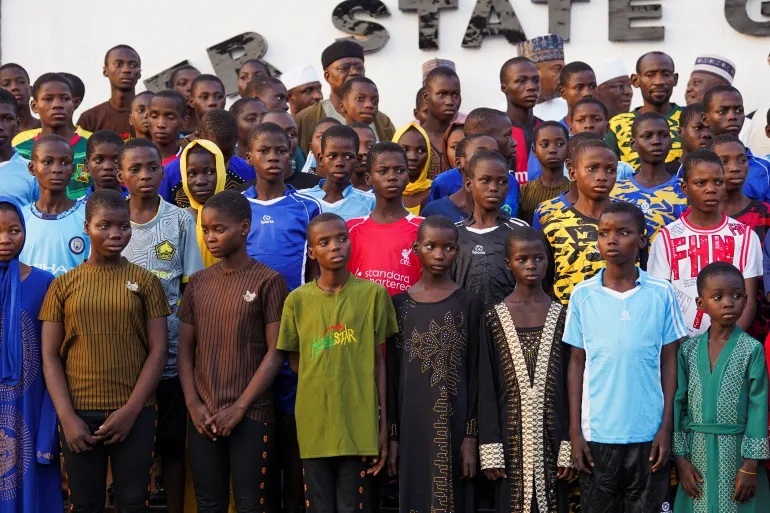
TEHRAN (Defapress) - At the heart of Nigeria’s security crisis, where mass kidnappings have become a constant nightmare, the government has managed to rescue about 100 children from the clutches of kidnappers. The children, who were kidnapped from St. Mary’s Catholic boarding school in the Papiri community of Niger State, arrived at the Niger State Government House on Monday in white buses escorted by dozens of military vans and armoured vehicles.
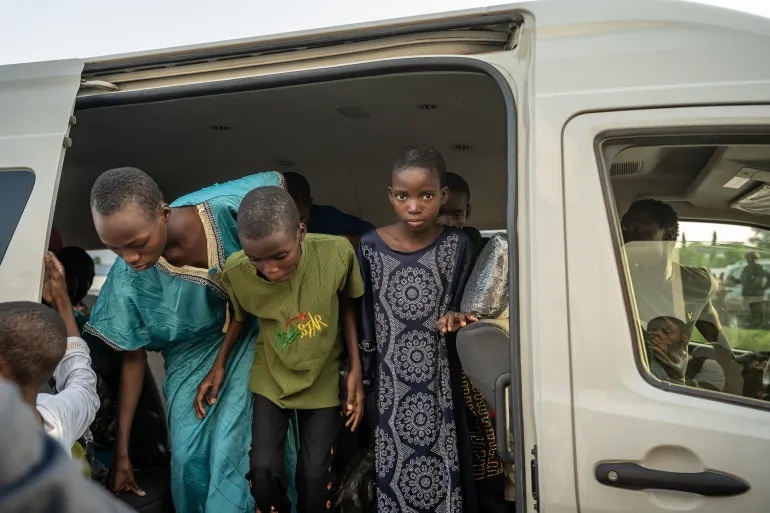
Aged between 10 and 17, they appeared in football kits, robes, and slippers and were warmly embraced by local authorities. The scene, captured on camera, symbolised a small victory in the face of the violence.
The kidnapping of the children took place on November 21, when some 303 students and 12 teachers were taken from St Mary’s School. In the early hours, 50 students managed to escape, but the rest were trapped in the dense forest. The freed children would soon be returned to their parents in Papiri, Niger state governor Mohamed Bagou said at the government building in the city of Mina.
He stressed that doctors and health professionals would carry out thorough medical checks before they were allowed to return. “I say to those who have prayed, keep praying. We hope to rescue the rest of the kidnapped students,” Bagou added.
President Bola Tinubu also commended the security forces for their efforts and ordered the rescue of all students and others abducted across the country. “We must look after all the victims,” he added.
However, details of the children’s release were not released, and the government remained tight-lipped about a possible ransom payment. Tinubu’s spokesman said 115 students and 12 teachers were still being held, although news agencies put the figure at 165.
“They gave us a tarpaulin and told us to sleep on it and be quiet,” Florence Michael, one of the freed children, described her ordeal. The children spent two weeks in the bush and now need psychological and physical support, according to Theresa Pamma of UNICEF.
Parents in Papiri, who learned of the release through the media, are in a state of anxiety. “I am worried about her safety, but I pray that she is among the students who were released,” said Samuel Musa, the father of one of the 13-year-olds. “Her mother has been ill since the kidnapping.”
The incident is part of a recent wave of mass kidnappings in Nigeria. Just four days ago, 25 schoolgirls were kidnapped from a school in Kebbi state, while 38 worshippers were kidnapped from a church in Kwara state, but were later released. Residents blame armed groups for the kidnappings of schoolchildren and passengers for ransom. Such acts of terrorism have plagued northern Nigeria for decades.
Nigeria, a religiously diverse country of 230 million people, is under pressure from the United States. US President Donald Trump has accused Christians in the country of facing genocide and has threatened military intervention and cut off aid. However, the Nigerian government and independent analysts reject this claim, calling it part of a narrative by Christian extremists in the West.
“The killings are not limited to Christians; Muslims and followers of traditional religions are also victims of terrorist groups,” said Kimiebi Imomotimi Ebienfa, a spokesman for the Nigerian Ministry of Foreign Affairs. Muslims make up 56% of the population, while Christians make up more than 43%, according to Pew Research Centre estimates. However, armed conflict, mainly in the Muslim-majority northeast, has been ongoing for more than 15 years.
The rescue of the 100 children, while promising and encouraging, is only one bright spot in the long darkness of Nigeria’s security crisis. Unless the federal and state governments decisively address the root causes of insecurity, namely widespread poverty, youth unemployment, arms trafficking, and the lack of governance in rural and forest areas, these mass abductions will continue to occur, leaving thousands of families in grief.
Instead of repeating one-sided and controversial narratives, the international community should stand with the people of northern Nigeria with real assistance in the areas of school safety education, strengthening security forces, and reconstruction programs, so that the nightmare of abducting children from their sweet childhood dreams can finally be eradicated.
