
Air Defense Force Thwarted Many of the Enemy's Operations
TEHRAN (Defapress) - The Islamic Republic of Iran’s Army, as a divinely-guided and revolutionary institution, bears the responsibility of safeguarding and defending the nation’s borders and territorial integrity. Throughout both the eight-year Iran-Iraq War and the twelve-day Imposed War, the Army demonstrated its resolute and unwavering commitment to protecting the country’s sovereignty.
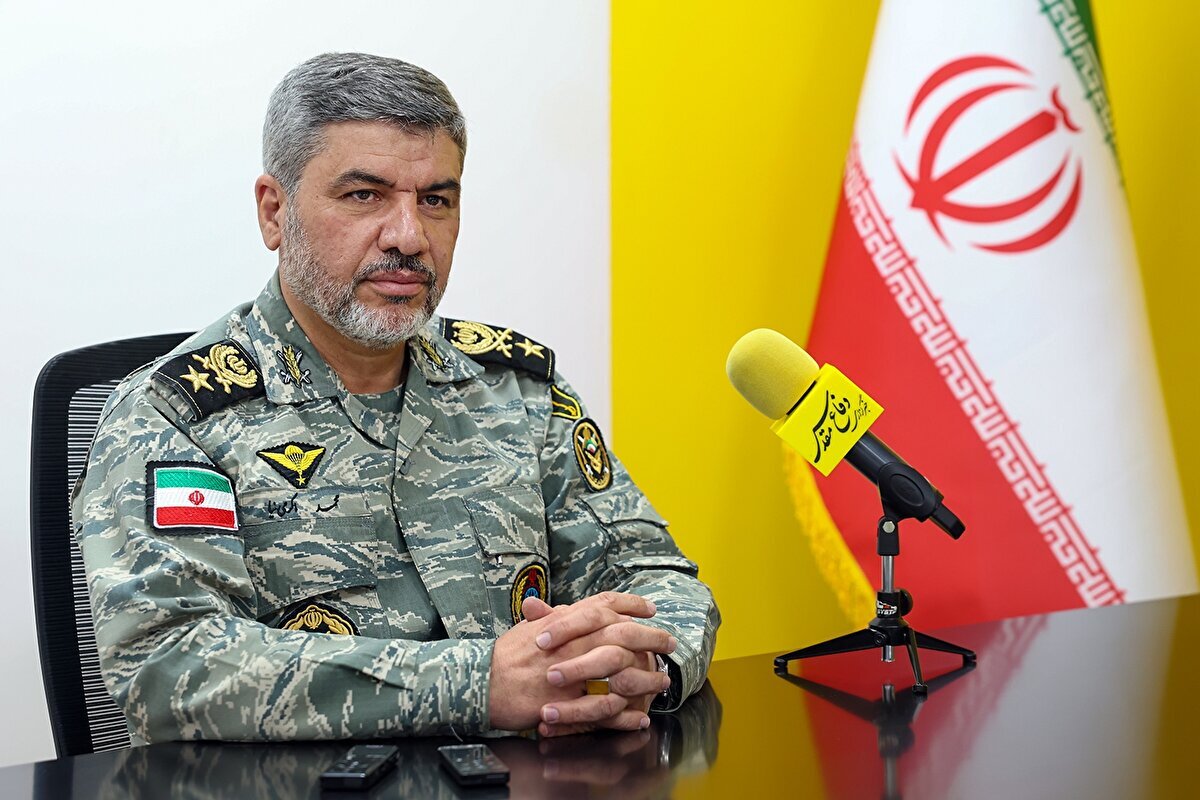
To gain a better understanding of the Army’s missions and capabilities, we conducted an interview with Brigadier General Mohammad Akraminiya, the Army’s Spokesman, during a visit to the Defense Public News Agency complex.
Defapress: As a revolutionary and military institution, what actions has the Islamic Republic of Iran’s Army taken to advance the goals of the Islamic Revolution till now?
As you are aware, preserving the sacred Islamic Republic of Iran, its independence, and territorial integrity are explicitly enshrined in the Constitution as the Army’s responsibilities. Over the past 47 years, since the glorious Islamic Revolution, the Army has exerted considerable effort and dedication in fulfilling these missions.
In the early days of the glorious Islamic Revolution, the Army played an irreplaceable role in preserving the nation’s territorial integrity and preventing its fragmentation. It also consistently assisted other institutions, enhanced the system’s capacity, and fostered power and authority of Islamic Revolution. These missions continue with strength till now, and the outcomes of the Islamic Republic of Iran’s Army’s actions have resulted in the preservation of Iran’s independence.
After 47 years since the blessed Islamic Revolution, our country enjoys complete independence. Foreign powers, particularly the United States, have consistently attempted to take Iran and its people under Western countries control, but they have failed in this endeavor. This independence is the result of the efforts of the armed forces and the Islamic Republic of Iran’s Army, and, thanks God, we currently have independence and power, both at the same time. Today, few countries have real independence like Iran.
Defapress: Considering the martyrdom of several commanders of the armed forces during the 12-day Imposed War, what is the process of successor planning within the Islamic Republic of Iran’s Army?
We have long prepared scientific mechanisms for peer-to-peer matching and successor planning within the Islamic Republic of Iran’s Army. Among these mechanisms is the establishment of the Assessment and Growth Center in Army.
We had made the necessary provisions for replacing commanders in Islamic Republic of Iran’s Army. Serving commanders within the Islamic Republic of Iran’s Army have peers who are capable of managing Army units, and this capacity has existed within the Army from past till now.
Defapress: Please elaborate on the Islamic Republic of Iran’s Army’s role in the 12-day Imposed War.
The enemy initiated the 12-day Imposed War with the aim of creating unrest in our country. The enemy’s goal was not merely to overthrown the sacred Islamic Republic, but also seek fragmenting Iran, which has been repeatedly clarified by American and Zionist theorists and officials. Zionist regime officials have repeatedly said about ‘Greater Israel’ plan, which signifies the fragmentation of regional countries. Today, in addition to Iran, countries in the region also face the threat posed by the Zionist regime, and the enemy is pursuing a plan to fragment our country.
Fragmentation, as the ultimate goal of the enemy, is pursued through initial actions. They create unrest, seeking to instigate a full-scale military conflict and overthrown the sacred Islamic Republic, thereby achieving their ultimate goal which is fragmenting Iran. Today, the sacred Islamic Republic is the most important factor in preserving Iran’s territorial integrity. If we review the political systems of Iran’s contemporary history, we see that each has lost portions of our sacred homeland. However, only the Islamic Republic of Iran, throughout its 47 years of blessed existence, has been able to preserve Iran’s territorial integrity, protect the country from the threat of fragmentation, and confront its enemies.
The Islamic Republic of Iran’s Army, in line with its missions, stood firmly against the United States and the Zionist regime during the twelve-day Imposed War. In this war, we were not only facing the Zionist regime, but also the United States and a significant members of NATO, which supported the Zionists. Nevertheless, the Zionist regime was unable to continue the war with the Islamic Republic of Iran and, after four days of fighting, turned to the Americans to seek a ceasefire.
We recall that in the early days of the war, when a reporter asked the President of the United States if he wanted to intervene and end the war, Trump replied that stopping a side that was winning the war was difficult. He was referring to the Zionist regime as the winning side; however, ultimately, Trump and this regime were forced to halt the war. This demonstrates that the armed forces stood firm against their enemies and resisted valiantly. During the 12-day Imposed War, some regional countries also assisted the enemy of Iran, but the armed forces of the Islamic Republic of Iran, through their dedication and efforts, prevented them from achieving their goals.
In this war, the enemy inflicted blows and also received severe blows in return. Ultimately, the war ended after twelve days, and the enemy failed to achieve its objectives, demonstrating the indispensable role of the armed forces in the twelve-day defense.
The Islamic Republic of Iran’s Army played a role in both air defense and air force operations during the 12-day Imposed War. Had it not been for the actions of the Air Force, the damage inflicted on the country would certainly have been greater. However, thanks to the Air Force’s operations, we were able to make the Zionist regime’s sky insecure and prevent many of their operations.
The Air Defense Force also played an effective role in this war, as over 200 large and small enemy aircraft were targeted and shot down by the Army’s air defense force. The world’s most modern equipment and technologies were at the service of the Zionist regime, and the United States and some Western countries supported this regime. However, the air defense efforts of the Army were able to reduce the damage and make the armed forces’ offensive power more effective, forcing the enemy to request a ceasefire.
Defapress: What actions has the Islamic Republic of Iran’s Army taken till now regarding border closure?
The closure of eastern borders in areas entrusted to the Army has been a priority, and currently, border closure has been implemented in some sections of the eastern border. Electronic equipment and night vision devices have also been deployed in the closed areas. This border, which stretches over 900 kilometers, is of utmost importance, and only a small portion of the border closure remains to be completed.
Defapress: Considering the Supreme Leader’s emphasis on unity and synergy among the armed forces, what is the current status of cooperation between the Army and the IRGC?
Good progress has been made in this area, and the Army and the IRGC have good unity. Our missions with the Law Enforcement Command and the Islamic Revolutionary Guard Corps (IRGC) are complementary and synergistic. Each of these organizations pursues its inherent missions, and in some cases where cooperation is needed, the cooperation is deep. Furthermore, mechanisms for cooperation are issued by the General Staff of the Armed Forces.
Now, thanks to God, cooperation among the armed forces is being pursued at a very high level, the result of which is the protection of our beloved country, the Islamic Republic of Iran, and the Islamic Revolution.
