
Continuously Upgrading the Country's Missile Capability
TEHRAN (Defapress) - Brigadier General Hossein Mohebbi, the spokesman for the IRGC, presented a comprehensive analysis of the enemy's failure and the dimensions of the Iranian nation's victory, detailing the military, perceptual, technological, economic, and media aspects of the recent conflict.
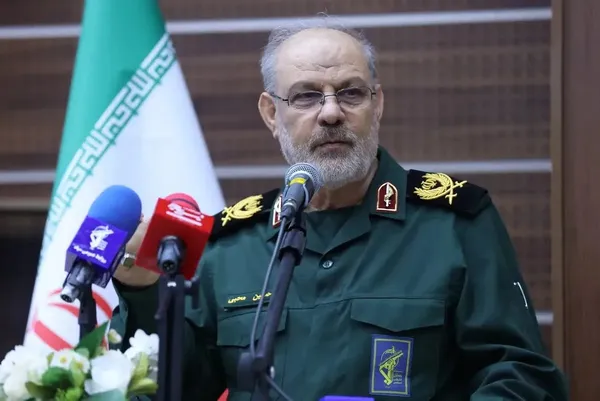
Referring to enemy attacks on low-priority targets, such as checkpoints manned by a few youths or multi-million-dollar drone strikes on empty police stations, he emphasized that these actions lacked military justification and were aimed solely at creating a cognitive and perceptual effect in society. The IRGC spokesman added that targeting high-ranking officials and senior commanders at the onset of hostilities went against conventional warfare norms to project the impression that the system depends on specific individuals and would collapse without them. However, due to the resilience of the state apparatus, the uninterrupted functioning of government branches, and the immediate redeployment of Basij and law enforcement forces to the streets, this cognitive warfare completely failed.
Brigadier General Mohebbi described the technological dimension as the second major characteristic of this conflict, explaining that the United States combined AI, command software, satellite data, drones, and sensors to reduce the time frame between target identification and firing from minutes to seconds. He stressed that while the enemy's technology successfully identified part of Iran's equipment, it failed to measure the primary component of Iranian power: national solidarity, mutual support between the government and armed forces, and public backing under the leadership of the Supreme Leader.
Emphasizing that Iran also fought technologically, he stated that strikes against enemy radars, operational centers, drones, and fuel depots disrupted their command networks and operational hubs. Detailing Iran's missile capabilities, he noted that Iranian missiles can now change course and track targets mid-flight. He highlighted the strategic transfer of vulnerability to the depth of infrastructure belonging to the U.S. and its allies as a major achievement.
Brigadier General Mohebbi said: Following U.S. threats and attacks on the South Pars gas field in Assaluyeh, Iran's sustained missile response demonstrated that its missile stockpiles were not limited, contrary to initial assumptions, and that production remains continuous. Conversely, this caused severe attrition of strategic U.S. weapon reserves, creating serious concerns for the U.S. military doctrine regarding managing multiple global fronts, such as potential conflicts in East Asia.
Brigadier General Mohebbi attributed the U.S. halt and withdrawal to the power and resolve of the Iranian nation, noting that the enemy's initial goals of forcing surrender or partitioning Iran ultimately dwindled to an unsuccessful attempt to open the Strait of Hormuz even for a few hours. Stating that the enemy has now shifted from the military arena to economic warfare, he noted that economic pressures and living costs are expected during wartime but remain minor compared to the nation's historical resistance. In conclusion, he called on the media to accurately narrate these realities, highlight achievements, prevent the enemy from altering societal priorities, and permanently etch this historical honor into the public memory.
