
The Ministry of Foreign Affairs and the Trump Corridor
TEHRAN (Defapress) - After numerous ups and downs, the Zangezur Corridor was agreed upon between the Republic of Azerbaijan and Armenia through U.S. mediation under the new title of the Trump Route for International Peace and Prosperity (TRIPP). This corridor, which is intended to connect Nakhchivan to the mainland of Azerbaijan through Armenia’s Syunik region, poses significant economic, transit, geopolitical, and political challenges and threats to Iran's national interests and security.
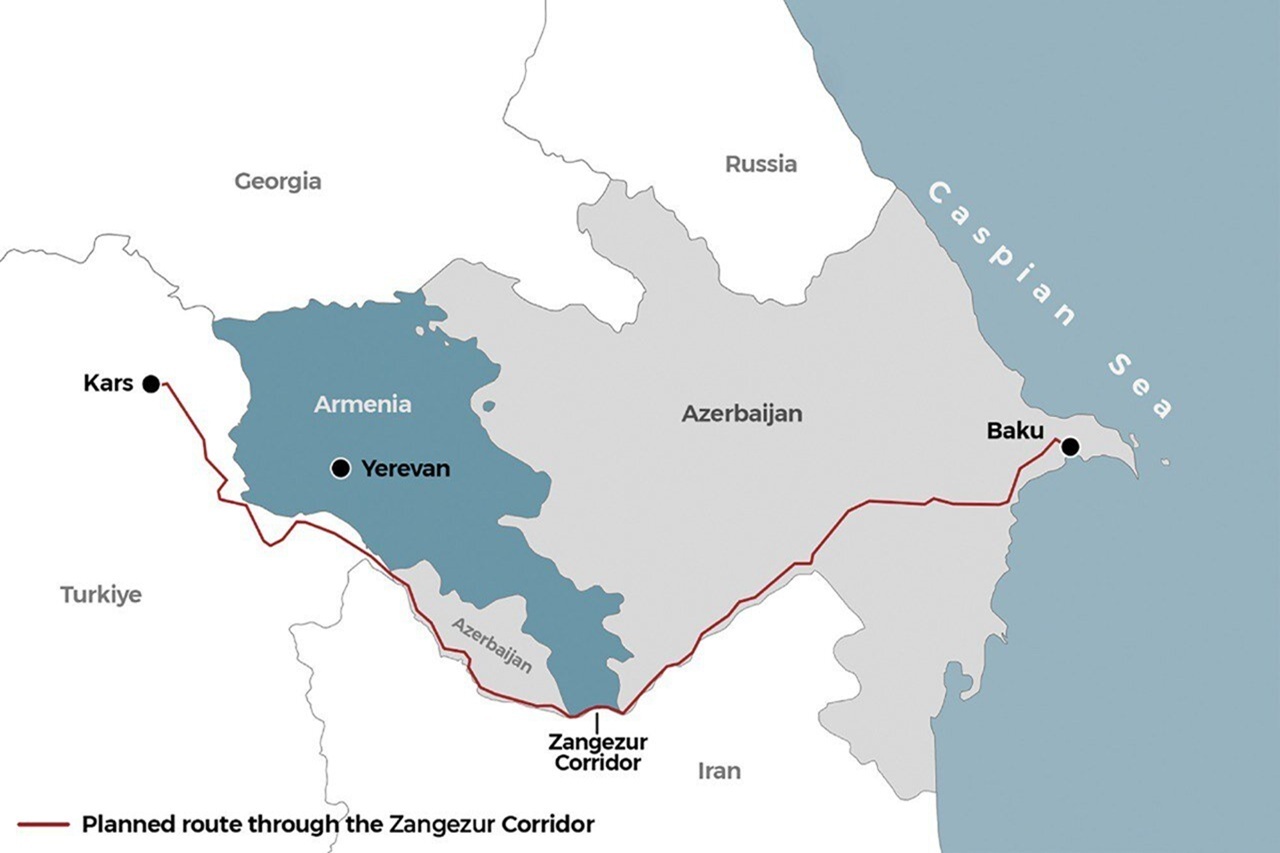
The Ministry of Foreign Affairs of the Islamic Republic of Iran stated in its announcement that it is closely monitoring developments in the South Caucasus region and maintains continuous communication with both neighboring countries, the Republic of Azerbaijan and the Republic of Armenia. However, it must be noted that this corridor will pose significant challenges and threats to Iran's national interests and security from various perspectives.
The significance and sensitivity of this agreement are such that Iran’s Foreign Ministry evaluates its implementation as a key step toward achieving lasting peace in the Caucasus region. At the same time, without explicitly naming the U.S., the Foreign Ministry has clearly expressed its concerns about foreign interference, particularly near shared borders, which could jeopardize the security and stability of the region.
Iran’s Ministry of Foreign Affairs has explicitly emphasized that the establishment of communication routes and the unblocking of transportation networks can only contribute to regional stability, security, and economic development if they are carried out within the framework of mutual interests, respect for national sovereignty and territorial integrity of regional countries, and without foreign interference.
However, given that the Caucasus region holds great importance and a special position for the Islamic Republic of Iran, and considering the U.S.’s long-standing record of destructive roles in various countries, it must be said that America’s presence in any region has brought instability and insecurity.
Accordingly, given the U.S.’s dark history of interfering in the affairs of countries around the world, its presence in the Caucasus could push the equations of this region into a period of widespread instability. Just as America’s presence in other parts of the world has always been accompanied by insecurity, instability, war, and conflict.
Due to its proximity to both countries and the sensitive geopolitical position of the Caucasus, Iran has been closely monitoring developments in this region with high sensitivity for a long time. Moreover, the geographical proximity of these developments to Iran’s borders, particularly in the northwestern regions of the country, has made any changes in the regional situation, including the interference of foreign powers, of utmost importance to Iran.
On the other hand, the statement by Iran’s Ministry of Foreign Affairs reflects a dual approach: on one hand, supporting regional peace and stability, and on the other, expressing sensitivity toward foreign interference that could affect Iran’s national interests. Furthermore, the Islamic Republic of Iran’s emphasis on "mutual interests" and "respect for national sovereignty and territorial integrity" demonstrates our country’s concern about the potential influence of foreign powers, particularly the U.S., on regional equations, which could harm Iran’s interests or regional stability.
Additionally, we must highlight the important point that the red lines set by the Supreme Leader, especially the Islamic Republic’s opposition to any changes in the region’s geopolitics, are an unalterable principle. Accordingly, we have witnessed how the Leader of the Revolution, with a precise understanding of the Turkish axis’s movements in the South Caucasus, has issued clear warnings against any attempts to alter the geopolitics of the South Caucasus.
Finally, given the strategic position of the South Caucasus and its impact on Iran’s national security, it is expected that Tehran will continue its careful monitoring of regional developments and, through active diplomacy, seek to safeguard its interests and strengthen regional cooperation. Because the U.S. presence in the Caucasus is not only problematic and dangerous for Iran but also for other regional countries such as Russia and China, it severely threatens their economic and political interests.
