

We Are Not Negotiating with America, We Are in a Real War
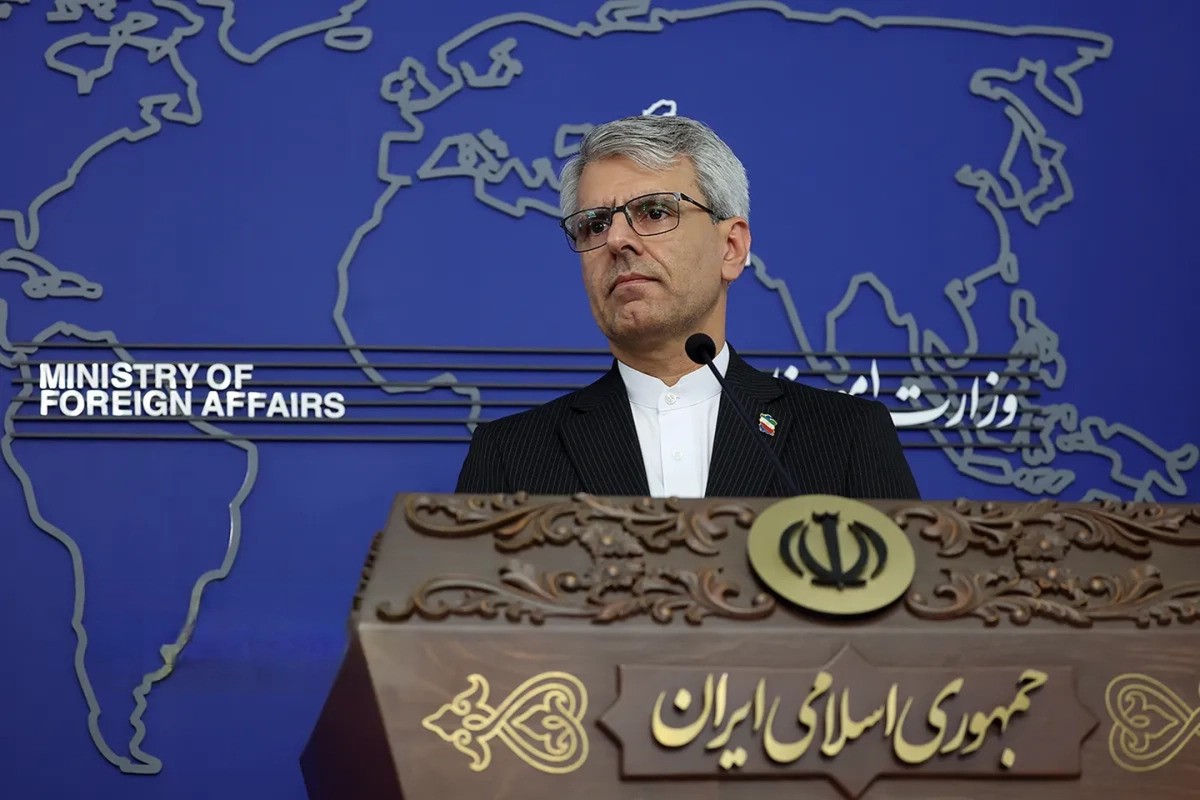
TEHRAN (Defapress) - Esmail Baghaei, the Spokesperson for the Ministry of Foreign Affairs, stated in his press conference with the media today that we are on the eve of Arbaeen and stated: In the past week, America once again sent us help; a bomb weighing 1000 kilograms fell on the family of Mr. Gheisar Jafari, killing the entire family.
Baghaei added: America's care has once again extended to Iraq, and several Iranian citizens were martyred during the US attack on Iraq. We also offer our condolences to their families for this tragedy.
The Foreign Ministry Spokesman continued: The Foreign Ministry's activities in the field of diplomacy continue. Negotiations with Oman have continued with seriousness in the past week. These negotiations are being conducted with the aim of preventing the escalation of insecurity and securing Iran's interests.
He noted: "We are not currently holding talks with the United States, but rather, we are only holding talks with Oman to create a safe route for ships to move through."
Baghaei added: "The Strait of Hormuz was not closed due to differences of opinion between Iran and Oman, but rather due to the regional war started by Iran on February 28. Therefore, the focus of the talks with Oman is on the Strait of Hormuz."
The Foreign Ministry Spokesman stated: "The war of the United States against the Islamic Republic of Iran is not a war against one country, but a war against the entire region. Accordingly, it is natural that the countries of the region want to try to prevent the escalation of tensions."
He clarified: "We are trying to determine the route at the earliest opportunity in consultation with Oman and based on that, provide shipping safety in the Strait of Hormuz. These are bilateral talks between the two coastal states. Others can certainly appear constructive or destructive in this process, but the issue of the Strait is solely related to Iran and Oman. What will happen next must be decided between these two countries."
Referring to the presence of the United States in the region and its role in the insecurity of West Asia, he added: "In these five months, we have seen with our own eyes that the presence of the United States in the region has exacerbated insecurity and instability in the region. It is natural for countries to try to prevent the insecurity from escalating, but experience has proven that what stops the enemy is nothing but the authority and deterrence of Iran."
The Foreign Ministry Spokesman noted: "Pakistan is a mediator in discussions related to Iran and the United States, and in the meantime, Qatar is also helping this process. We have friendly relations with China, and China shares our concerns about the escalation of America's belligerent behavior and insecurity in the region. Chinese friends are making effective efforts to prevent the situation from escalating, but it is not true that we added a new mediator."
The Foreign Ministry Spokesman denied the news of negotiations between Iran and the United States today and said: "Today, Mr. Araghchi is leaving for the Arbaeen ceremony, and his trip to Iraq is also personal." In addition, all the negotiating friends are in Iran, and there are no negotiations with the United States.
Referring to the growing opposition of the people of the region to the continued military presence of the United States, he said: The elites and people of the region have expressed their opposition to the military presence of the United States in their land and country on numerous occasions. The people of the region know very well and clearly that Iran's regional war is an oppressive war against Iran as a Muslim country in the region.
In another part of his speech, Baghaei added: Everyone knows that the Iranian nation is a peace-loving nation and seeks peaceful life with all countries in the region. Accordingly, Iran's defensive reactions were solely against the military origin of the attack, and the people and countries of the region have not been targeted by us.
In response to the US claim regarding Iran-Yemen relations and the opening of a new front by Iran, the Foreign Ministry spokesman stated: Those who make such claims are deliberately trying to distort reality. Iran faced a US military attack five months ago on February 28. But has Iran opened a new front or not? In addition, the US and the Zionist regime have been using the territories of regional countries to attack Iran since the very first days. Again, have we opened a front? The answer is no.
Referring to Yemen’s recent actions, he added: The Yemen issue is only relevant to this country. We have already said that the Yemen issue should only be resolved through dialogue. However, for Iran’s enemies to link any issue to Iran’s regional war is a form of evasion of responsibility.
Baghaei continued: Regarding the recent regional conflicts, I must point out the important issue that they started this problem themselves and did not pay attention to the fact that incitement is contagious. It should be noted that the responsibility for everything that happens in the region and beyond lies first with the United States and then with those who are accomplices of the aggressor.
In response to the claims made regarding the presence of Pakistani and Qatari representatives in negotiations with the United States, the Foreign Ministry Spokesman added: I am not aware of such an issue. We are not going to host a delegation these days, and we are not going to be guests.
In response to the continued attacks by the Zionist regime on countries in the region, he noted: The crimes of the Zionist regime are still ongoing, and the crimes of this regime in Gaza, the West Bank, and Lebanon are currently continuing.
Referring to the responsibility of the Security Council and the United Nations in this regard, Baqaei added: The responsibility of the Security Council and the United Nations is clear, and normalizing crimes, especially genocide, is shameful. Accordingly, all Islamic countries should draw their attention to the biggest issue of the Islamic world and the world, but unfortunately, we see that these attacks continue due to the negligence of Islamic countries.
Referring to Iran-China relations, the Foreign Ministry Spokesman continued: Our relationship with China is a very important one, and we move in various areas based on the strategic partnership agreement. Whenever necessary, we sign new understandings for issues we deem necessary.
Referring to the Ukrainian attack on the Iranian ship and the telephone conversation between the Iranian and Ukrainian foreign ministers regarding this incident, he added: Ukrainian officials emphasized in their contact with Foreign Minister Araghchi and in their separate messages that this action was unintentional, but clear evidence, including the explicit statement of the Ukrainian President, indicates that this attack was intentional.
Baghaei continued: We have heard the explanations of the Ukrainian officials and are waiting to see what action they take in practice. We will definitely take whatever action is necessary to hold Ukraine accountable and ensure that such a crime does not occur again.
He added: "According to Article 5 of the Memorandum of Understanding on the End of the War on June 18, we agreed to devise the future management of the Strait of Hormuz. We had 30 days to return the traffic volume to the days before the war. We were seriously carrying out our duties, but the US did not even let the 30 days expire and carried out widespread attacks under the pretext of targeting several ships, violating all commitments and imposing a naval blockade."
Baghaei continued: "The US canceled all commitments at once, and after that the situation became more tense." What we had agreed upon was that ships would travel through Iran’s safe route, but one day after the US Secretary of State’s visit to our region, we were confronted with a unilateral US attempt to open the southern route through Omani waters, which was contrary to the Memorandum of Understanding and posed a threat to Iran’s national security.
The Foreign Ministry Spokesman noted: “The ships that were traveling through this route, to intimidate CENTCOM, some were carrying military equipment, and this conflicted with the overall understanding. During this period, the negotiations centered on the idea that the southern and northern routes should become an intermediate route that would serve the interests of the two coastal countries. We are talking about a corridor that is round-trip, and this intermediate route is a temporary route until the fixed route, or TSS, replaces the old TSS.”
Regarding the disruption of security in the Kurdistan Region and the violation of Iraqi sovereignty by Ukraine, he noted: "This is a cause for concern, that a party that is engaged in a four-year conflict and has done unconventional things to gain support wants to carry out a false flag operation in our region. This is a warning for the entire region, and we are in talks with the authorities in Iraq."
Regarding the dialogue with the region to prevent insecurity, Baghaei clarified: "We are always in contact with the countries of the region and have been talking since the first days of the imposed war. The wise people of the region know that insecurity in one country in the region spreads to the others, whether they want it or not. They also realized that the US military presence is destabilizing. Everyone is trying to prevent the escalation of insecurity, but what ensures us against the evil of the enemy is our own authority."
Regarding the statements of the President of our country about the MoU and the exchange of messages in this regard, the spokesman for the Ministry of Foreign Affairs added: "We did not violate the memorandum of understanding, but the US did." We explained why the US announced, with unproven claims, that it would not implement its commitments. We were not the ones who initiated the breach in any understanding, and the ball had long since fallen into the US court.
Regarding the talks between Lebanon and the Zionist regime in Rome, Baghaei added: "You can have a negative approach in any process with the Zionist regime, because the regime has not adhered to any promises or agreements."
Regarding the Caspian Sea Convention bill, the Foreign Ministry Spokesman said: "This convention was signed and finalized in 2018 between the five Caspian littoral states, and we conducted detailed studies. It was approved by the government on July 22, 2026, and sent to the parliament. It is hoped that the ratification process in the parliament will be completed as soon as possible."
He added: "This process has been completed, and we believe that the approval of this document in the Iranian parliament will pave the way for cooperation between coastal countries and will prevent other foreign actors from taking malicious actions. Some of our concerns about determining the maritime baseline are not in this convention and will be discussed later."
Referring to the Saudi and American attacks on Iraq, Baghaei said: "We condemned this attack and expressed strong protests to the Saudi side through various means, including diplomatic ones." The Saudi side explained that they did not participate. But what is certain is that this crime was committed jointly with the United States, and several Iranians were martyred.
The Foreign Ministry Spokesman continued: "Certainly, the security and preservation of Iraq's national sovereignty are important to us, especially during the Arbaeen, when hundreds of thousands of pilgrims are present in Karbala. This crime itself shows that the American side has a problem with everything sacred to us."
In another part of the press conference, he said about the Saudi naval coalition for Bab al-Mandab and Pakistan joining it: I do not want to talk about what was formed under the name of a coalition and was already formed and ineffective. The Yemen issue is not going to be solved with these things. We should try to form a coalition for peace, not a coalition to cause harm and create insecurity in the region.
Regarding the US’s sanctions on several Iranian ships, Baghaei also noted: The US’s action to attack Iranian commercial shipping, whether through direct attacks or sanctions, is an example of piracy. Many American parties are not going to be ashamed because they have openly admitted to this piracy. These actions indicate the fact that the US is still moving on the path of confrontation with Iran. Naturally, Iran will take any action to protect its own interests in return.
Regarding the publication of news of Hamas handing over weapons, the Foreign Ministry Spokesman said: The news is contradictory, and you must have seen the condition of Palestinian Resistance. The Zionist regime has not fundamentally adhered to any treaty or understanding and has used these tools and agreements to continue the path of genocide. These crimes of the regime show that it still insists on the goal of annihilating the Palestinians and that the Palestinians cannot take any action other than resistance for the right to self-determination.
At the end of this press conference about relations with regional countries during the imposed war, he said: We are not attacking any country; Iran's defensive strikes are against the bases of attack and aggression against Iran. We have no animosity or hostility towards any country in the region, and we adhere to their sovereignty. But the countries of the region must act on their responsibility and not allow their territory to be used by the United States to attack Iran. We in the region must adopt a mechanism for regional security.
