
State of the Trump Corridor, One Year After the Meeting with Pashinyan and Aliyev
TEHRAN (Defapress) - On the sidelines of the Shanghai Cooperation Organization summit in Bishkek on September 1, Ilham Aliyev and Nikol Pashinyan, the heads of state of Azerbaijan and Armenia, once again emphasized the continuation of the dialogue and agreed to expand bilateral trade with each other.
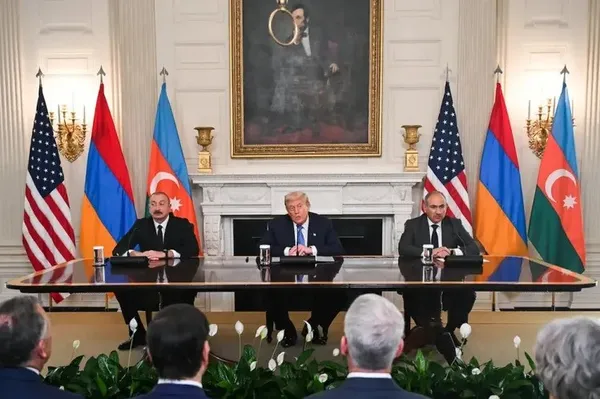
However, the realization of this depends largely on the implementation of the Trump Route project, which has encountered many problems. The corridor has been a strategic priority for Baku, but for Yerevan it is a factor in the socio-political divide among the Armenian people. On August 7, Pashinyan spoke with Aliyev by phone, and the two sides, while noting the progress in normalizing relations, emphasized the implementation of the Trump Route project as the next step to transform political peace into a sustainable economic bond.
In his conversation with Trump, Aliyev listed the export of oil products to Armenia, the transit of goods through Azerbaijani territory, and the start of trade relations as achievements of the past year, and announced that the operation related to the Trump Route in Azerbaijan has reached the final stages and is waiting for the start of work in Armenia. Pashinyan, referring to Yerevan’s readiness to begin construction operations in Syunik province, emphasized that Armenia has a transparent and public position on the implementation of this corridor and will respond to all concerns. However, experts believe that despite the Armenian side’s promise to begin commitments by the end of the year, the practical implementation of the project faces serious uncertainties.
The main goal of the corridor, in addition to connecting the Azerbaijani mainland with Nakhchivan and Turkey, is to ensure control of the transit routes of the South Caucasus by American and transnational companies, especially in the vicinity of Iran. In January of last year, the Trump Route Special Fund (later renamed the Trans-Caspian Entrepreneurship Fund) was established under the management of Konstantin Sokolov, an international investor of Russian origin. Sokolov, who is of Jewish descent, controls assets in Armenia, including the telecommunications operator Viva Armenia and the copper mine Molybdenum Teghut. Aryeh Lightstone, a senior adviser to Steve Witkoff and the Trump Peace Council, also traveled to Yerevan in mid-August to present a model for normalizing relations in the Caucasus, based on his experience with the Abraham Accords.
According to the agreements reached between the two countries, the corridor will operate from Syunik province, preserving Armenian sovereignty and under the supervision of the country's customs and border, but in practice, the Trump Route Special Fund, established by Washington and Yerevan, has received exclusive rights to use the land and build in the relevant areas for 49 years (with the possibility of extension up to 99 years). The shares of the company are such that 74% of it is in the hands of the United States and 26% in the hands of Armenia, and if extended, Armenia's share will increase to 49%.
The Armenian government, which is deeply dissatisfied with the operationalization of this corridor, has warned that "instability in the region" (referring to Iran) could jeopardize the operationalization of this corridor. In the meantime, Iran, after winning a regional war, has expressed concern about the presence of the United States near its northern borders and has called for mechanisms to manage risks.
