

China's No. 2 Military Officer Under Investigation for Nuclear Spying for US
TEHRAN (Defapress) - The People's Liberation Army (PLA) has seen one of the most extensive anti-corruption purges in its top leadership in recent months. China's Defense Ministry recently confirmed that General Zhang Youxia, the country's number two man, has been investigated. The case is the most high-profile in President Xi Jinping's anti-corruption campaign to rid the military of corrupt elements.
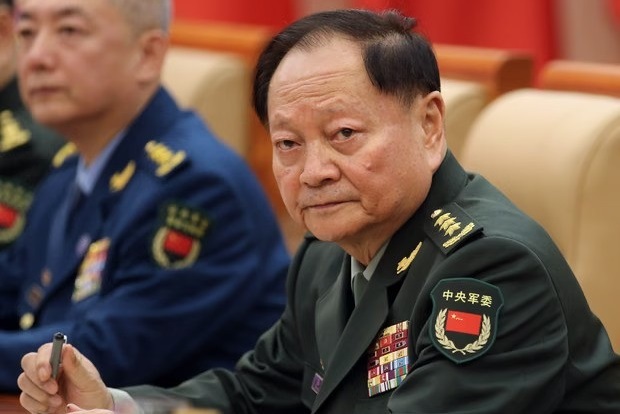
General Zhang Youxia serves as vice chairman of the Central Military Commission (CMC), China’s highest military command, and is considered one of Xi Jinping’s closest allies in the military. At the same time, Liu Zhenli, the chief of the Joint Staff of the Central Military Commission, has suffered a similar fate. The investigation was launched on serious allegations of violations of discipline and law, and reflects the depth of the Chinese government’s commitment to fighting corruption, especially in the military’s hard core.
Xi Jinping’s anti-corruption campaign began in 2012 and made the military one of its main targets. The efforts intensified in 2023, targeting the People’s Liberation Army’s Rocket Force. Zhang Youxia’s removal is now the second removal of a general serving on the Central Military Commission since the Cultural Revolution (1966-1976).
According to the Wall Street Journal, which cited people who attended a top-secret meeting, General Zhang Youxia is accused of passing classified information about China’s nuclear weapons program to the United States and accepting bribes for things like promoting an officer to the position of defense minister. Although the reports have not been independently verified, they are significant given the tense Sino-US relations.
General Zhang is also a member of the ruling Communist Party’s Politburo and is one of the few senior officers with actual combat experience, having last appeared in public during a meeting with the Russian defense minister in Moscow on November 20. But his absence from the public eye since then has fueled speculation.
Zhang Youxia’s career traces the rise of a military officer in China’s military system. He was born in Beijing in 1950 and joined the army in 1968. General Zhang participated in the brief but bloody border war with Vietnam in 1979, which China launched as punishment for Vietnam’s invasion of Cambodia.
General Zhang was sent to the front at the age of 26 and, according to state media such as the China Youth Daily, performed excellently in both offensive and defensive operations. He also participated in another border conflict with Vietnam in 1984. These combat experiences have distinguished Zhang as an experienced and modern military commander.
Chinese analysts have noted that he learned lessons from these conflicts about military tactics, advanced weaponry, and the need for a trained force. In 2012, General Zhang became a member of the Central Military Commission, quickly rising to the rank of vice chairman, as the People’s Liberation Army’s modernization program accelerated.
The purges are part of Xi Jinping’s broader efforts to tighten control over the military. In October 2025, eight senior generals, including He Weidong, a former vice chairman of the Central Military Commission, were expelled from the Communist Party on corruption charges. He Weidong had been expelled from the party and military in October of the previous year and was replaced by Zhang Shengmin. Two former defense ministers have also been purged from the party in recent years for corruption.
The measures have not only affected the purchase of advanced weapons but have also reduced the revenue of some of China’s largest defense companies. Foreign diplomats and security analysts are watching the developments closely because General Zhang is close to Xi Jinping, and the Central Military Commission plays a key role in commanding, modernizing, and positioning the People’s Liberation Army. China has not fought a war in recent decades, but it has taken a more aggressive approach in the East and South China Seas and has strengthened its claim to Taiwan. The massive military exercises around Taiwan late last year were the most dramatic example of this approach.
Despite the purges, the country’s military’s day-to-day operations have continued unabated. James Char, a Chinese security researcher at the S. Rajaratnam School of International Studies in Singapore, believes that Xi Jinping is using second-line officers from the People’s Liberation Army to temporarily fill vacant positions. He stresses that the moves are a response to criticism that the purges are selective.
However, China’s military modernization efforts remain focused on achieving Xi’s twin goals of completing the basic modernization by 2035 and transforming the PLA into a world-class armed force by 2049. These goals include improving technology, training, and operational capabilities, which Zhang, as a war veteran, played a key role in advancing.
Ultimately, the investigation of Zhang Youxia is a symbol of Xi Jinping’s commitment to uprooting corruption in the military, even at the cost of removing close allies. Such purges could boost public confidence in the PLA, but they also risk instability in military leadership.
Finally, as China faces external challenges such as maritime tensions and troubled relations with the United States, maintaining the unity of the military seems crucial. Time will tell whether this campaign will strengthen the People’s Liberation Army or negatively impact its pace of modernization. Given Zhang’s record in border wars and his role in modernization, replacing him will be a challenge for Xi Jinping, but the commitment to long-term goals is likely to continue.
