
End of the American Order with the Useless Mecca Pact
TEHRAN (Defapress) - The joint defense agreement known as the "Mecca Pact" among Pakistan, Saudi Arabia, and Turkey, recently signed amid immense media noise and structured with clauses similar to NATO's Article 5, has not yet shown clear effectiveness in real-world crises. Although the signatories strive to portray it as a fundamental shift in the region's security architecture, early reactions to operational developments show how cautious and hesitant this coalition can be in implementation.
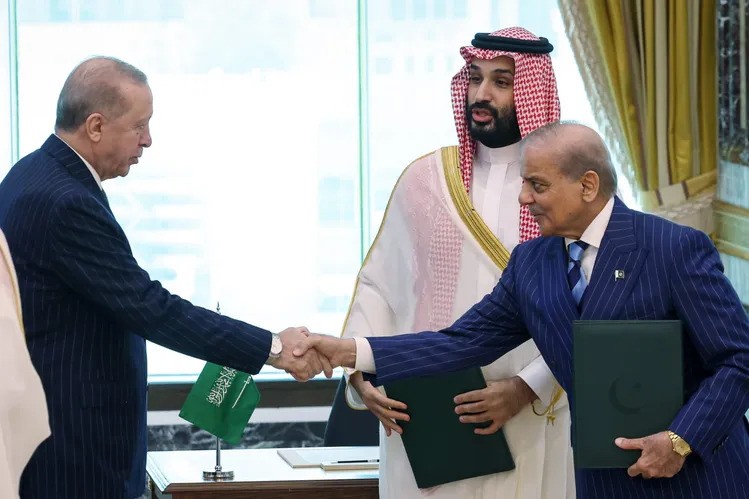
In its assessment of the treaty, the Center for Strategic and International Studies (CSIS) believes that rather than being a flawless and guaranteed defense mechanism, this alliance reflects regional actors' drive to fill the vacuum created by shifting U.S. policies in West Asia. It is a move that, while challenging the traditional power structure, leaves its long-term stability and effectiveness fraught with serious uncertainties, offering little prospect for a clear outlook.
The full text of the analysis reads as follows:
Pakistan, Saudi Arabia, and Turkey signed a joint defense agreement known as the "Mecca Pact" on August 7th. None of the parties released an official text regarding the terms of the agreement; however, reports indicate that the three nations essentially agreed to a clause akin to NATO's Article 5, a provision stipulating that an attack on one signatory is considered an attack on all. On paper, this security guarantee carries immense weight: it obligates Saudi Arabia and Turkey to defend Pakistan in the event of a war in South Asia, while Saudi and Pakistani troops would join the fight should a potential Israeli conflict with Turkey erupt in Syria or the Eastern Mediterranean.
Nevertheless, these commitments were put to the test merely 48 hours after the signing ceremony when Ansar Allah fired at the Saudi Aramco oil refinery in Jizan, southwestern Saudi Arabia. Even though Saudi Arabia had been under continuous Ansar Allah fire since July 13th, Saudi leaders did not request assistance from their new partners. While some assume this restraint stems from Saudi leadership not taking the Ansar Allah threat seriously, what is closer to the truth is that despite the grandiose announcement of a new security pact, Saudi leaders did not believe Turkish and Pakistani leaders were eager to join a fight on the Arabian Peninsula.
Of course, the superficiality of this clause does not lessen the Mecca Pact's significance. Its primary importance lies not in its security guarantees, but in signaling a transformation taking place in the regional order of West Asia, a shift that diminishes the decades-long leadership role of the United States.
Since the 1970s, the U.S. has nurtured and led a regional order encompassing Bahrain, Egypt, Jordan, Morocco, Qatar, Saudi Arabia, Turkey, the UAE, and practically Israel. Other nations, such as Oman and Kuwait, also played unique roles in this regional architecture. These relationships made pursuing Washington's core interests in West Asia relatively easier and less costly, interests such as preventing threats to the free flow of oil, helping guarantee Israel's security, and preventing any single country or coalition of countries from challenging U.S. dominance in the region.
The U.S. was generally successful in achieving these objectives, even accounting for notable setbacks such as the 1973 Arab oil embargo and the 1979 Islamic Revolution in Iran, which managed to overthrow an authoritarian regime. Following the short-term disruption of the global oil market and the deep recession it created in the 1970s, oil was never effectively weaponized again, Israel's security was largely secured, and the U.S. remained the guarantor of regional security. All of this would have been vastly more difficult and consumed far greater resources without Washington's regional partners.
However, following the inconclusive wars in Afghanistan and Iraq, debates within American think tanks and decision-making circles pivoted toward military withdrawal and cost-cutting in the region. The idea that West Asia no longer mattered coincided with the notion that guaranteeing the flow and safety of regional energy sources was rapidly becoming obsolete.
One argument supporting this view pointed to the substantial surge in U.S. domestic oil and gas production, leading some American analysts and experts to suggest that an energy-independent America could safely withdraw from the region. Another argument, somewhat naively, assumed that protecting the region's oil fields was unnecessary given the transition to alternative energy sources. The first argument conveniently overlooked the reality that energy markets are global, meaning threats in one part of the world still impact American consumers. The second claim severely minimized the immense challenge of decarbonizing the energy system and society at large.
Since Donald Trump took office, his transactional and personal style of diplomacy has amplified American unpredictability. Consequently, in the ongoing friction with Iran that escalated into a regional conflict, the U.S. has oscillated between force, threats of force, and negotiation. Washington's regional partners were often left completely in the dark regarding Trump's sudden shifts in posture, yet they paid a high price during the regional war with Iran by being directly targeted by Iranian strikes. Trump's pattern of engagement during this regional crisis has left several U.S.-allied nations in the region wondering if they will be left to stand alone against a powerful Iran.
These doubts are clearly manifested in the Mecca Pact, where the Saudis, visibly anxious about U.S. reliability, are now actively seeking alternative avenues to safeguard their security. For Saudi Arabia, it is initially irrelevant that Turkey and Pakistan lack the military capability of the U.S.; Riyadh and its new security partners are pursuing a new order that allows them to shape the region without American intervention.
For Pakistan and Turkey, both U.S. partners dissatisfied with American power projection, the Mecca Pact serves as a vehicle to expand their influence in the Persian Gulf at the expense of their respective rivals, India and Israel. Turkish President Recep Tayyip Erdoğan also holds an ideological commitment to this new security arrangement, given the long-standing affection among Turkish Islamists for creating an "Islamic NATO." Riyadh and Ankara have even gone a step further by proposing a rerouting of the railway network that forms part of the IMEC corridor.
Under this proposed detour, instead of goods traveling from Jordan to Israel and connecting to Europe via Cyprus and Greece, the transit route would bypass Israel entirely, stretching from Saudi Arabia through Jordan, moving north into Syria, reaching Turkey, and ultimately delivering goods to European markets.
The U.S.-aligned regional order could now fragment into a West Asia with at least two distinct blocs: countries committed to the Abraham Accords and those aligning with its alternative, the Mecca Pact. Previously, regional rivalries and disputes were kept in check because regional leaders prioritized their ties with the United States; the relationship with Washington served as the linchpin holding West Asia's regional order together. Now, with Pakistanis, Saudis, and Turks shaping their national policies around a vision directly competing with the Abraham Accords, the era of the American-led order in West Asia appears to be drawing to a close.
This is a monumental shift, and there is no need to exaggerate it. After five decades, one can no longer speak of a U.S.-led order in West Asia.
