
Conundrum of Rebuilding the Syrian Army After Bashar Al-Assad
TEHRAN (Defapress) - A country that has been embroiled in a devastating civil war for more than a decade, Syria is now facing enormous challenges in its reconstruction, a year after the fall of Bashar al-Assad’s regime. With Assad’s fall in December 2024, not only did the Ba'ath Party era end, but the country’s security and military structures also completely collapsed.
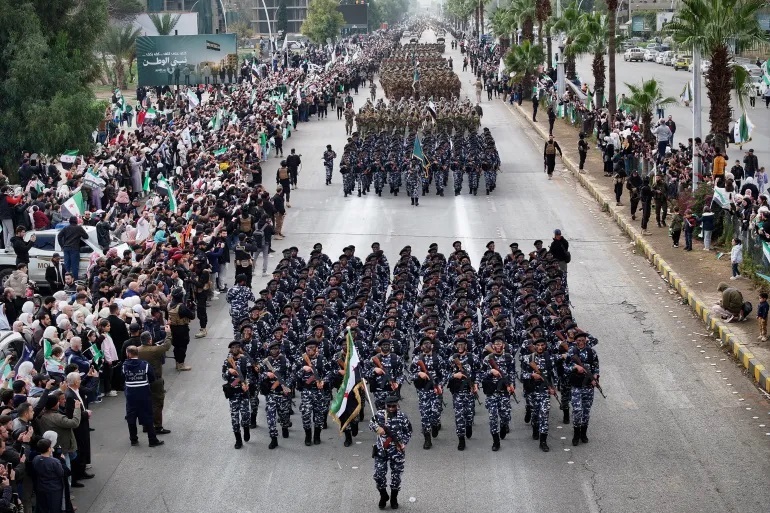
The new regime, led by Jolani, has prioritized rebuilding the national army, an army designed to protect the regime and the territorial integrity of a shattered Syria. But the process, like building a fortress on earthquake-stricken ruins, is fraught with obstacles.
For decades, the Syrian army served Bashar al-Assad in the fight against the Free Syrian Army and, later, Takfiri elements and ISIS; But this structure collapsed in the early hours of December 8, 2024, with the fall of the Assad government. Many officers and soldiers fled, some went into hiding, and others handed over their weapons. In the early days, Israel destroyed 80 percent of Syria’s strategic military capabilities with more than 600 airstrikes. These attacks, which included the destruction of ground, air, and naval equipment, effectively brought the Syrian army back to zero.
But the new government has begun rebuilding, using forces from the HTS terrorist group, which has about 40,000 fighters. “We have begun the process of rebuilding the army, and we will build a worthy Syrian army that represents the nation and repels challenges,” Defense Minister Murhaf Ahmed Abu Qasra said at a ceremony at the Aleppo Military Academy.
He spoke of developing all branches of the army, increasing military readiness, and issuing disciplinary laws. However, analysts warn that this path is long and difficult. "If Syria fails to integrate all the armed forces and former opposition groups into the Syrian National Army, it risks disintegration and collapse, because without unity, internal conflicts could drag Syria back to war," Caroline Rose, director of military priorities at the New Lines Institute, told Al Jazeera.
Challenge 1: Vetting new recruits
One of the biggest obstacles is the vetting process for recruits. After the fall of the Assad regime, thousands of young men aged 18 to 23 joined the army due to a lack of economic opportunities caused by sanctions and war. This rapid recruitment has bypassed the vetting process and created security problems. "This is not a simple recruitment process, and different sectors need to be integrated. Given the current situation, after a year or two, we can be more selective."
Foreign and Takfiri mercenaries who played a role in the war against Assad are another problem in the reconstruction of the Syrian National Army. Western powers, including the United States, have warned that these individuals should not be placed in key positions. Jolani has repeatedly stressed that they are not a threat and will not be placed in sensitive positions. However, tens of thousands of Assad’s army’s junior and senior officers, estimated by the Middle East Institute to number around 70,000, remain unsettled. These experienced individuals could pose a major threat to the Jolani regime if they are not integrated into the Syrian National Army.
Challenge 2: Equipment and External Dependency
The Syrian army under Assad was heavily dependent on the military power of Russia and Iran, and they were not very resilient without their support. However, after Assad’s fall, relations changed, and they benefited from the support of Saudi Arabia, Qatar, and the United States. Jolani is also trying to strengthen its relations with Russia.
Rob Guest Pinfold, an international security expert at King’s College London, emphasizes: “The biggest challenge for the new Syrian army is its Russian doctrine and equipment. It still has to rely on Russia for spare parts and ammunition, which creates leverage for Moscow and complicates Syria’s relations with the United States as the Trump administration seeks to distance Damascus from Tehran and Moscow’s influence.”
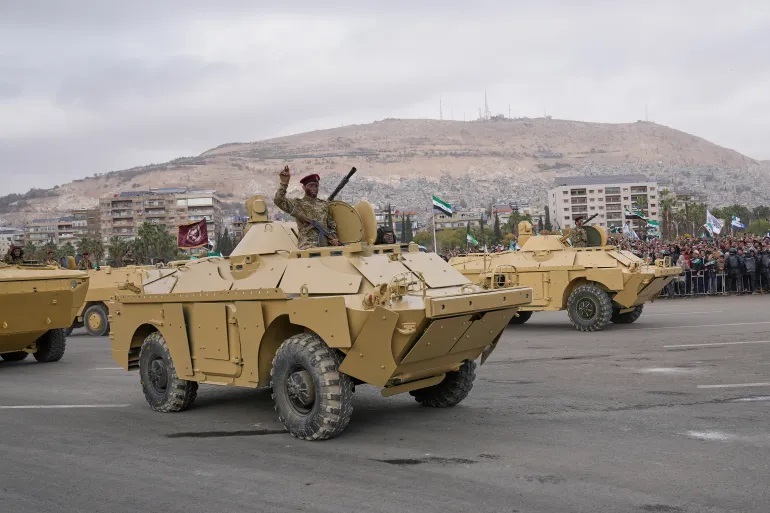
International support, however, is growing. The United States is playing a role in bolstering intelligence, surveillance, and reconnaissance (ISR) capabilities and, as Syria joins the global coalition against ISIS, has sent training advisers to counter the potential threat of a resurgent ISIS group.
Turkey also signed a defense contract in August 2025 and will train 49 Syrian cadets (10 army, 18 navy, and 21 air force) at its military academies. But this aid cannot, overnight, overcome the deep dependence on Russian equipment. The Syrian military must choose whether to continue with Russian systems or shift to Western and Turkish equipment. The decision is not just technical, but deeply political, and could determine the course of Syria’s foreign relations for years.
Challenge 3: Integrating Forces and Winning the Trust of Minorities
Integrating diverse armed groups and avoiding membership in terrorist attack groups is the only key to forming a national army. The core of the new army is made up of HTS and smaller anti-Assad and Takfiri groups, but these forces alone are not enough to control the entire country. The Jolani regime’s Ministry of Defense, under the supervision of the Ministry of Interior and Internal Security, has merged many different departments and appointed new commanders.
However, one of the biggest obstacles is the Kurdish Democratic Forces in the northeast of the country. An agreement was signed in March 2025 to merge the Kurdish Democratic Forces by the end of the year, but progress has been slow and sometimes tense. The negotiations continued until late 2025, and, likely, a merger agreement will not be reached until mid-2026. Under the plan, the Kurdish Democratic Forces would be divided into three divisions and several independent brigades.
Moreover, sectarian incidents such as the massacres in the coastal (Alawite) and Sweida (Druze) regions in 2025 have severely damaged the trust of minorities. Accordingly, “Polls show that most Sunni Arabs trust the army and the government, but minorities see it more as a sectarian militia that not only does not protect, but also threatens their interests and security.”
This lack of trust could lead to secession and jeopardize the stability of the country. Therefore, for the army to succeed, it must increase its internal legitimacy and include minorities in the command structures, demonstrating that the Syrian army represents all of Syria and does not belong to any particular religion or group. Without such steps, the risk of a return to sectarian conflict is inevitable. External threats, especially the ongoing Israeli aggression that has already destroyed much of Syria’s defense capabilities, require the formation of a unified and efficient defense structure.
This reconstruction will only be sustainable if it goes beyond unifying domestic armed groups and creates an inter-sectarian and professional force capable of defending Syria’s territorial integrity against any external aggression. Without such a shield, the cycle of vulnerability and external aggression will repeat itself.
