
How Does the Enemy Protect Its Tankers?
TEHRAN (Defapress) - Mohammad Zarchini - The US military is pursuing its air operations with targeted methods; this is a good opportunity for Iran to disrupt this path.
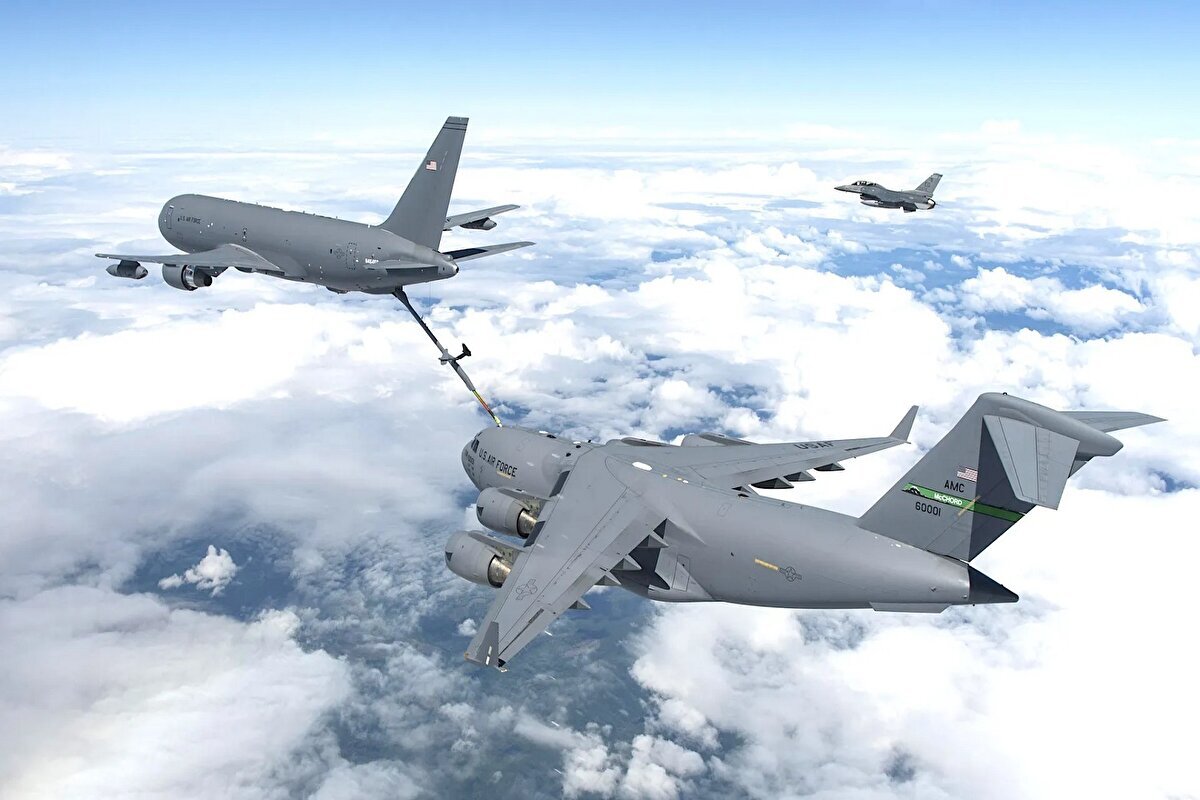
Field sources report that the US is seeking to protect its refueling systems. The War Zone website says in this regard: The US Air Force is exploring new methods to protect aerial refueling tankers and other high-value support aircraft; methods that are based on the “physical destruction” of incoming threats, rather than attempts to disrupt or divert them electronically. The service has stated that a “kinetic” (kinetic/physical) defense option could provide valuable performance against anti-aircraft interceptor missiles as a last line of defense that could withstand some types of electronic warfare attacks.
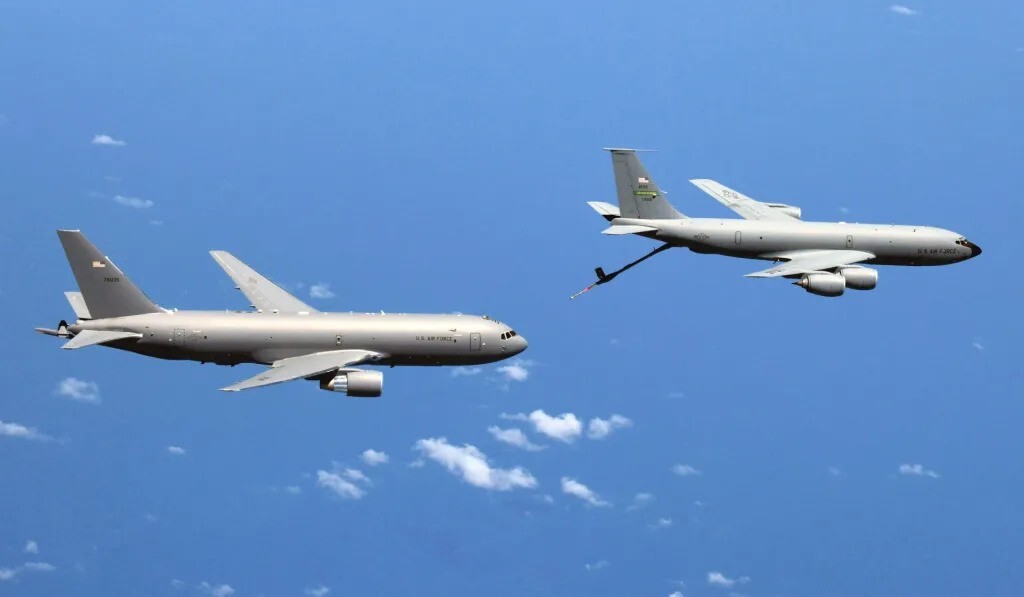
Kevin Stamey, executive director of the U.S. Air Force’s Mobility Program and director of the Mobility Office at the Air Force Lifecycle Management Center (AFLCMC), said in a recently released official interview about the kinetic defense capability of U.S. tankers: “The current “mobility” portfolio of the service includes KC-46 and KC-135 tankers and C-130, C-17 and C-5 transport aircraft; so some of the technologies that we are really looking at are kinetic protection for our high-value air assets.”
He added: “As the threat evolves, we are trying to develop a capability to protect our tankers that is independent of the nature of the threat. We consider kinetic defenses to be a kind of last-line defense. If all else fails and a threat somehow breaks the kill chain, we still have a means of protecting the tanker. Whether it’s an infrared seeker or a radar, if we have a means of physically destroying it, we don’t need to attack it electronically or use decoys that are effective against some threats, but not all.
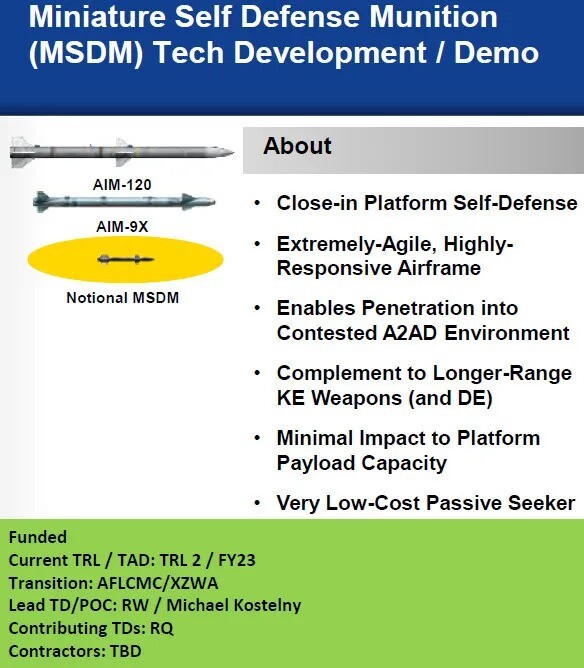
In 2015, an Air Force Research Laboratory (AFRL) project called the Miniature Self-Defense Munition (MSDM) was publicly announced; at the time, the U.S. Air Force Research Laboratory reported that it was looking for a miniature missile with “extreme agility and very fast response,” equipped with a “very low-cost passive seeker,” and with an overall length of about 3.3 feet (one meter). For comparison, that’s about a third the length of the AIM-9X Sidewinder missile, and even shorter than the AIM-120 AMRAAM missile.
The Air Force Research Laboratory initially hired both Raytheon and Lockheed Martin to work on the MSDM program. In 2020, Raytheon was awarded an additional contract for what was then described as a “miniature self-defense missile.” The stated scope of work for this new contract included “research and development of a flight-test-ready missile.” All of this clearly seemed like a continuation of previous MSDM efforts, although, despite a slight name change, Raytheon has apparently not publicly demonstrated even a preliminary concept of the MSDM interceptor to date.
It’s also worth noting that Northrop Grumman was awarded a patent in 2017 for an aircraft kinetic protection system based on a miniature interceptor. The accompanying images, some of which can be seen below, showed the system mounted on a “futuristic” concept fighter aircraft.
In 2018, the US Navy also issued a relatively open call for information on possible options for a “Hard Kill Self Protection System” for transport aircraft, tankers, and other combat support aircraft. It was also suggested that the system could be used on future drones. The call notice called for a system capable of launching a swarm of miniature, highly maneuverable interceptor missiles, and that it could provide “an alternative and/or complement to more conventional personal electronic defense solutions.”
Other kinetic defense concepts for aircraft have been proposed in the past that do not involve firing a miniature missile at another missile. In 2012, the Israeli company, Rafael, demonstrated a system that was essentially a “hard kill” active protection system for armored vehicles and was designed to be mounted on a helicopter. For a while, at least in the 2010s, the US Navy also had a program called “Helicopter Active Protection Against RPGs” that seemed to focus on a similar, if not identical, concept.
Finally, in recent years, the Air Force has been testing the ability of its KC-135 tankers to launch small drones for self-defense and a variety of other purposes. Compared to a miniature missile, an unmanned aerial system could offer valuable survivability and provide different options for engaging or re-engaging incoming threats, especially if they are fired in batches. This, in turn, can prevent interceptors from being wasted if their primary target is destroyed first by something else.
Laser-guided infrared protection systems are now found on tankers and transport aircraft throughout the U.S. armed forces; however, they are designed to blind and confuse heat-seeking missiles, not destroy them. These systems do not affect radar-guided interceptors. Efforts to develop airborne directed energy weapons capable of destroying targets, including incoming missiles, have faced significant challenges and have not yet resulted in an operational capability.
The Air Force is also developing self-defense systems for tankers and other high-value aircraft that are housed in modified Multipoint Refueling System (MPRS) pods.
Any kinetic defenses would also need to be connected to sensors, including infrared search and track (IRST) systems and/or radars, to detect incoming threats that may be moving at very high speeds and direct interceptors to engage; the ever-improving networking capabilities that are another priority for Air Force mobility fleets could allow for a distributed sensor network across multiple platforms. The use of “Refueler Guard” drones, known as “Loyal Wingman,” is another strategy the Air Force has already been exploring to help protect tankers, in particular.
In any case, the Air Force has clearly identified a continuing desire for a kinetic defense capability for tankers and other valuable support aircraft. Although Stamey did not explicitly state this in his interview, his remarks certainly reflect deep concerns about the United States’ ability to defend its strategic assets against other competitors.
Weapons that use imaging infrared seekers are remarkably immune to radio frequency electronic jamming, as well as design features that reduce radar cross-sections. They are also passive in nature, meaning they do not emit a signal that would alert the aircrew that they are under attack. The increasing use of infrared sensor capabilities on aircraft and as part of surface-to-air missile systems will create additional challenges in identifying threats.
The U.S. Air Force is also pursuing “cognitive electronic warfare” capabilities to help speed up these processes. Questions about the appropriate mix of active and passive defenses will also likely be at the center of the Air Force’s ongoing refinement of its plans for future tankers and transport aircraft.
Given that a war between Iran and the United States may occur in the near future, Iran has a good opportunity to destroy American tankers as a strategic asset and the Achilles heel of the continuation of the American war; therefore, the armed forces of the Islamic Republic of Iran must try to take the necessary countermeasures against American strategic assets with a fundamental solution; this fundamental solution could seriously disrupt the military operations of the United States Army in the West Asia region.
