
Does Iran Need Military Support from China and Russia?
TEHRAN (Defapress) - Mohammad Zarchini - As the military threats from the United States and its allies, including the Zionist regime, against the Islamic Republic of Iran intensify, the armed forces of the Islamic Republic of Iran are preparing themselves for a possible long-term conflict with their enemies.
As we have witnessed in recent weeks, Iran and the United States have prepared a large amount of equipment for a long-term conflict; For example, the United States military is preparing for a full-scale conflict by sending two battle groups led by the aircraft carriers Abraham Lincoln and Gerald R. Ford to the West Asia region and the Mediterranean Sea (although the Gerald R. Ford has not yet reached its pre-determined position to defend Israel, but will soon be deployed there) and sending hundreds of fighter jets.
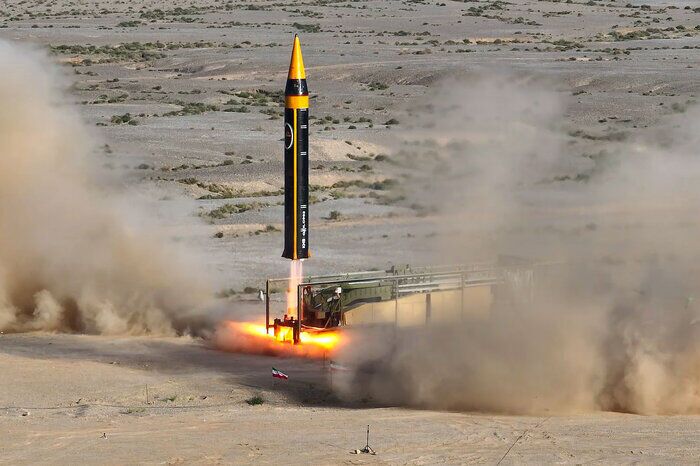
On the other hand, the armed forces of the Islamic Republic of Iran are strengthening their combat capabilities on several fronts. For example, the addition of Khorramshahr hypersonic ballistic missiles and strengthening the country's air defenses could greatly help Iran in a possible confrontation with the United States, but the question that arises is to what extent will Iran's and the US's allies support and accompany these two countries in a possible military conflict?
America’s regional and extra-regional allies have repeatedly emphasized that they will not provide land or military bases to the United States military in a possible war with Iran, and that it is America that must fight against Iran itself. Even the UK monarchy recently announced that it will not provide the Diego Garcia base to the US military; in parallel, Arab and Islamic countries in the region, such as Saudi Arabia, Turkey, Jordan, Qatar, Oman, and Kuwait, have also announced that they will not participate in a possible confrontation with Iran, but have also announced that they will not allow military action against Iran from their territory.

Another form of support for the allies of the US could be equipment and political support, and so far, none of the extra-regional powers (albeit in appearance) have announced their support for the US in a war with Iran. "The situation in Iran is very sensitive, and we do not need another war in the region," said Kaja Kallas, the EU's foreign policy chief. "We must emphasize a diplomatic solution to this situation; we are also ready to help in this direction," she added.
This stance by the EU foreign policy chief shows that although the Europeans may be supporting the United States militarily behind the scenes, they are outwardly opposed to any military attack on Iran.
The opposite of America’s allies in the war with Iran is China and Russia; Moscow and Beijing have repeatedly announced their support for a diplomatic solution to Iran’s nuclear program. In the military sphere, there have also been reports of military and equipment cooperation between the two sides and an increase in these interactions.
For example, foreign media claim that dozens of military shipments and a large amount of military equipment and facilities have been transferred from China and Russia to Iran (of course, this is media speculation and has never been officially announced or confirmed by our country’s officials). Foreign media also claim that Emad ballistic missiles and Shahed drones have been transferred from Iran to Russia, which has also not been confirmed so far, and has mostly been speculation by media members. Kazem Jalali, Iran's ambassador to Russia, says in this regard: "We have no secret issues with Russia, and all military contracts that have existed between Iran and Russia in the past are being implemented and being carried out."
The media has also raised various speculations about military cooperation between China and Iran, including the possibility of delivering advanced "YLC-8" radars, "J-10" and "J-20" fighters. In this regard, the "Defense Security Objects" website says in an article titled "Will Advanced Chinese Radars Rewrite the Air Power Equations in the West Asian Region": Sending radar systems from China to Iran and deploying these radar systems in Iran will significantly change the balance of power in favor of "Tehran"; these radars will be a real challenge to the fifth and sixth generation fighters of the United States and Israel. The website adds: The People's Republic of China has delivered its advanced radar systems to Iran, a move that is considered a significant change in the military balance of the region; several media outlets and defense experts have announced that the delivery, which was first reported in early February 2026, will significantly enhance Iran's air defense capabilities.
The second phase of Chinese and Russian support for Iran could include support for the purpose of defending the territory, but this is fundamentally against the Constitution of the Islamic Republic of Iran, because according to our country's Constitution, a foreign country does not have the right to establish a military base in Iran. "Article 121 of the Constitution" of the Islamic Republic of Iran states in this regard: The establishment of any foreign military base, even if it is for peaceful purposes, is prohibited in Iran; therefore, territorial protection of Iranian territory by China and Russia is completely ruled out; in addition, Iran does not need territorial protection or for a country to enter into war with a third party in its favor.
In addition to the above reasons, two countries that want to have territorial support for each other through military forces must sign a mutual defense treaty with each other, which Iran currently does not have with any country (with the dimensions of mutual territorial defense); strategic military treaties may be aimed at mutual equipment support, but territorial military support is not defined in this framework. For example, the Russian and North Korean armies have an extensive military treaty with each other in the field of territorial and equipment support, and the North Korean army sent 10,000 containers of ammunition and thousands of soldiers to help Russia in the Ukrainian war, which allowed the Russian army to make advances in eastern Ukraine and take back the strategic area of "Kursk" from Ukraine.
Considering the above points, it is possible that Iran may have received equipment from allied countries such as China and Russia in the form of strategic treaties or provided them with equipment. However, regarding territorial protection, apart from the fact that there is no treaty between the two countries in this regard, it is also against the Constitution of the Islamic Republic of Iran, and, fundamentally, Iran, given its defense capabilities, does not need foreign support for territorial defense.
