
From Gandhi to Modi: India's Moral Collapse in Israel's Embrace
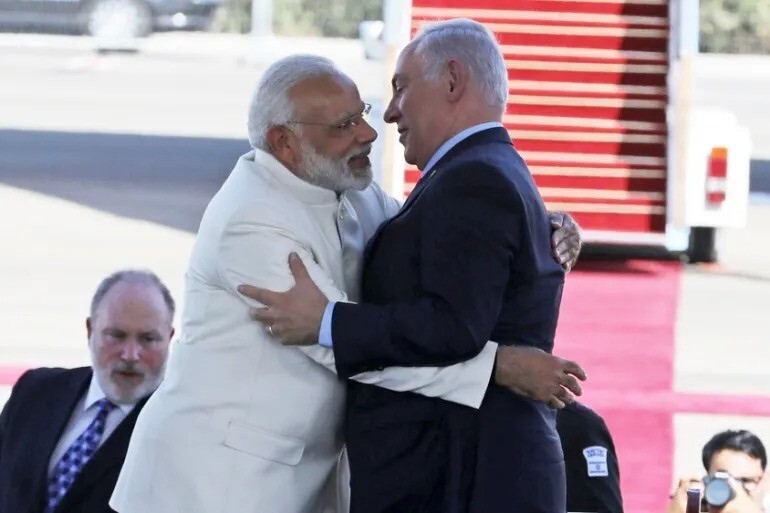
TEHRAN (Defapress) - On July 4, 2017, Indian Prime Minister Narendra Modi stepped off his plane at Ben Gurion Airport. Israeli Prime Minister Benjamin Netanyahu was waiting for him at the end of the red carpet on the runway. Minutes later, the two embraced. Modi described the trip as a "groundbreaking trip" in his speech at the airport.
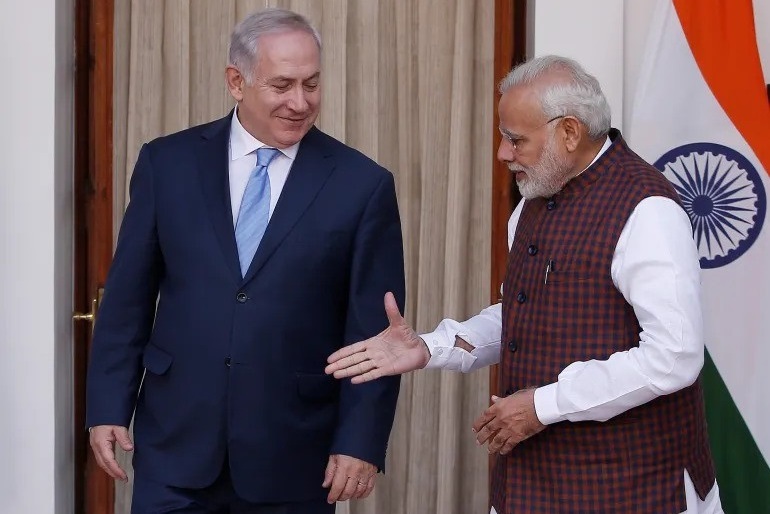
It was the first time in history that an Indian prime minister had visited Israel. Netanyahu also referred to their first meeting in New York in 2014, when they agreed to remove the remaining walls between India and Israel.
Nine years after that meeting, as Modi prepares for his second visit to Israel on February 25, analysts believe he has largely achieved that goal. A relationship once frowned upon in India and pursued in secret has now become one of New Delhi’s most open and public friendships.
Modi has repeatedly called Netanyahu his “dear friend,” even as the International Criminal Court issued an arrest warrant for the Israeli prime minister in late 2024 on charges of genocide in Gaza.
Indian diplomats and officials justify the turn toward Israel as a “pragmatic approach.” They argue that Israel, with its vast technological and military expertise, offers opportunities that it would be illogical for India to ignore.
At the same time, New Delhi has sought to strike a balance by strengthening ties with its Arab allies. However, analysts believe the shift has come at a high cost, both for Palestine and India’s relations with it, and, some experts say, for India’s moral credibility.
“India’s so-called realist turn has cost it the moral authority it once enjoyed in the global South,” said Anwar Alam, a senior fellow at the Foundation for Policy Perspectives in New Delhi. He told Al Jazeera that in the context of the ongoing war in the Palestinian territories, Modi’s visit “means legitimizing the apartheid state of Israel.”
India’s historical record of support for an independent Palestine
India has been a staunch supporter of Palestine in the post-colonial world order. Its leaders have consistently advocated for Palestinian independence. In 1947, India opposed the United Nations’ partition plan for Palestine. Four decades later, in 1988, India was one of the first non-Arab countries to recognize Palestine.
The end of the Cold War, despite India's official policy of non-alignment and its inclination towards the Soviet Union, changed New Delhi's calculations, and alongside its rapprochement with the United States, India established formal diplomatic relations with Israel in January 1992. Since then, defense ties have served as a main pillar of this relationship, and in recent years have expanded to other areas.
Ideological alliance under Modi
Narendra Modi’s rise to power in 2014 was a major turning point in the transformation of relations between India and Israel. Modi’s Bharatiya Janata Party (BJP) pursues a Hindu nationalist ideology that is based on transforming India into a Hindu nation.
This view is in many ways similar to Israel’s view of itself as the homeland of the Jews. Both sides see “Islamic terrorism” as the main threat. Critics of such reforms see it as a pretext for pursuing broader anti-Muslim policies.
Under Modi, India has become Israel’s largest buyer of arms. In 2024, during Israel’s war on Gaza, Indian arms companies sold missiles and explosives to Israel, according to an investigation by Al Jazeera.
Ahead of the upcoming trip, the two signed a memorandum of understanding aimed at further deepening defense cooperation. India is considering joint development of an anti-ballistic missile defense system with Israel. Modi is also scheduled to address the Knesset.
"Modi's speech is special because it highlights the scale of the shift in relations under the Bharatiya Janata Party towards a more openly pro-Israel policy," Max Rodenbeck, project director for the Israel-Palestine division of the Washington-based Crisis Group, told Al Jazeera. He added that the trip also has a personal dimension for Netanyahu.
Israel is due to hold national elections in a few months, which have effectively become a referendum on Netanyahu's government. However, Netanyahu's successive setbacks, from the October 7 invasion to his failure to bring the Gaza war to fruition and his attempts to weaken the independence of the judiciary through reforms, have meant that the referendum results are unlikely to go to Netanyahu's liking.
Rodenbeck stressed that the visit was “almost a personal favor to Netanyahu to bolster his image as an international politician at a time when Israel’s election campaign is underway.” While several Western leaders have visited Israel since the start of Israel’s genocidal war on Gaza in October 2023, very few leaders from the Global South have done so.
Modi’s visit is particularly significant as the Gaza war has narrowed the circle of countries willing to be seen as Israel’s friends, especially among emerging economies.
“Israel doesn’t have many friends globally right now; so India is playing that role,” said Kabir Taneja, executive director of the Middle East office of the New Delhi-based think tank The Watchdog. “[Modi’s trip] kind of shows that Israel is not completely isolated,” he added.
2017 visit and achievements
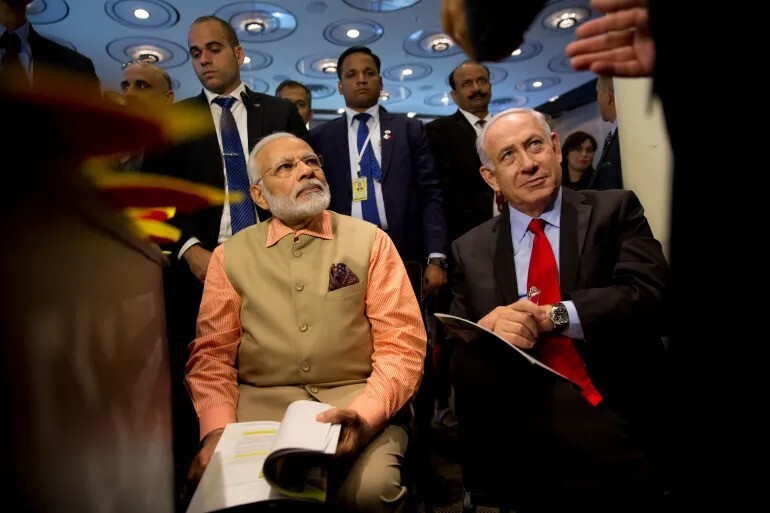
Modi’s upcoming trip builds in many ways on his July 2017 visit, which analysts see as a defining moment in bilateral relations. Before that, no Indian prime minister had visited Israel, and even low-level diplomats often combined a visit to Israel with a trip to the Palestinian territories.
Modi broke with this tradition. He did not visit Palestine in 2017 and only visited there in 2018, when he hosted Netanyahu in New Delhi. That visit was also the first by an Israeli prime minister to India. Modi’s 2017 visit has recently come under renewed scrutiny. An email released by the US Department of Justice in the Jeffrey Epstein case showed that he had advised a billionaire close to Modi during the trip.
After the July 6 visit, Epstein emailed an anonymous person he called “Jabor Y” and wrote: “PM Modi consulted and danced and sang for the US President in Israel. They met a few weeks ago.” India’s Ministry of External Affairs dismissed the claims as “the slurs” of a convicted criminal.
Despite these quibbles, Modi’s visit deepened bilateral ties. Trade between the two countries has grown from $200 million in 1992 to more than $6 billion in 2024. India remains Israel’s second-largest Asian trading partner after China, with trade mainly in diamonds, oil, and chemicals.
India and Israel signed a bilateral investment treaty last September and are close to finalizing negotiations for a free trade agreement.
People-to-people ties have also expanded in the context of this relationship. Thousands of Indians lined up to work in Israeli construction companies after the October 7, 2023, ban on Palestinians working in Israel. “India and Israel have a fairly deep strategic and economic relationship that has blossomed since Prime Minister Modi came to power,” Taneja said.
Modi was one of the first world leaders to condemn the Hamas attack and support the Zionist regime. “This really helps India’s stance on terrorism. Israel is a country that India sees as very similar to itself in the face of the terrorism crisis,” Taneja said.
The future of Western Asia
Despite its closeness to Israel, New Delhi under Modi has not completely abandoned its stance on the Palestinian issue, and continues to call for a two-state solution and a negotiated peace. However, criticism of Israel’s war crimes in the occupied Palestinian territory has become increasingly cautious.
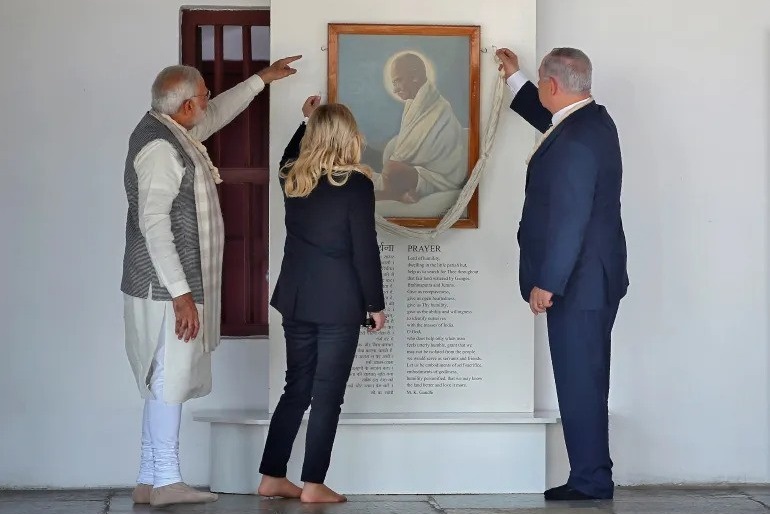
India’s historical support for Palestine has its roots in its key role in the Non-Aligned Movement, a neutral position adopted by developing countries during the Cold War. Even before independence, Mahatma Gandhi called the creation of Israel “the imposition of Jews on Arabs.” India now calls its approach “strategic independence.” “The Middle East is the only region where this policy really works and pays off,” Taneja told Al Jazeera. India has good relations with Israel, the Arab powers, and Iran. One of the reasons for its success is that India has not been drawn into regional conflicts.”
However, under pressure from Donald Trump, India has stopped buying oil from Iran and shelved the development of the Chabahar port, which it saw as a gateway to Central Asia and Afghanistan.
“I think India is looking at a Middle East where Iran has been severely damaged by the US and Israeli aggression and is no longer a regional power,” said Rodenbeck. “In such a situation, Israel will become a regional hegemon.”
“India may be preparing itself to exploit this situation,” he added. Modi also sees Israel as influential in Washington and hopes that friendship with Israel will gain concessions with Congress and Trump, concessions that India desperately needs.”
India-Israel relations have come a long way from secrecy to open and strategic friendship. This transformation has occurred largely under Modi and has brought significant defense, technological, and economic benefits. However, this rapprochement has come at the cost of weakening traditional support for Palestine and reducing India’s moral authority in the Global South.
Modi’s upcoming trip to Tel Aviv will further legitimize Israel and strengthen Netanyahu’s position. India continues to strive to maintain its strategic independence and balance relations with all Middle Eastern players. The future of this relationship is likely to be shaped by major regional developments, especially a possible US attack on Iran. This shift reflects the primacy of pragmatism in contemporary Indian foreign policy, but its moral and historical challenges remain.
