
Latest Stage of the Nuclear Race: From US Revelations to Chinese Denials
TEHRAN (Defapress) - On February 5, 2026, with the expiration of the “New START” treaty, the last remaining nuclear arms control treaty between Washington and Moscow also collapsed, leaving the world for the first time in decades without a legal framework to limit the nuclear weapons of the two superpowers.
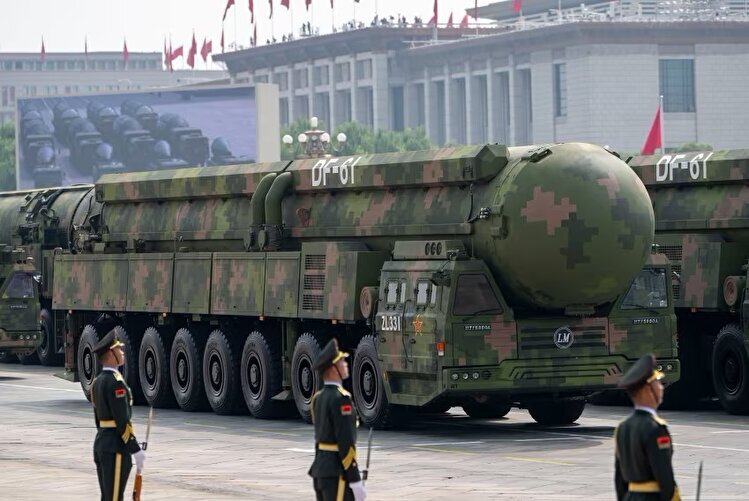
Recently, the US government has made a new accusation against the People’s Republic of China on nuclear issues, conducting a secret nuclear test in June 2020, which, according to Washington officials, was hidden from the eyes of the international community by using advanced concealment techniques. The accusation comes as US President Donald Trump has called for the expansion of arms control negotiations with China, while at the same time declaring that it will no longer be subject to unilateral restrictions, which in fact means a new chapter in the nuclear arms race between the United States and the People's Republic of China.
US accusation and global response
US Undersecretary of State for Arms Control Thomas DiNanno announced on Friday at the International Arms Control Conference in Vienna that the US government is aware of China's nuclear explosive tests in 2020. He named June 22, 2020, as the date of a powerful nuclear test by the Chinese and claimed that China has tried to hide its activities by using the technique of "seismic decoupling" (digging huge holes to reduce the seismic waves caused by the explosion).
However, the Comprehensive Nuclear-Test-Ban Treaty Organization (CTBTO) issued a statement saying that its international monitoring system had not detected any explosions that matched the characteristics of a nuclear test on that date. Rob Floyd, the organization’s executive secretary, stressed that their monitoring system is capable of detecting explosions of over 500 tons of TNT and has accurately tracked all of North Korea’s tests, while Daryl Kimball, executive director of the Arms Control Association, noted that very low-yield tests (under 500 tons) may be hidden from monitoring systems.
In response, China categorically rejected the US accusations of a new round of nuclear tests. Liu Pengyu, a spokesman for the Chinese embassy in Washington, recalled that Beijing follows a policy of “no first use” of nuclear weapons; Its nuclear strategy is purely defensive and adheres to the ban on nuclear tests. He also called for the United States to adhere to international obligations and maintain global strategic stability.
Expiration of new start and the future of arms control
The war of words between US and Chinese officials on nuclear issues has not ended here, and the Americans claim that they have suffered in this regard and have fallen behind China in conducting nuclear tests. US Deputy Secretary of State DiNanno says in this regard: February 5, 2026, is the "end of an era" and this day symbolizes the end of "US unilateral abstention" from developing nuclear weapons. He added: The United States will complete its nuclear force modernization programs and, if necessary, will use unstable stocks of nuclear weapons to counter new threats; Washington's declared goal is to negotiate a new trilateral treaty with the participation of China and Russia.
But the main challenge lies in getting China to the negotiating table. China has consistently argued that its nuclear arsenal (around 500 warheads) is too limited compared to the US and Russia (each with over 5,000 warheads) and that entering into trilateral talks is therefore not fair. Matthew Kroenig, a fellow at the Atlantic Council, says: This argument may be a cover for Beijing’s long-term goals; in fact, China has invested heavily in building a superpower nuclear force; it does not want to give up this asset easily in negotiations.
Meanwhile, experts warn that lifting restrictions and increasing weapons could start a dangerous cycle of arms race; Daryl Kimball, an international nuclear weapons analyst, says: Complaining about treaty violations will not solve the problem; the US should pave the way for a return to international frameworks by proposing realistic bilateral talks.
The expiration of the New START treaty and the recriminations over nuclear tests have brought the world to a historic turning point in strategic security. While Washington insists on “negotiating from a position of power,” Beijing and Moscow refuse to enter into new treaties, and the international arms control system is on the verge of complete collapse. Without cooperation from the three major nuclear powers, the likelihood of arms proliferation and a return to the dangerous competition of the 1950s and 1960s has increased. Therefore, the only possible solution is a return to realistic diplomacy and acceptance of collective responsibility for maintaining global stability, a step that none of the major players has shown itself ready to take so far. In a world where the boundaries of nuclear testing are blurred and monitoring systems are in doubt, diplomatic silence may impose the highest cost on the world, leading to nuclear races and perhaps even war.
