

Useless TRAM After the Death of Trump's Dreams
TEHRAN (Defapress) - The Pentagon is trapped in its past, and now a critical vulnerability in U.S. warships has created numerous challenges for them in their confrontation with Iran. History has witnessed many unsuccessful military operations that ended in catastrophic outcomes not due to weakness on the battlefield, but because of minor issues such as navigational drift, sandstorms, sudden cold, or running out of ammunition; now, it is the turn of the terrorist U.S. Navy for one of these exact types of problems to cause its breakdown against Iran.
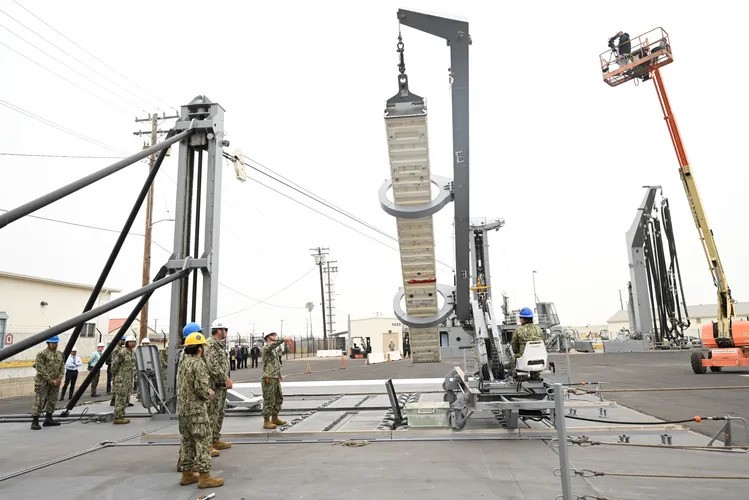
The absence of naval missile rearming systems known as "TRAM" has placed a major obstacle before the terrorist U.S. Navy in the regional war with Iran. The naming of this system, which borrows from the name of the terrorist U.S. president, is interesting in its own right, but this high-sounding system could not offer any help to the terrorist U.S. military in the regional war with Iran, because it has not yet been installed on any U.S. warship.
U.S. military officials have announced that this system will reach operational readiness by 2027. Without a doubt, the readiness of this system in 2027 will offer no assistance to the failed and wounded U.S. Navy.
The TRAM system is essentially a set of equipment, including a cart with a cargo crane and a pair of rails, that enables the rearming of missile launch systems at sea. The absence of this system means that warships must travel long distances to shore bases to replenish their ammunition, bases that are sometimes thousands of kilometers away from the front line.
The irony of the story is that the West has always acted precisely in designing rearming technologies, trying to design systems to be modular and rapidly rearmable; for instance, the U.S. HIMARS missile system can pick up and install the missile pod directly from the ground without needing a specialized loading vehicle. However, regarding the needs of its navy, it must be said that since the 1970s, the U.S. has designed the "Mk 41" Vertical Launch System, which featured a loading mechanism. But after several unsuccessful tests in the open sea, this design was deemed inefficient, and its loading mechanism was set aside to allocate that space to extra cells for three additional missiles.
Since this system was fielded near the end of the Cold War, the development of the loading mechanism was halted, as subsequent U.S. military operations were mainly against weaker adversaries, and warships could easily return to numerous bases in the Persian Gulf region after expending their ammunition. However, during the regional war with Iran, the Americans lost the ability to secure logistical support in areas near the Persian Gulf, and Western media have pointed to this problem, noting that warships are forced to stay at sea for longer periods, leading to crew fatigue and dissatisfaction.
Although the Americans foresaw these problems and began developing the TRAM system, the system could not be ready in time to reach the arena of the regional war with Iran. On the other hand, the outbreak of this war led Americans to doubt the effectiveness of their unrevealed system in advance, as this structure is not built in internally and must be mounted on the deck each time. Given that loading each cell takes about half an hour and each warship has at least 32 launch cells, a complete rearming cycle could take up to two days.
Hence, the question arises whether this solution is worth the current expenditure by the United States. Although this method, with all its flaws, is far simpler and cheaper than a complete modernization of all Mk 41-equipped warships with a new loading system, the U.S. has concluded that in asymmetric warfare such as the regional war with Iran, this workaround is also non-operational and will not help the terrorist U.S. military.
In discussions of U.S. failures against Iran, emphasis is usually placed on the shortage of air defenses or long-range missiles; however, it appears that more trivial issues also exist that affect the course of the war just as much, reinforcing the principle that in war, nothing is minor.
