

Hezbollah’s Silent Hunter: The New Nightmare for Merkava Tanks on the Front Line
TEHRAN (Defapress) - During the recent clashes in southern Lebanon, Lebanese Hezbollah has been able to create a significant advantage on the battlefield by using new and asymmetric tactics. One of the most important tools of this advantage is the widespread use of fiber-optic drones, which have posed a serious challenge to the advanced technology of the Israeli army. Despite their apparent simplicity, these drones have become deadly weapons due to their unique technical characteristics, which have presented the Zionist regime with serious challenges in dealing with them.
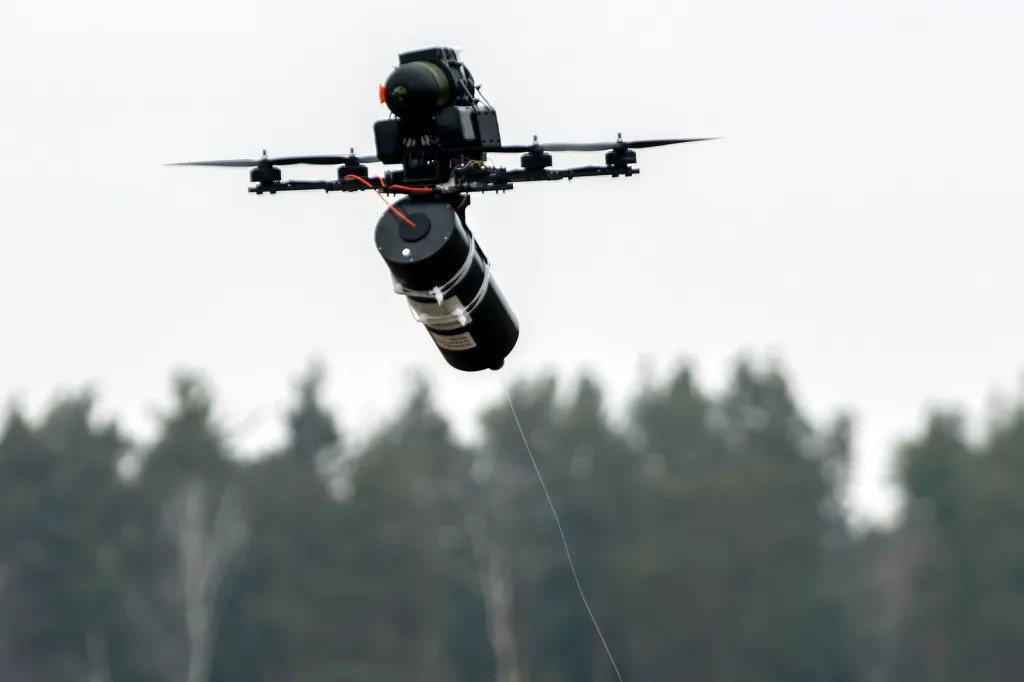
Unlike conventional models, fiber-optic drones use a thin, lightweight fiber-optic cable to communicate directly with the operator. This feature makes them completely resistant to electronic warfare and jamming. The operator can remain completely safe up to a distance of 15 kilometers or more and receive a clear and precise image of the target. In one of Hezbollah’s recent operations, such a drone flew precisely over the destroyed buildings of southern Lebanon and targeted an Israeli Merkava tank; in such a way that the Zionist soldiers did not even notice the presence of this drone.
Zionist experts have admitted that these drones are “undetectable” because they leave no electronic traces, and their launch location cannot be traced. The Israeli army, which relies mainly on its technological superiority, tries to disrupt wireless signals and hunt down drones, but it has been left practically empty-handed in the face of this low-tech system. For this reason, it has resorted to temporary solutions such as installing physical nets, which also have a very low success rate.
These successes are part of Hezbollah’s larger strategy in asymmetric warfare, which, by relying on drones and high operational experience, has continued to maintain the initiative in many parts of the field. In this way, the movement has built a diverse and advanced drone arsenal and trained experienced operators. These drones are usually adapted from Chinese or Iranian civilian models and are equipped with small explosive munitions. The result of this adaptation is a cheap, accurate, and compact weapon that has been very effective for targeted attacks against Israeli forces in southern Lebanon and the north of the occupied territories.
Military analysts believe that this approach is a classic example of asymmetric warfare; While Israel operates with high costs and advanced technology, Hezbollah targets the enemy’s weak points with simple but intelligent tools. The experience of the Ukrainian war showed how these drones can disrupt supply lines; Hezbollah has also applied this lesson in the geographical environment close to the border and has pressured the Zionist regime’s forces even close to its bases.
In sum, the use of fiber optic drones not only demonstrates Hezbollah’s operational power but has also changed the equations of the battlefield in favor of the Resistance front. In a way, even the military officials of the Zionist regime have opened their mouths to admit and consider the struggles of the regime’s army to counter these drones to be futile. This tactical advantage has solidified Hezbollah's position as a capable player against one of the most advanced armies in the region and demonstrates that, in modern warfare, will, creativity, and adaptability can overcome mere technological superiority.
