

Isn't the Kremlin Taking the Ukraine War Seriously?
TEHRAN (Defapress) - The US State Department's Bureau of Consular Affairs issued a security alert, advising its citizens not to travel to Russia, setting the highest risk level, Level 4, for the country.
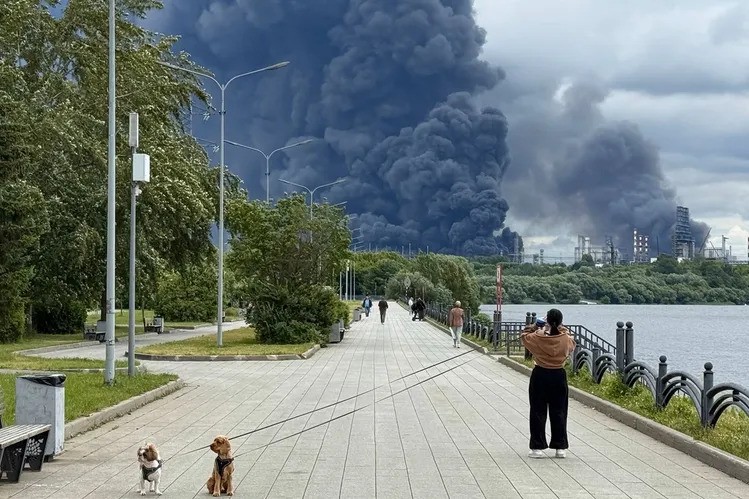
The US State Department also warned those citizens who still decide to travel to Russia to keep an eye on the sky and be careful of drones, but to refrain from taking any photos or videos of them so as not to get into trouble with Russian law enforcement agencies.
The alert published on the US State Department's website states: In an emergency, you should follow the instructions of local Russian authorities and go to shelter. If you see a drone, immediately move away and seek shelter if necessary. Russian law prohibits the publication of photos or videos of the consequences of drone attacks, and violation of this can be accompanied by fines or imprisonment.
The reason for issuing this alert was also given as drone attacks and explosions near the Ukrainian border, as well as in major Russian cities, including Moscow, Kazan, and St. Petersburg.
When the US State Department tried to ban its citizens from traveling to Ukraine in recent years, few people imagined that these problems would one day engulf Russia itself.
It seems that even those who were supposed to think about these issues did not foresee such a situation.
The fuel crisis in Russia is a clear and obvious example of the weakness of the Moscow authorities in analyzing and predicting the situation. Almost daily images of burning refineries and long lines at gas stations selling gasoline either at exorbitant prices or with a limit of 20 liters per car, as reported in Crimea or at gas stations on the Neva River, clearly show that Moscow was not prepared for these conditions at all.
Russia has not created a sufficient strategic reserve of gasoline and has instead filled tankers with cargo and exported it abroad. Russia indeed needs money, but the point is that Moscow’s economy is slowly dying due to the wrong tax policies of its Central Bank in the fifth year of the war.
On the other hand, Russia has not created an effective defense against drones and naively thought that it could cope with the attacks of Ukraine with the available means, but this did not happen. Now the issue is not only the formation of drone forces in the Ministry of Defense, which, due to their nature, are not capable of creating a “no-fly zone” over the whole of Russia, but also the creation of “civil air defense”, provided that such an interpretation is correct.
The main question is why, in a country with 2.4 million guards in the state and private sectors, there is the manpower to form a civilian anti-drone air defense, as well as a complete set of technologies and solutions for detecting, directing, and intercepting everything that is launched at it; has a civilian air defense system not been formed? In response, Russian officials can be accused of having other priorities than the ongoing war between Russia and Ukraine.
Interestingly, the absence of such a system so far is another consequence of Russia’s always reactive policy. Instead of planning and taking the initiative for the future, Moscow always waits for a challenge to arise and then reacts to it.
Russian journalist Dmitry Smirnov wrote about this: “The root of the problem is not air defense, but the fact that Ukraine can regularly concentrate and launch such a huge number of drones. If Ukraine were at war with the United States, it would never understand the logic of “we will not attack there because civilians may be harmed” and would have reduced the port of Odesa to ruins in the first weeks.
The journalist emphasized: If Kyiv were at war with the Israelis, they would never accept the logic of “you can’t attack their leader” and would hunt down the “Zelenskys”, “Budanovs” and “Syrskys” every night with missile strikes to hunt them in forest shelters, rather than the Ukrainian leaders easily attending summits and receiving political delegations. This war has long passed the stage of purely “retaliatory” measures.
Smirnov clarified: What, in fact, except for strange restraints, prevented Russia from bombing all the bridges over the Dnieper, airports, and key railway stations in Ukraine? In fact, the current crisis is the result of the obvious unwillingness of Moscow’s political leadership to fight seriously, while Ukraine makes no exceptions in this war and does not observe any rules.
He added: "In this situation, the Russian people hope that the recent US-Iranian memorandum will lead to a sharp decline in global oil prices. If Trump resumes sanctions on the Russian oil industry, oil exports will become unprofitable, and supply on the domestic market will increase." However, none of this solves Russia's main problem, the inability and even reluctance of Moscow authorities to take timely and forward-looking initiatives has become Russia's Achilles heel in the war with Ukraine.
