
America's Achilles' Heel in the Battle with Iran
TEHRAN (Defapress) - In recent days, the United States has brought a large number of facilities to the region to exert pressure and carry out possible military operations against the Iranian nation. These facilities, which are mainly focused on aircraft carriers and a fleet of light and heavy American warships, are to be deployed extensively in the Persian Gulf to, according to the Yankees, surround Iran at sea; a matter that seems unreasonable.
As we know, the US military has extensive assets in the Persian Gulf and some countries in the region, and if we want to point out two very important assets of the Americans, we can point out the Al-Udeid base and the Sheikh Isa refueling base, which have a large number of naval and air facilities, and Iranian ballistic missiles can easily target these two bases.
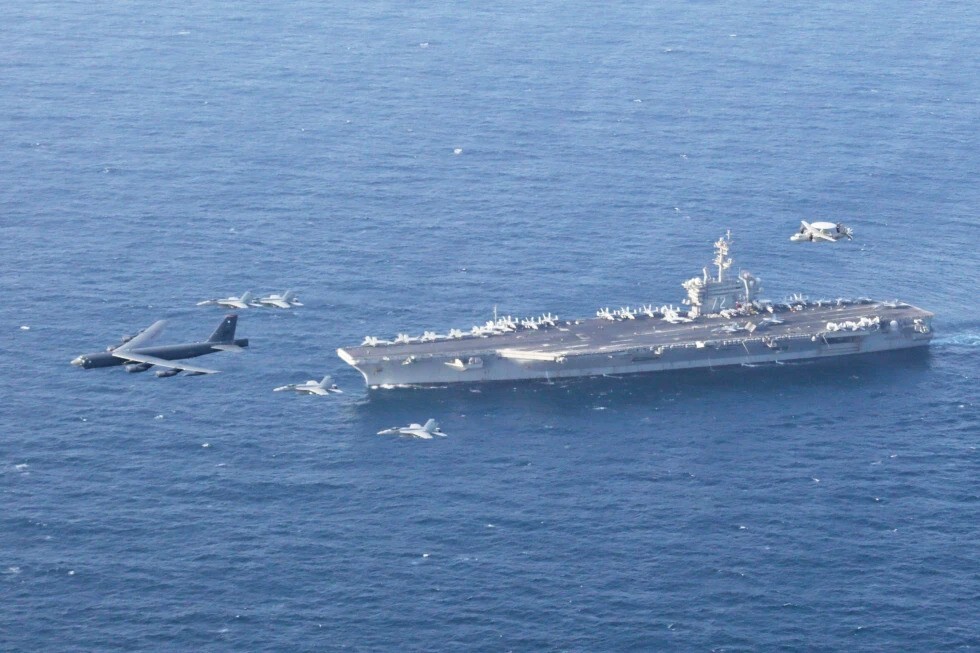
Also, the US military's aircraft carriers, each of which is the size of a town, may be a tool of power for the Yankees; But at the same time, it can also be America’s Achilles heel against the Islamic Republic of Iran’s anti-ship missiles. Accordingly, the Islamic Revolutionary Guard Corps Navy, as one of the pillars of the Islamic Republic of Iran’s armed forces, has in recent years developed massive capabilities to confront the American enemy in the Persian Gulf and the Strait of Hormuz.
These capabilities and facilities, centered on ballistic missiles, USVs (unmanned/uncrewed surface vehicle), patrol craft, and drones, can pose serious challenges to any powerful naval force in the Persian Gulf; as was the case during the eight-year imposed war, there were clashes between the Iranian and American armed forces, and Iran at that time, despite numerous weapons limitations, had struck at the American enemy.
One of the foundations of the Islamic Republic of Iran’s capabilities is its coast-to-sea missiles. These missiles can hit and ground aircraft carriers in the Persian Gulf at high speed. This is not a bluff or rhetoric, but a reality that the United States has already experienced in the Red Sea; the Ansar Allah movement and the Yemeni armed forces' shore-to-sea missiles, at a time when the Americans thought they could destroy Yemen's military equipment with air strikes, inflicted severe blows on USS Harry S. Truman and the fleet attached to this aircraft carrier, destroying three American fighter jets; an issue that ultimately led to the United States accepting a ceasefire in the war with Yemen and with this apparent retreat, the United States' military image was greatly tarnished on the world stage.
In 2025, Yemeni armed forces repeatedly targeted commercial ships and tankers affiliated with the United States and its allies in the Red Sea and the Gulf of Aden, which led to increased ship insurance costs, forced rerouting, and increased global shipping prices. Some reports indicate that these actions caused tens of billions of dollars in damage to the global economy, especially American interests, and now the United States military is trying to implement the same failed strategy in Yemen this time against Iran; of course, there is a stark difference between the armed forces of the Islamic Republic of Iran and the armed forces of Yemen, centered on the Ansar Allah movement; this difference is the very high power of Iran’s equipment and weapons in naval battles that can upset the calculations of the Americans.
In a drill conducted in 2015, the Islamic Revolutionary Guard Corps showed that it could destroy or capture an aircraft carrier with great power. In that year, we witnessed the attack on the aircraft carrier USS Nimitz by the Islamic Revolutionary Guard Corps Navy using 400 missiles and rockets, and this attack was successful.
Also, the Islamic Revolutionary Guard Corps has much more capabilities and a wider range of operations compared to the Ansarullah movement; therefore, this issue can ground the United States Navy.
The second issue that the IRGC Navy, as one of the pillars of the Islamic Republic of Iran’s armed forces, can rely on to deal hard blows to the American enemy is the use of fast boats and USVs; for example, one of the USVs that the Islamic Revolutionary Guard Corps Navy uses and foreign media try to attribute its military use and assembly to Yemen is the “Ya Mahdi” USV. The powerful Ya Mahdi USV is built on the basis of a two-person patrol boat and is also capable of moving quickly in rough seas. "Ya Mahdi" is 11.9 meters long, 3.1 meters wide, and 1.5 meters high. This remote-controlled suicide speedboat has two 660-horsepower engines that give the vessel a speed of about 60 knots (each knot is estimated to be about two kilometers per hour).
The Ya Mahdi USV demonstrated in a real-life simulated exercise during the Great Prophet 9 (PBUH) exercise that enemies would be extremely vulnerable if they entered by sea. In this exercise, the Islamic Revolutionary Guard Corps Navy responded when a large replica of the USS Nimitz aircraft carrier was targeted in the Persian Gulf. The Ya Mahdi USV entered the fray and caused a huge explosion when it collided with the replica of the aircraft carrier. This is why the Americans know that confronting the Iranian Navy in the Persian Gulf is not an easy task, because Iran can strike back at the US Navy fleet; a fact that has been clearly demonstrated to its enemies in the naval conflicts of the last few years.
Another measure that will ground the US Navy in the region is the use of drones that can hit American ships. Also, in May of this year, the Islamic Revolutionary Guard Corps Navy showed images of the "Mohajir 6" drone observing the aircraft carrier "Eisenhower"; this issue has a clear message, and that is the constant and precise monitoring of the regional fleet by the Islamic Revolutionary Guard Corps Navy; the "Mohajer 6" drone has unique features, the most important of which is the ability to carry about 200 kilograms of explosives and surface-to-surface bombs, which clearly shows the power of this drone in destroying targets.
The firepower of the Mohajer 6 strategic drone is also very important. "Qa'em" and "Sadid" surface-to-surface bombs are installed on these drones. One of the characteristics of this drone is its precise command and control from a distance to destroy targets, and Mohajer 6 can destroy targets with high power, with a range of more than two thousand kilometers.
The Associated Press quoted a commander of the IRGC as saying: Iran is more prepared than ever, and we warn the United States that the Iranian armed forces finger is on the trigger.
Given the current situation, the IRGC Navy has tested its capabilities and is capable of striking back at the American enemy; but when and with what intensity such a strike will be struck depends entirely on the behavior of the American side and its allies; according to media conversations between our country's officials, Iran is serious about giving a military response to the American enemy and has also considered massive preparations for this; now it remains to be seen how determined the belligerent US president is to attack Iran; the more insistent he is, the more devastating Iran's response will be.
