

Iranian ICBM Launch: From Claim to Reality
TEHRAN (Defapress) - Some foreign media outlets and social networks have published images claiming that Iran is launching an intercontinental missile, and a video of the launch has also been shared on YouTube; the reliability of this video requires further investigation.
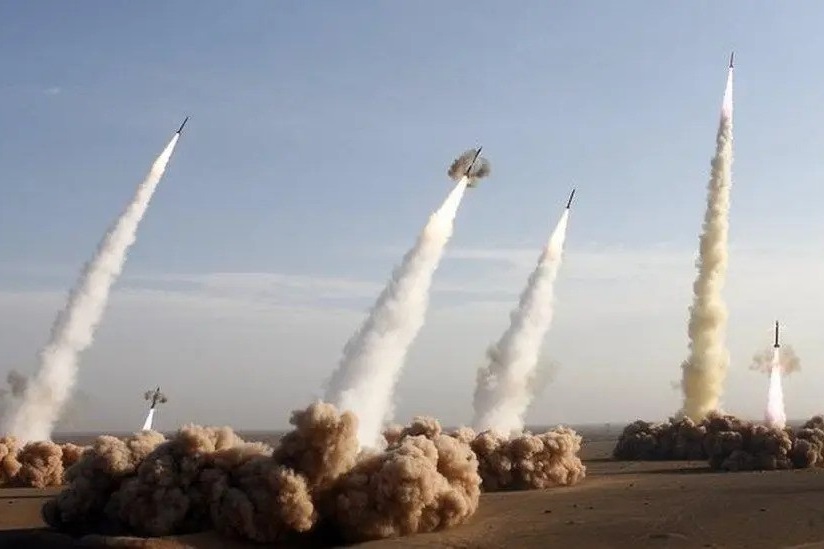
The Wion News claimed in this regard that the Iranians claim to have built a ballistic missile with a range of about 10,000 kilometers, which could increase tensions between the United States and Iran.
The website claimed: Iranian media reports show that the intercontinental ballistic missile has a range of 10,000 kilometers and was launched from a point in Iran and landed in a point in Siberia.
Military tensions in the West Asian region are increasing as the Americans seek to start a military conflict by sending a new fleet led by the aircraft carrier Abraham Lincoln and deploying F-35 fighters on the aircraftcarrier, as well as deploying F-15 fighters at the Prince Sultan Air Base.
The Wion News website wrote in this regard: The aircraft carrier Abraham Lincoln has entered the Persian Gulf region from the Strait of Malacca for a possible military conflict with Iran; Iran also has the most diverse missile arsenal in Southwest Asia and has no problem producing and launching ballistic missiles (for a military conflict).
In 2022, General Kenneth McKenzie, then commander of the US Central Command (CENTCOM), announced that Iran had more than 3,000 ballistic missiles. These missiles have ranges ranging from 300 km to 10,000 km and include the Shahab, Qiam, Fateh, Ra'ad, Zolfaghar, Dezful, Qadir, Emad, Khorramshahr, Ya Ali, and other types of missiles; it is difficult to accurately estimate the total capacity of the Islamic Republic's missile arsenal; Iran had also set a limit on the range of its missiles at 2,000 km since 2015; but recent reports indicate that this limit has been lifted.
Lifting the limit on Iran's ballistic missile range means that there are no restrictions on the production and testing of long-range missiles, and the message of this action to the United States is that if the United States attacks Iran, Iran can retaliate by hitting the United States with intercontinental ballistic missiles; This is something that the North Korean army has also done to confront the United States.
North Korea, with its Taepodong missiles, can target the depths of the United States, and this has prevented the United States from using warlike rhetoric against North Korea.
The Taepodong-2 missile is one of the North Korean army's most powerful missiles, which has also been tested in recent years. The North Korean army's military exercises are usually focused on firing ballistic missiles and intercontinental ballistic missiles. For example, the North Korean army has repeatedly fired Musudan intermediate-range missiles into the Sea of Japan; today, one of the most powerful intermediate-range missiles of the North Korean army is the Taepodong-2 missile. Foreign sources say the range of this intercontinental ballistic missile is at least 5,500 kilometers and at most 10,000 to 12,000 kilometers.
In addition to the above points, holding missile exercises with intercontinental missiles can weaken the will of the enemies to take military action against the Islamic Republic of Iran; something we have witnessed in recent years with North Korea; because the United States and its allies adhere to the law of the jungle and only the language of force will deter them from making a military decision.
