
Using the Weapon of Diplomacy to Secure National Interests
TEHRAN (Defapress) - Esmail Baghaei, the Iranian Foreign Ministry Spokesperson, stated at a press conference regarding the Trump-Netanyahu talks and their reaction to Iran's proposal: "The only thing we have demanded is Iran's legitimate rights. Is Iran's demand to end the war and halt maritime piracy against Iranian ships an excessive demand? Is Iran's demand for the release of assets belonging to the Iranian people, which have been unjustly blocked for years, excessive?"
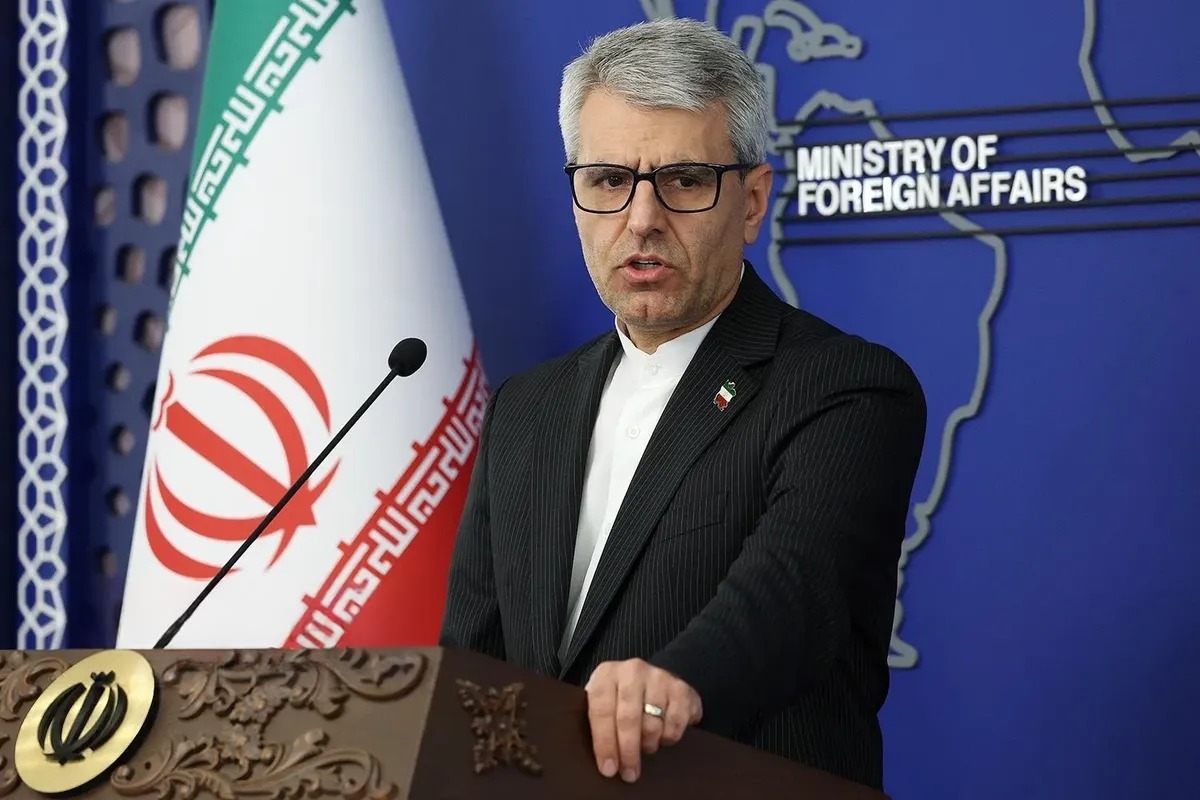
Baghaei added: "Is our proposal to ensure safe passage through the Strait of Hormuz an excessive demand? Is establishing security in the region and northern Lebanon an excessive demand? Therefore, we have put forward generous proposals, not just for Iran's interests but for the entire region. All of these issues were supposed to be discussed within the proposed package, but we regret that the American parties continue to insist on a mindset fabricated by the Israeli regime."
Referring to the dispatch of fighter jets by Egypt to Iran to target Iranian drones, the Iranian Foreign Ministry Spokesperson continued: "Our relationship with Egypt is based on mutual respect. Matters of regional security are the concern of regional countries. Any intervention that undermines regional security is rejected by us, regardless of which country carries it out. Security that relies on the presence of foreign forces in the region intensifies insecurity."
Regarding Trump's visit to China, he noted: "Trump's visit to China is bilateral and their own affair. China is one of our strategic partners with whom we are in constant communication. The Chinese are well aware of our positions and know correctly that the imposed war against Iran is not a transient issue but rather part of a global process to escalate unilateralism by the United States. The stability of West Asia is as important to China as it is to us. Our Chinese friends know well how to use this opportunity."
Regarding the US allegations against Iran, Baghaei added: "Iran has proven to be a responsible power in the region, and at the same time, we are anti-bullying. Just look at Iran's record. Were we the ones who deployed forces? Are we the ones bullying countries in the Western Hemisphere? Did we commit assassinations on two occasions during the negotiations? You mentioned US interventions in the region. The very presence of the US in the region is itself an instance of creating a cycle of violence."
Regarding the UAE's actions against citizens of other countries and Iran's reaction to this issue, the Iranian Foreign Ministry Spokesperson stated: "Pakistan will certainly proceed professionally, and no mediator will allow its professional actions to be influenced by third-party actors. The UAE's actions against citizens are contrary to human rights standards. Our consular department in Tehran is also following up on the matter."
Regarding the approach of some European countries to send naval vessels to the region, he added: "We have communicated very clearly that Europe should not allow the temptations of the US and the Zionist regime to inadvertently drag them into a crisis that has no benefit. There is certainly this awareness that this war has been illegal, and they should not allow US pressures to at least openly become part of actions against international peace and security. Any country that believes in responsible behavior regarding international peace and security must direct pressure towards the party that disrupted passage in the Strait of Hormuz."
In response to a question about the fate of diplomacy if the US attacks again, Baghaei continued: "We will fight whenever necessary, and whenever we deem it appropriate, we will use the weapon of diplomacy to achieve national interests. The satisfaction of others is not our criterion. In a diplomatic process, the parties involved in negotiations must decide based on their national interests. Iran has shown it is serious in pursuing its national interests and legitimate rights, and at the same time, it participates in diplomatic processes in good faith and within a reasonable framework. The other side must prove that it is serious. So far, it has failed."
Regarding the transfer of Venezuelan uranium to the US, the Iranian Foreign Ministry Spokesperson noted: "If other parties achieve something, that is their own affair. What we have seen from Venezuela's official position relates to the shutdown of one of its nuclear power plants in the early 1990s. Given that this plant has not been operating since 1997, and some amounts of 20% uranium accumulated in various parts of it were remnants of materials used for research, based on the decision of the Venezuelan government, which we respect, they decided to transfer it. It was a matter between Venezuela and other parties."
Regarding Trump's threat to use nuclear weapons against Iran, he said: "This is part of the rhetoric of US officials, which reveals their nature and approach towards the Iranian nation and international law. Such threats are contrary to international principles, and they are not authorized to threaten other countries. Moreover, rest assured that Iran knows very well how to defend itself."
Regarding the implementation of the security agreement between Iran and Iraq, Baghaei added: "We are in continuous contact with our Iraqi neighbors and our friends in the Iraqi Kurdistan Region. This communication existed during the Imposed War, and contacts have continued in recent days. Everyone acknowledges that any insecurity in our surrounding region has consequences for all countries in the area. This consensus lays the groundwork for beneficial cooperation between the regional countries, Iran, and Iraq."
Regarding whether the issue of transferring Iran's uranium to the US has been raised in negotiations, the Iranian Foreign Ministry Spokesperson said: "In the current phase, our negotiations are about ending the war. This is an issue that will be discussed when its time comes."
Regarding Qatar's mediating role between Iran and the US, he said: "Many countries are calling; regional countries have genuine concerns, and we have always appreciated countries with good faith. Pakistan is the main mediator. Qatar also has its views, which they will convey to our Foreign Minister whenever they deem necessary."
Regarding Putin's statement that the US cannot claim global leadership, the Foreign Ministry spokesperson said: "I need to see the exact phrasing. What is clear is that this is a matter of principle. The world should not be dominated by a party that places no value on norms, and whose behavior at the United Nations has been such that it has undermined them."
Regarding Araghchi's trip to China and Iran's view on Taiwan, Baghaei noted: "Our position on Taiwan is clear. We have UN Resolution 2758, which clarifies the status of a unified China, and the international community has accepted this basis regarding China. Any action contrary to that is rejected by us. Mr. Araghchi's trip to China was an important one, and given regional developments, the significance of these consultations is doubled. We will certainly make use of any action we can jointly take for regional security."
Referring to reports of a Zionist regime base in Iraq, the Foreign Ministry spokesperson stated: "We do not rule out any possibility. Regarding the mischief of the Zionist regime, everything must be taken seriously. What is clear is that the regime observes no limits when it comes to creating discord among regional countries and harming Iran's interests. We will certainly discuss this report along with other reports we have received."
Regarding Grossi's remarks, he added: "Was it ever supposed that Iran's nuclear facilities would be destroyed through means other than war, for Grossi to make such statements? These comments confirm what we have repeatedly stated: that the Director General of the IAEA has strayed from his duty. What would revive the Agency's role is for the Director General to condemn attacks on Iran's nuclear facilities. Iran's nuclear facilities were under IAEA inspection. The IAEA Director General must see this reality."
Regarding claims that the Foreign Ministry's position on the Strait of Hormuz differs from the country's stance, Baghaei stated: "The Foreign Ministry is part of the Islamic Republic, and decisions made based on the hierarchy of the system are fully binding on the Foreign Ministry. Regarding the Strait of Hormuz, sometimes imprecise phrasing is used. I have emphasized here many times that the measures Iran has taken since January 29th, following the military aggression by the US and the Zionist regime, and the complicity of some countries, are based on international law and domestic laws. A coastal state and a country that has come under military attack need to take measures to prevent misuse of that waterway. The Foreign Ministry's position is clear, and the Foreign Ministry is not separate from the country's decision-making system and sovereignty."
Regarding Netanyahu's claim that the war with Iran is not over, the Iranian Foreign Ministry Spokesperson added: "We too have unfinished business with those who have committed crimes against the Iranian people. If they give Iran the opportunity, we will settle the account."
Regarding Trump's claims that Obama treated Iran well and brought smiles to Iranians, he stated: "No US official has ever brought a smile to the lips of Iranians. The history of US actions goes back to 1953, when they staged an inhumane coup against the Iranian people. Over the past five decades, if you look at their record, they have not refrained from any action to harass Iranians. Even during Obama's term, we repeatedly faced violations of JCPOA implementation. We have no positive record of US behavior. In these past two years as well, we have no memory of the US other than mistreatment, breach of promise, criminal acts, and aggression. The insult they inflicted on the Iranian people will never fade from the Iranians' memory."
Regarding the revocation of citizenship of Bahraini citizens on the pretext of sympathizing with Iran, Baghaei added: "The actions Bahrain has taken in the past two months against those who have sympathized with Iran constitute a gross violation of human rights. Revocation of citizenship is a medieval punishment that has long been obsolete and is contrary to fundamental human rights principles. In line with respecting human dignity, we have clearly stated our positions, and Bahrain's actions are against human rights."
Regarding reports against Iran about creating an oil slick in the Persian Gulf, the Iranian Foreign Ministry Spokesperson stated: "It is an absolute lie. We are certainly concerned about damage to the Gulf of Oman and the Persian Gulf. The history of harming the region's environment goes back many years. US actions in the region have caused severe environmental damage. One of the reasons we believe a management mechanism is needed for the Strait of Hormuz is precisely to take measures to remedy the damage caused by US crimes that have occurred."
Reacting to US opposition to Iran's proposal, he stated: "To summarize, the disagreement is with a party that seeks only to violate Iran's rights. The release of Iran's blocked funds is not a concession but the restoration of a right. Regarding the continuation of our path, we have shown that regardless of all the distractions, we are focused on Iran's national interests. We will act as necessary to secure our interests."
Regarding contradictory US behavior against Iran, Baghaei added: "These contradictions are inherent in US policy. They have repeatedly leveled accusations against countries; the contradictions are numerous. The fact that we acted to counter an imminent threat from Iran, and they subsequently said there was no threat; these contradictions are completely clear. That is why public opinion does not support US actions."
Regarding consultations with countries and claims about the Strait of Hormuz, the Iranian Foreign Ministry Spokesperson stated: "I don't think any country supports the continuation of insecurity in the Persian Gulf region. In principle, in talks, all countries agree that this situation must end. All countries must courageously identify the root cause of this situation. We are currently facing a similar situation. The repetition of the claim that the Strait of Hormuz must be opened indicates that some countries deliberately ignore reality and the primary role of the US and the Zionist regime in creating the situation we are witnessing."
Regarding allegations against the Foreign Ministry in negotiations, he stated: "Any action by the diplomatic apparatus, both legally and logically, must comply with the guidelines of the Supreme National Security Council."
Regarding Starmer's claims about Iran conducting antisemitic acts in the UK, Baghaei added: "Yes, it may not be individual actions. One should ask the UK Prime Minister whether he knows what is behind these actions! They cannot cover up their own failure to provide security for their citizens by blaming Iran. We are a nation that, despite all the crimes committed against us, has never committed the slightest aggression against synagogues or Jews in Iran. The only crime against a synagogue in Tehran was committed by the Zionist regime. Did Starmer condemn that?"
