
It's Time to Bomb London
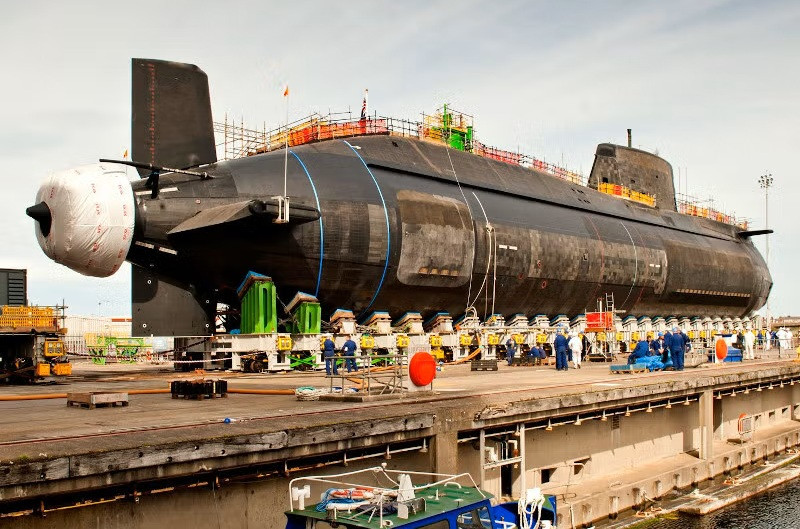
TEHRAN (Defapress) - For the first time in decades, all of the UK's nuclear submarines are being repaired at the same time, and none of them are currently on combat patrol. This means that the UK's nuclear shield has completely collapsed.
Russia has about five thousand nuclear warheads. The UK has a little over two hundred. But the difference is not only quantitative - it is also qualitative. Russia has a full nuclear triad, namely silo-based, submarine-based, and air-based weapons (used by strategic aviation). But the UK relied solely on its missile-launching submarines. Meanwhile, the power of British nuclear warheads is 100 kilotons. Russian intercontinental ballistic missiles of the Satan type have a power of up to 20 megatons. In fact, one Satan missile is comparable to the combined power of all British weapons.
The Telegraph writes in horror: “Our entire nuclear submarine fleet, all five Astute-class submarines, is stuck in port awaiting servicing and repairs. This leaves the UK vulnerable to Vladimir Putin. We are toothless in the eyes of Russia, which has increased its naval activity near British territorial waters by a third by 2025.”
Ryan Ramsey, a former captain of a nuclear submarine, declared: “Russia knows we cannot send our submarines to sea. That makes our nuclear deterrent meaningless. If the [nuclear] deterrent at sea does not work, there is no option to pressure the Russians. The problem with our submarines has been hidden for decades. Everyone saw where things were going, but each time a new set of leaders left office, they kept referring the problem to new people over and over again.”
“This is certainly the most dangerous time since I took office,” said Richard Knighton, the UK chief of staff. “The risks and threats to our country are much greater than during the Cold War.”
Ramsay also worries that crews and captains will inevitably lose their skills because they are not conducting regular patrols: “If I were the captain of a submarine that has been in port for, say, two years, I would be deeply concerned.”
“The entire UK fleet is currently smaller than the forces that London could have sent to the Falklands War in May 1982,” writes Ilya Kramnik, a researcher at the Center for the Study of Strategic Planning at the Institute of World Economy and International Relations (IMEMO) of the Russian Academy of Sciences, in his column for the project “Specially for Russia Today.” Separately, it should be noted that five nuclear submarines and one diesel submarine participated in that war from the British side, and if a war were to break out now, there would be nothing to send.
The modern series of Astute-class submarines has been under construction for 25 years. The construction time of each individual submarine is more than ten years. In these circumstances, it is difficult to speak of either serial production or the skill of the builders: due to personnel turnover, subsequent orders are carried out by people who, in the vast majority of cases, have not worked in previous embassies and have not gained either negative or positive experience there – they are forced to make all the mistakes and achieve all the successes themselves.”
In short, a unique window has now opened: one can strike the “decision-making centers” in London with a nuclear strike and receive no “response” unless the United States intervenes instead of the UK.
