

Rebuilding Beijing's Authority by Relying on a Fusion Ideology
TEHRAN (Defapress) - China has entered a stage in the past decade where ideology is not a peripheral tool, but the backbone of policy-making. This transformation has not only altered China's internal structure but has also entered its relations with the United States, Russia, and the world into a new phase.
Today's China is one of the most ideological societies in the world, but the important point is that, unlike the Soviet Union experience, this ideology has not led to economic inflexibility. China has been able to turn ideology into a tool for social cohesion, but manage the economy based on pragmatism, innovation, and global competition; this combination has turned China into a model that is neither Western, nor classical socialist, nor an Eastern version of capitalism; rather, it is a new civilizational-ideological model.
In the path of redefining China's power, the country's leader, Xi Jinping, has succeeded in integrating three intellectual sources into a single framework:
1. The need for social cohesion in a society of 1.4 billion
2. Geopolitical competition with the United States, which has taken on an ideological nature
3. The necessity of political control during the period of economic and technological transition
For this reason, Beijing considers ideology not a promotional tool, but a defensive shield and a driving engine of development.
On the other hand, China has experienced a decrease in economic growth in recent years, but the slowdown of China's economic growth is not a "sudden crisis", but a natural stage of economic maturity. Among the reasons for this decrease in growth, we can mention: reaching a high level of GDP per capita, population decline and aging of society, increasing cost of resources, and the transition of the economy from "mass production" to "advanced innovation". This means that China has entered a stage where the quality of growth is more important than the speed of growth.
Also, in the past 12 to 15 years, China has been able to expand its nuclear arsenal, upgrade its missile and space capabilities, and modernize its military command structure; this process has brought China to the brink of becoming the world's third nuclear superpower, a development that can change the global balance of power.
Also, relations between China and Russia have reached an "unprecedented level"; these relations do not depend on global conditions, are based on long-term and complementary interests, and play an anti-hegemonic role for both countries. This means that Beijing and Moscow are pursuing a common security-economic architecture.
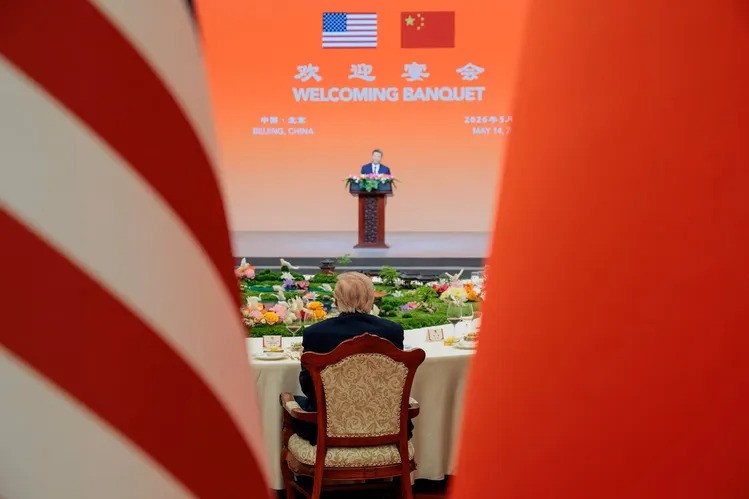
In contrast, China-US relations have entered a stage where competition is intense, but economic interdependence remains very high, and both sides know that cutting ties is impossible. Xi Jinping, in a meeting with Trump, told him that the two countries must guide the "giant ship of China-US relations" through "winds and waves." This sentence shows that Beijing seeks to manage competition and not to escalate it.
Alongside these issues, the anti-corruption fight is underway in a completely serious manner. This fight in China is not a show action; rather, it is the main pillar of reconstructing the legitimacy of the Communist Party. In recent years, several members of the "Politburo" committee, senior military commanders, and managers of military industries have been tried and even executed on charges of corruption; this level of purging shows an unprecedented political will to fight corruption within China's power structure.
Contrary to popular perception, China does not intend to take the place of the United States as the global hegemon; Beijing's goal is to break the unipolar world, create a multipolar order, and define international relations based on "civilizations", not Western ideologies; this approach makes China the architect of a new world order.
This report shows that today's China is building a new governance model, a model that is based on three pillars:
1. Combined and civilizational ideology
2. Economic and technological pragmatism
3. Rising military power
These three elements have transformed China from an economic power into a "civilizational-geopolitical" power; a power that neither wants to become Westernized nor wants to take the place of the United States, but intends to rewrite the rules of the global game.
